
 Chinese
 English

Deploying automated guided vehicles (AGVs) within pharmaceutical, bioprocess, or medical-device manufacturing environments introduces strict environmental challenges. Unlike standard industrial warehouses, sterile production zones require mobile equipment configurations to prioritize active contamination control over raw mechanical throughput.
Key Cleanroom Integration Directives: Preventing surface particle shedding, eliminating electrostatic discharge (ESD) risks, tolerating aggressive chemical sanitization regimes, minimizing localized airflow disruption, and eliminating lubricant outgassing.
While many global equipment suppliers market models as "pharma-ready," actual levels of hardware compliance and validation support vary significantly. Translating high-level marketing claims into robust, audit-proof cleanroom executions requires strict engineering scrutiny.
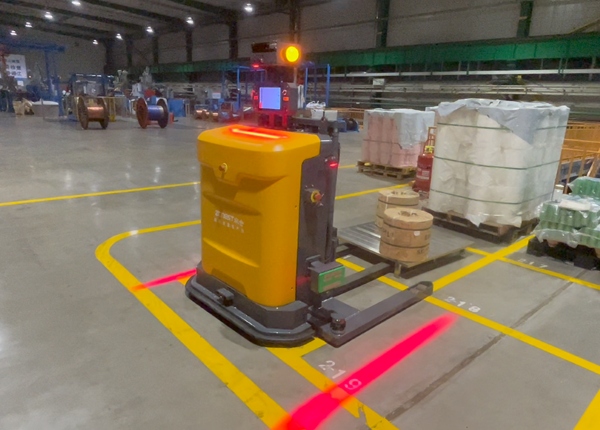
1. Wheel Material Dynamics: Non-Marking and True ESD Safety
Electrostatic buildup during vehicle travel represents a dual risk vector: it threatens sensitive microelectronics packaging lines and can trigger particulate attraction arrays. To maintain facility integrity, drive and caster wheel selections must integrate two distinct material features:
Particulate Prevention
Vehicles utilize premium, non-marking light-gray or white polyurethane compounds optimized to prevent floor scoring and minimize aggregate micro-particulate shedding along epoxy or resin floors.
Conductive Performance
True cleanroom setups mandate explicit surface resistance controls—typically restricted within the 10⁶ to 10⁹ ohms range—to discharge static potentials continuously into the facility grounding grid.
Standard industrial material catalogs often provide non-marking surfaces without verifying anti-static pathways. Procurement teams should require trace independent ESD validation reports rather than accepting broad composite compound material assertions.
2. Environmental Engineering: Contamination and Sanitization Matrix
Mobile platforms running within localized sterile filling lines or primary packaging hubs must withstand rigorous, daily surface sterilization workflows without experiencing premature chassis degradation or sealing failures.
| Sanitization Agent | Engineering System Compatibility | Chassis Sealing & Component Risks |
|---|---|---|
| Isopropyl Alcohol (IPA) / Ethanol | Excellent baseline compatibility across standard deployments. | Requires chemically stable, non-porous faceplates and sealed external interface screens. |
| Hydrogen Peroxide Vapor (VHP) | Supported by fully specialized, advanced cleanroom adaptations. | Demands strict IP65 ingress ratings to block vapor penetration into underlying control logic stacks. |
| Sodium Hypochlorite (Bleach) | Requires tightly managed dilution ratios and exposure cycles. | High Risk: Accumulation risks include outer paint degradation, premature seal aging, and connector oxidation. |
3. Airflow Integrity: Mitigating Fan Emission Turbulence
Standard automated platforms vent on-board controllers and lithium battery heat sinks via standard exposed cooling fans. In a cleanroom environment, these unrestricted air streams act as major micro-particulate dispersal vectors, breaking downward laminar airflow patterns.
Isolated Internal Loop
Positive Housing Pressure
HEPA Filtered Exhaust
Passive Heat Sink Bars
To preserve cleanroom environmental baselines, high-tier pharma platforms utilize completely fan-less architectures. These leverage passive aluminum thermal transfer bars, internal positive pressure boundaries, or fully enclosed HEPA-shrouded exhaust vents that direct residual particle traces toward facility floor extraction points.
4. Demystifying Cleanroom Classifications
A frequent error during procurement cycles is interpreting a vehicle's marketing literature as an absolute environmental certification. In practice, automated platforms function as cleanroom-adapted assets; their ongoing grading relies heavily on local execution factors.
⚠️ The Environmental Reality: A mobile robot certified as "ISO Class 7 Compatible" can easily drop to an active ISO Class 8 rating if the facility neglects wheel cleaning protocols, overrides internal fan configurations, or pushes travel velocities past safe laminar flow thresholds.
Long-term regulatory compliance depends on validating the complete operational ecosystem—including custom wheel maintenance SOPs, post-sanitization inspection intervals, and site-specific particulate testing conducted under realistic multi-vehicle traffic loads.
Cleanroom AGV Regulatory Audit Validation
Before confirming an automated hardware order intended for a regulated medical device or pharmaceutical space, verify that your engineering package includes trace paperwork across all compliance vectors: