
 Chinese
 English

Deploying automated guided vehicles (AGVs) alongside manual material handling fleets requires an understanding of layered safety architecture. Industrial robots do not possess human-like spatial awareness or intent prediction; instead, they function as deterministic systems that react exclusively to hard-coded geometric zones.
The Core Safety Mandate: Operational risk mitigation relies on the strict, real-time separation of navigation software from safety execution hardware. Human obstacle evasion is achieved through automated zone violations, not cognitive recognition.
To establish a secure workspace within mixed-traffic facilities, procurement teams must verify how hardware fields, safety PLC loops, and facility layout patterns work together to protect personnel and inventory.
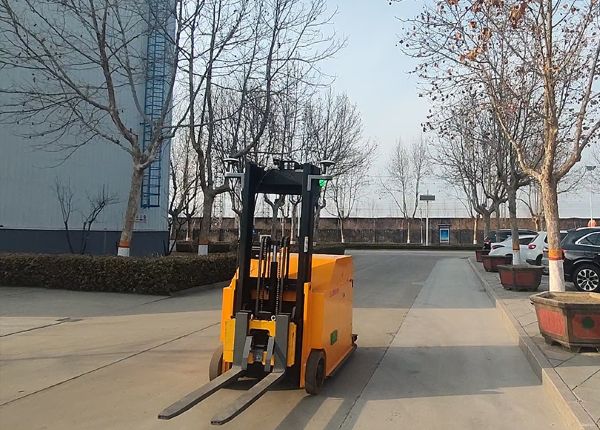
1. Three-Tier Architectural Stack: Perception to Action
Industrial safety regulations mandate that an AGV's safety processing sub-assembly must run completely independent of its main steering and location computing core. This functional split isolates safety actions from potential system software freezes:
1. Perception Layer
Type-approved safety LiDAR scanners establish continuous front, rear, and corner optical surveillance zones, reinforced by secondary ultrasonic sensors, mechanical bumpers, and optional 3D time-of-flight cameras.
2. Decision & Action Layers
A dedicated, hardware-validated safety PLC processes field violations against real-time velocity curves. It bypasses navigation paths to trigger immediate speed reduction, controlled deceleration, or an E-stop circuit drop.
2. Zone-Based Safety Logic: The Radial Field Threshold
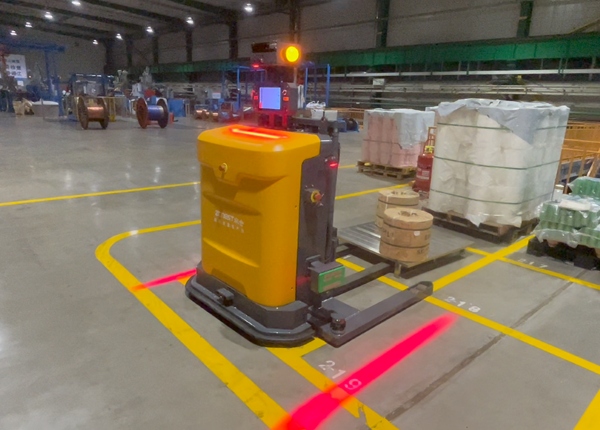
When a pedestrian or an oncoming manual forklift crosses into an AGV's operating path, the vehicle's response is governed by concentric, velocity-adaptive safety fields mapped out by the integrators.
| Safety Field Layer | Physical Boundary Range | Deterministic Vehicle Action |
|---|---|---|
| Warning Zone | Outer customizable perimeter. | Initiates smooth speed restriction; activates localized audible alerts and strobe patterns to signal path presence. |
| Protective Zone | Intermediate variable perimeter. | Triggers aggressive mechanical deceleration; transitions the platform into a highly restricted creep-velocity profile. |
| Emergency Zone | Immediate contact-avoidance perimeter. | The safety PLC cuts drive motor power instantly, engaging mechanical brakes to lock down the vehicle. |
3. Optical Coverage Dynamics: Cornering and Intersection Risk
Standard vehicle configurations often implement basic front and rear scanning fields, which can leave blind spots during turns. As an AGV swings its chassis into a narrow racking row or crosses a busy cross-aisle, its true travel path shifts laterally.
The Turning Clearance Vector: Advanced deployments implement true 360° or corner-mounted side-scanning lasers. These systems automatically adjust their monitoring zones outward based on steering angles, detecting side approach hazards, crossway forklift cross-traffic, and tight racking corner clearance variations before a collision occurs.
4. Post-Stop Protocols: The Non-Automatic Safe Restart Sequence
Managing what happens after a vehicle stops is critical for maintaining warehouse productivity. To comply with international safety standards (such as ISO 3691-4), an AGV cannot simply resume travel immediately after its emergency zone is cleared.
1. Hazard Clearance
2. Operator Reset
3. Map Re-localization
4. Task Resumption
Requiring an operator to acknowledge resets via a physical button or HMI screen prevents vehicles from starting up unexpectedly while personnel are still clearing path obstructions. Once validated, the robot recalibrates its sensor map alignment before picking up its active transport task.
5. High-Risk Hotspots and Coexistence Rules
Relying solely on on-board robot sensors to manage safety in a high-velocity facility can lead to excessive stops and traffic gridlock. True operational safety requires combining hardware features with disciplined warehouse traffic management.
Intersection Reservations: Fleet controllers use software-driven intersection management rules, locking down shared crossing squares for one vehicle at a time to prevent near-miss incidents.
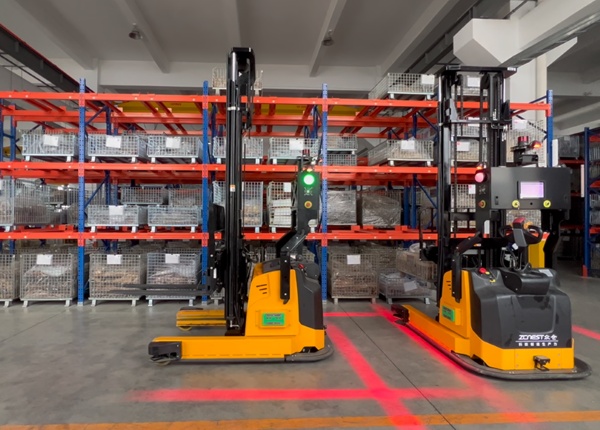
Physical Spatial Separation: High-volume warehouses use distinct lane markings to separate pedestrian walkways, dedicated AGV pathways, and manual forklift loading zones.
Predictive Traffic Buffering: Advanced fleet management software tracks moving manual equipment, adjusting AGV speeds early and opening up wider safety buffer margins when approach paths overlap.
Mixed-Traffic Industrial Safety Sourcing Audit
Before executing a mobile automation deployment contract, confirm that your system integration documentation includes the following validation records: