
 Chinese
 English

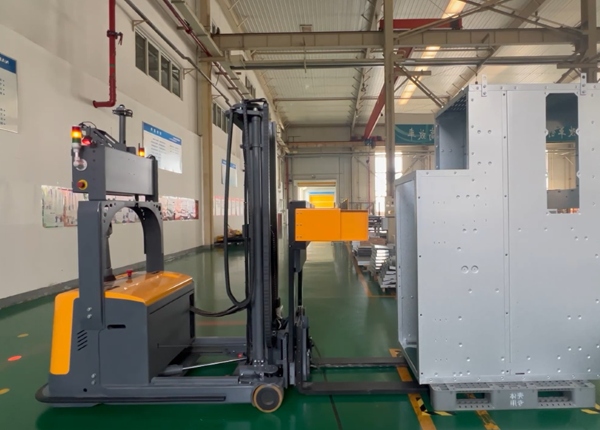
Integrating specialized load handling mechanisms—such as paper roll clamps, drum handlers, carton stabilizers, and vacuum arrays—shifts a mobile robotics deployment from a standard vehicle procurement into a custom application-specific automation engineering project. At this tier, the attachment ceases to be an external add-on; it fundamentally changes the vehicle's core physical properties.
The Core Engineering Shift: Introducing custom load carriers changes load center geometry, hydraulic flow demands, braking kinematics, and software safety zoning. Successful integration requires engineering the entire AGV platform around the tool's unique handling profile.
Whether configuring automated loops for sensitive printing plant paper rolls, heavy steel coils, or fragile carton layers, procurement teams must ensure that fluid dynamics, structural rigidity, and real-time software boundaries are modeled concurrently prior to production.
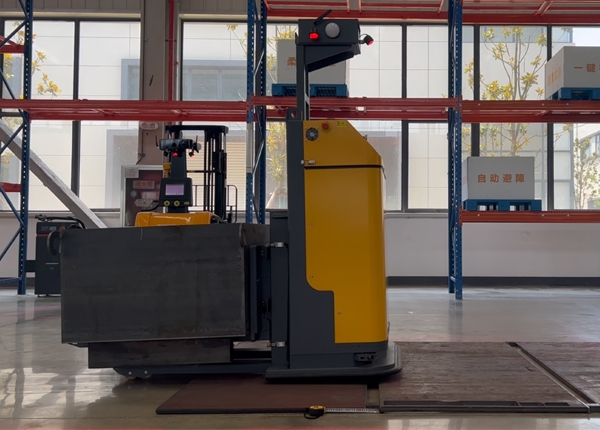
1. Specialized Material Dynamics: The Paper Roll Vector
Non-palletized cylindrical loads, like heavy paper rolls, introduce complex material parameters that contrast sharply with standard square pallet footprints. Their handling requires precise control variations:
Deformable Surface Sensitivity: Clamping mechanisms require highly regulated proportional valve controls. Excessive hydraulic pressure deforms or tears outer material layers, while insufficient pressure introduces drop risks during rapid travel deceleration.
High and Variable Center of Gravity: Tall vertical rolls elevate the platform's center of gravity. This requires wider mast footprints, heavy structural rigidity, and softer software acceleration profiles to counteract dynamic tipping vectors.
Modified Inertial Braking: As roll diameters and weights change, the onboarding software must actively alter turning speed thresholds and straight-line stopping distances to preserve vehicle equilibrium.
2. Integrated Intelligence: Multi-Attachment Software Profiles
Modern industrial fleets employ dynamic software adjustments to adapt vehicle performance metrics to the exact physical tool mounted on the fork carriage.
| Active Attachment State | Kinematic Control Profile | Dynamic Software Adjustment Loops |
|---|---|---|
| Unloaded Travel | Chassis Minimum Tipping Envelope. | Unlocks maximum nominal acceleration, optimized velocity curves, and standard defensive safety LiDAR zones. |
| Paper Roll Clamp Engagement | Elevated Center-of-Gravity Matrix. | Throttles maximum turn velocities, caps peak elevation ceilings, and expands longitudinal safety fields. |
| Third-Party Hydraulic Tooling | Regulated Auxiliary Fluid Loop. | Synchronizes flow limits, monitors pressure drop sensors, and establishes hard software interlocks against travel during active clamping cycles. |
3. Hardware Interoperability: Third-Party Hydraulic Integration
While mechanical carriage mounting often follows universal ISO standards, achieving deep software and fluid compatibility with third-party attachments (e.g., Cascade) requires detailed system engineering.
Fluid Power Synchronization
The vehicle's internal hydraulic pump and manifold block must match the precise flow rate and pressure constraints of the attachment, ensuring reliable tool cycles without overheating the oil supply.
Electronic Signaling Loops
Integrating advanced components requires bridging electrical connections. The tool's integrated sensors, position indicators, and analog transducers must feed real-time data back to the core safety PLC via integrated CAN networks.
⚠️ The Integration Risk Vector: Mechanical fitment is rarely where custom projects encounter bottlenecks. The primary risk lies in synchronization lag between the vehicle's safety PLC and the attachment's hydraulic valves, which can trigger fault cutouts during fast handling sequences.
4. Engineering Lifecycle and Custom Development Lead Times
Developing application-specific automated platforms requires significant design validation time compared to deploying standard, off-the-shelf pallet lifters. The engineering lifecycle follows a rigorous developmental loop:
1. Load Matrix Analysis
2. Finite Element CAD Modeling
3. Valve & Fluid Loop Layout
4. Adaptive Kinematic Tuning
5. Dynamic Weight Testing
Project lead times are driven primarily by the design verification phase. Engineers conduct structural stress mapping, calculate dynamic braking capacities, and program customized software profiles before the vehicle ever enters the assembly line.
Custom AGV Attachment Engineering Audit
Before executing an agreement for application-specific automated vehicles, confirm that your manufacturer's submittal package contains the following technical documentation: