

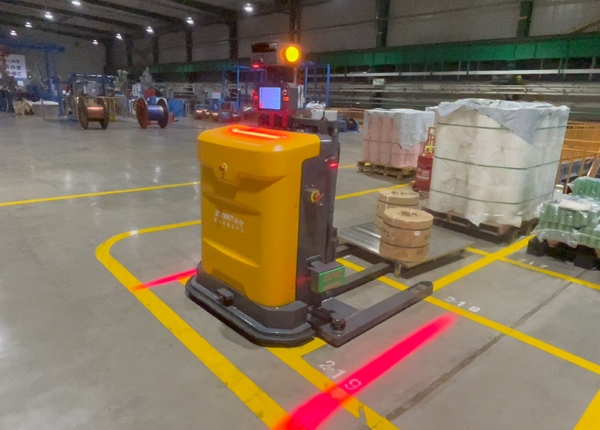
A reality check: you don’t really “calibrate blind spots” in LiDAR like adjusting a software setting. In modern AGVs, blind spot handling involves:
Safety zone configuration (software layer)
Sensor parameter tuning (firmware layer)
Environment correction (map + filtering)
Sometimes physical sensor adjustment (hardware layer)
Most Chinese AGVs handle this through the RCS (Robot Control System) plus onboard safety controller.
Many mid-to-high-end Chinese AGVs allow partial adjustment of safety zones through:
Web-based RCS dashboard
Desktop configuration tools
Engineering console (advanced users)
You can usually configure:
Safety Zone Layers: warning, deceleration, emergency stop
Radius / Shape: circular, polygon, or dynamic speed-dependent zones
Important: Critical safety parameters are often locked behind engineer/admin access due to ISO safety and liability requirements.
Advanced systems may show:
Point cloud visualization
Reflectivity or obstacle density maps
SLAM confidence maps
These heat maps help engineers identify:
Navigation instability zones
False obstacle triggers
Reflective interference areas
Lower-cost AGVs may only display basic maps and obstacle points without diagnostic heat maps.
Causes of false LiDAR objects include:
Dust or particles reflecting laser pulses
Steam or condensation
Temperature gradients
Reflective shrink wrap or polished floors
Solutions (Layered Approach):
Sensor-Level Filtering: noise thresholds, multi-frame validation, reflectivity filtering
Software Filtering: temporal smoothing, obstacle persistence, minimum object size filtering
Environmental Control: reduce steam, improve airflow, avoid direct exhaust
Hardware Enhancements: LiDAR + vision fusion, dual LiDAR, radar-assisted filtering
Chinese support teams can:
Adjust SLAM map parameters and correct drift
Resize safety envelopes and tune deceleration curves
Connect via VPN/cloud to view real-time LiDAR streams
Analyze point clouds remotely and suggest parameter adjustments
They cannot physically fix dirty lenses, misaligned sensors, or reflective structural issues remotely.
Onboard Layer: LiDAR processing, emergency stop logic, local obstacle detection
RCS Layer: fleet coordination, route planning, safety zone configuration, traffic control
Cloud/Remote Layer (optional): diagnostics, logs, updates, remote tuning
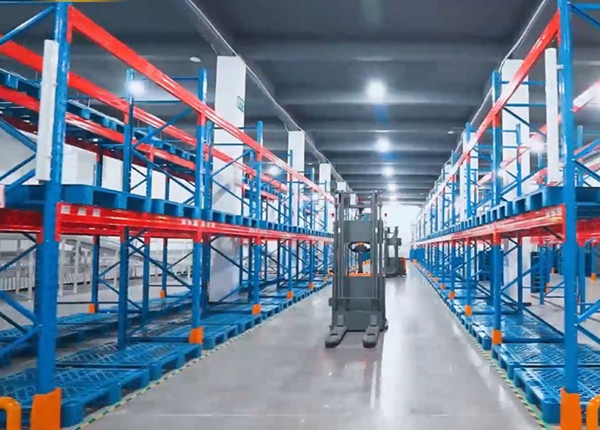
Physical geometry: racks blocking LiDAR view angles
Reflection environment: glass, metal, shrink wrap
Software mapping: incomplete SLAM, incorrect safety zone tuning
Redesign aisle geometry slightly where possible
Tune speed zones by area
Segment warehouse into safety regions
Combine LiDAR + vision validation
Enforce strict mapping procedures during commissioning
Can my team maintain navigation accuracy independently?
Will constant Chinese engineer involvement be required?
Can the system adapt to dust, steam, and reflective surfaces?
Is the software transparent for in-house management?
How much is autonomous vs. vendor-dependent?
Bottom line: AGV hardware runs the robot, but software stability and mapping practices determine whether your warehouse operations run smoothly.
FREE ENGINEERING SUPPORT Stop Gambling on Generic Platforms. Get an AGV/AMR Tailored to Your Warehouse.Buying automated guided vehicles involves complex safety standards (CE/ANSI), navigation setups (Laser SLAM), and ERP system integration. Don't risk your factory safety with middle-men. ✓ 100% Direct Factory: Customized payload up to 5 Tons. ✓ Free CAD Simulation: Send us your layout, and our engineers will simulate the optimal AGV routes. ✓ Global Support: Overseas installation guidance & local maintenance partners. |





 Chinese
 English