


While most AGVs are highly capable, a mixed or unstandardized pallet environment is one of the biggest hidden challenges in AGV deployment.
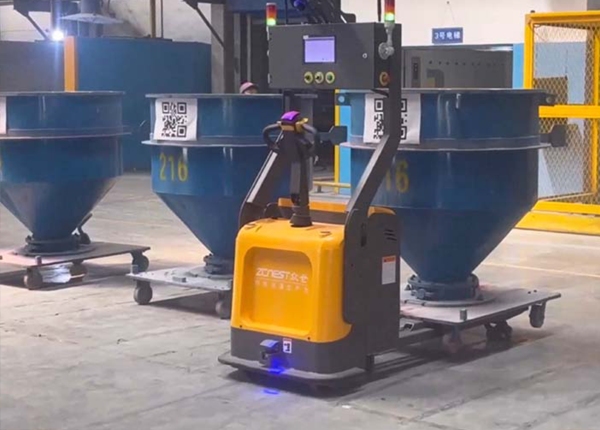
Here is what you need to know about compatibility, customization, and ensuring a successful rollout.
Generally, standard AGVs can handle both wooden and plastic pallets, but they present entirely different challenges to the robot's perception and mechanical systems.
Wooden pallets are traditionally easier for AGVs to handle.
The Pros: Fork pockets are visually distinct, surfaces are non-reflective, and the overall geometry is predictable for the robot’s sensors.
The Risk: Damaged wood. Broken entry boards, warped frames, and split wood create inconsistent fork access and can completely stall an automated fleet.
Plastic pallets offer extreme durability but can be more difficult for standard AGV sensors.
The Pros: Long lifespan and zero splintering or debris.
The Risk: Sensor interference. Glossy plastic surfaces can reflect LiDAR beams incorrectly, molded shapes vary widely between brands, and plastic can deflect or deform significantly under heavy loads.
The critical issue for automation success is not strictly "wood vs. plastic." Instead, AGV reliability depends entirely on repeatability:
Pallet Consistency: Are all your pallets from the same manufacturer and model?
Pocket Accessibility: Is there enough clearance for the forks to enter without friction?
Geometry Repeatability: Does the pallet maintain its shape under maximum load weight?
Load Presentation: Is there excessive stretch-wrap overhang blocking the entry pockets?
Floor Conditions: Is the floor level at the exact point of pickup and drop-off?
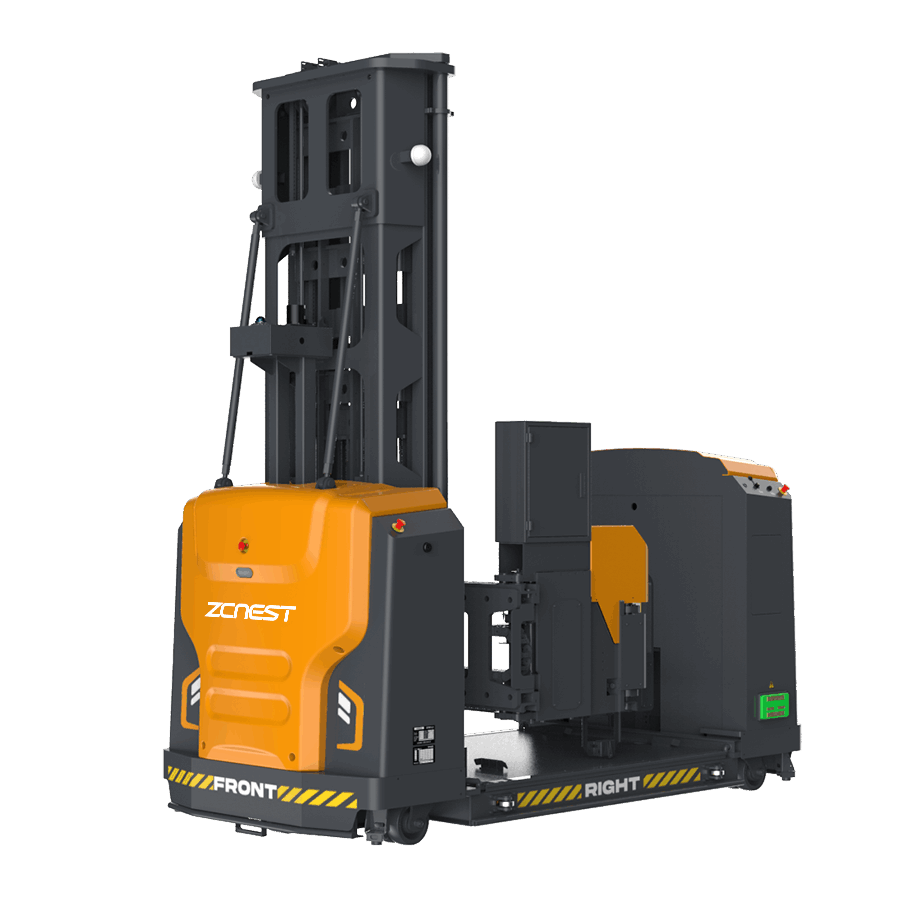
Yes. Customizing fork geometry for non-standard loads is a standard procedure in serious industrial AGV engineering.
If your facility handles Intermediate Bulk Containers (IBCs), chemical totes, or heavy custom racks, standard off-the-shelf forks will not suffice. Most professional manufacturers can fully customize:
Fork length, width, and thickness
Adjustable spacing ranges
Lifting height limits
Heavy-duty carriage structures
Handling liquid-filled IBCs introduces dynamic variables that a standard pallet does not:
Sloshing Liquids: Shifting centers of gravity affect braking and acceleration.
Narrow Access: Tiny clearance windows require extreme fork insertion precision.
Because of this, fork customization is not just mechanical—it also requires the engineering team to tune the AGV’s stability algorithms, turning-radius software, and mast stability control.
Most AGV failures in production environments come from poor load presentation and inconsistent pallet quality, not from the robot's navigation system.
Before signing a contract, experienced buyers always request live testing or simulation using their worst-case scenario inventory:
Wrapped loads with dangling plastic film
Moderately damaged wooden pallets
Mixed pallet inventories on the same line
Off-center or misaligned load placements
Partially blocked fork entries
A mature, modern AGV system should recognize standard US 48×40 inch (or Euro 1200×800 mm) pallets reliably, tolerate minor alignment errors, and adapt dynamically.
However, technology alone cannot solve total chaos. The most reliable deployments combine advanced AI vision systems with basic warehouse discipline:
Pallet Audits: Audit your current pallet pool before the robots arrive.
Standardization: Reduce the circulation of severely damaged pallets.
Process Consistency: Define strict tolerances for how operators place loads in pickup lanes.
Don't guess whether your current inventory will stall your automation project. Let our engineering team analyze your specific warehouse setup to determine if a standard LiDAR AGV is sufficient or if an AI-driven Vision Upgrade is required.
Share your current specs with us to receive a custom compatibility report:
Pallet Types & Dimensions (e.g., Wood/Plastic, 48×40)
Container Specifications (e.g., IBC Totes, Custom Racks)
Average Load Weights
Estimated % of Damaged Pallets in Circulation
📖 AGV Forklift Guide — Essential manual for selection and safety.
⚙️ How AGV Systems Work — A deep dive into navigation and logic.
⚖️ AGV vs. AMR Comparison — Choosing the right technology for your facility.
💰 AGV Cost and ROI — Evaluating investment and payback periods.
FREE ENGINEERING SUPPORT Stop Gambling on Generic Platforms. Get an AGV/AMR Tailored to Your Warehouse.Buying automated guided vehicles involves complex safety standards (CE/ANSI), navigation setups (Laser SLAM), and ERP system integration. Don't risk your factory safety with middle-men. ✓ 100% Direct Factory: Customized payload up to 5 Tons. ✓ Free CAD Simulation: Send us your layout, and our engineers will simulate the optimal AGV routes. ✓ Global Support: Overseas installation guidance & local maintenance partners. |





 Chinese
 English