


When procurement teams evaluate Automated Guided Vehicles (AGVs), they heavily focus on payload, battery life, and LiDAR specifications. Yet, in real-world operations, warehouse floor quality is the #1 underestimated factor that determines project success.
Unlike human operators who naturally cushion wheel shocks and adjust for tilted pallets, an AGV cannot "feel" floor irregularities. For autonomous forklifts, reach trucks, and Very Narrow Aisle (VNA) systems, poor floor conditions directly lead to navigation drift, fork insertion failures, and compounding maintenance costs.
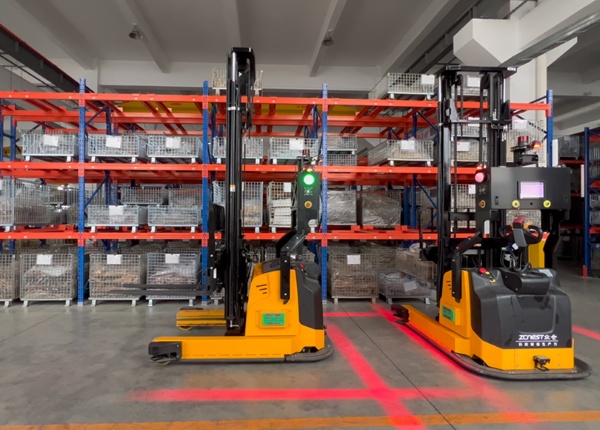
Industrial concrete floors are universally measured using the $F_F / F_L$ floor flatness system. Understanding these metrics is critical before mapping out an AGV path:
📐 The $F_F$ vs. $F_L$ System:
$F_F$ (Floor Flatness): Measures the local surface bumpiness or waviness. High $F_F$ ensures sensors don't oscillate.
$F_L$ (Floor Levelness): Measures the overall slope, tilt, or elevation pitch across a distance.
While standard pallet movers tolerate moderate industrial floors, high-precision high-lift stackers require strict flatness tolerances. Even a tiny bump at the base translates to **massive mast oscillation** when a load is elevated 30 feet in the air.
Many oversea factory demo videos show AGVs gliding effortlessly across flawless, mirror-polished test labs. Your actual facility likely contains patched concrete, expansion joints, and slope transitions.
Potentially yes. A 5-degree incline represents a significant grade for heavy industrial AGVs. Crossing an excessive slope can result in reduced traction, steering drift, braking instability, and rapid battery drainage. When carrying maximum capacity, AGVs may automatically slow down, trigger an emergency stop, or refuse to enter the zone entirely.
The maximum gap an AGV can safely cross depends heavily on its wheel diameter, tire compound, and suspension setup. Large unmanaged expansion joints shake the vehicle's chassis, which disrupts LiDAR localization confidence, accelerates tire degradation, and risks dropping unstable or loosely wrapped loads.
Does your concrete floor need an expensive epoxy finish? Not necessarily, but surface textures must be highly predictable for braking and steering repeatability.
While industrial coatings improve dust control and reduce wheel wear, ultra-gloss decorative coatings can introduce unexpected failures. Highly reflective, mirror-like surfaces distort LiDAR laser beams, creating "noise" that can blind the AGV's navigation system. For optimal performance, professional integrators recommend a matte or satin anti-slip industrial finish.
Yes—but expectations must be aligned. There is a vast difference between an AGV simply being able to "move" and an AGV performing reliably at high industrial precision. If your floor does not meet VNA (Very Narrow Aisle) standards, you can still deploy automation successfully, provided you adjust your expectations:
| Floor Environment | Feasible AGV Applications |
|---|---|
| Standard / Non-VNA Concrete Floors | Low-speed pallet movers, wide-aisle transport, low-to-moderate lifting heights, and flexible AMRs. |
| Strict VNA Flatness Floors Required | High-bay automated racking, tight narrow-aisle clearance navigation, high-speed travel, and multi-tier stacking. |
To avoid unexpected, expensive floor remediation costs halfway through your project layout, ensure your team conducts a comprehensive floor evaluation beforehand:
Perform $F_F / F_L$ Surveys: Map out the high-traffic picking and docking paths.
Measure Expansion Joints: Identify joints exceeding maximum chassis crossing capabilities to evaluate sealant options.
Audit Slope Grade Transitions: Verify that incline angles do not violate loaded center-of-gravity limits.
Match Tire Compound to Surface: Select polyurethane or rubber wheel configurations based on actual floor traction profiles.
Don't let hidden infrastructure constraints derail your warehouse automation goals. Share your current floor characteristics with our engineering team, and we will help determine whether your existing space is AGV-ready or if targeted, low-cost remediation is recommended.
Submit your warehouse layout parameters for an engineering review:
Target Aisle Widths & Maximum Lifting/Stacking Heights
Approximate Floor Age & Existing Coating Type (Concrete, Polished, Glossy Epoxy, etc.)
Average Expansion Joint Widths & Major Crack Conditions
Required AGV Payload Weights & Planned Travel Speeds
📖 AGV Forklift Guide — Essential manual for selection and safety.
⚙️ How AGV Systems Work — A deep dive into navigation and logic.
⚖️ AGV vs. AMR Comparison — Choosing the right technology for your facility.
💰 AGV Cost and ROI — Evaluating investment and payback periods.
FREE ENGINEERING SUPPORT Stop Gambling on Generic Platforms. Get an AGV/AMR Tailored to Your Warehouse.Buying automated guided vehicles involves complex safety standards (CE/ANSI), navigation setups (Laser SLAM), and ERP system integration. Don't risk your factory safety with middle-men. ✓ 100% Direct Factory: Customized payload up to 5 Tons. ✓ Free CAD Simulation: Send us your layout, and our engineers will simulate the optimal AGV routes. ✓ Global Support: Overseas installation guidance & local maintenance partners. |





 Chinese
 English