


At a lifting height of 10 meters, an Automated Guided Vehicle (AGV) stops being a mere lifting machine and transforms into a complex, dynamic stability-controlled system. At this altitude, the laws of leverage, mast rigidity, and micro-vibrations dominate operations.
To ensure high-bay warehouse safety, advanced reach-truck AGVs integrate active stabilization logic powered by Mast Angle Sensors, Inertial Measurement Units (IMUs), and Hydraulic Feedback Loops. This real-time tilt compensation keeps forks level, reduces pallet deflection, and dampens mast sway during rapid acceleration.
⚠️ An Important Physics Limitation: Tilt compensation drastically improves safety and alignment precision, but it does NOT increase the physical structural capacity of the steel mast. It cannot overcome overloading or poor facility floor levelness.
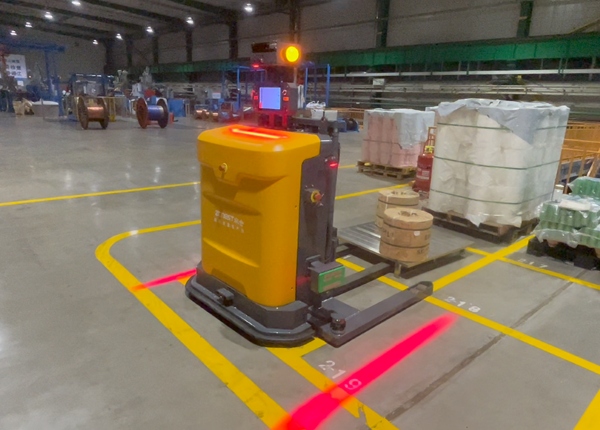
In modern industrial AGV forklifts, the answer is a strict yes. Overloading at height is the #1 root cause of high-bay tipping accidents, mast damage, and catastrophic pallet collapses. Therefore, safety logic is engineered to be intentionally conservative.
Utilizing hydraulic pressure sensors, localized load cells, and motor current feedback, the AGV constantly estimates fork force. The moment an overload profile is detected, the vehicle will:
Immediately refuse the vertical lift command.
Halt all mast movements at the current safe height.
Trigger a fleet-wide safety alarm and log the event into the central management software.
In real-world logistics, cargo is rarely perfectly centered. To manage unbalanced inventory safely, an intelligent AGV builds a multi-dimensional live estimate of the load's true center of gravity:
📸 1. Geometric Geometry Recognition 3D LiDAR and vision systems instantly scan the pallet alignment, cargo silhouette, and load asymmetry before fork entry.
⚖️ 2. Fork Pressure Distribution Analysis Left vs. right independent fork force sensors measure uneven side-loading or forward/backward tilt tendencies.
🔄 3. Mast Torque & Motion Response The system monitors hydraulic feedback and physical sway during acceleration to calculate active stability margins.
If a significant imbalance is calculated, the AGV's on-board brain automatically implements protective measures. It will automatically reduce maximum lift height limits, cap travel speeds, or refuse high-level storage placement entirely, requiring manual operator re-centering.
A critical trap for AGV buyers is relying on a single nominal weight rating (e.g., a "2-ton forklift"). In actual operations, true usable capacity operates on a derating curve governed by multiple overlapping facility variables:
| Variable | Impact on High-Lift Stability |
|---|---|
| Lift Height Scaling | As height increases, the allowable payload decreases exponentially to prevent tipping levers. |
| Floor Flatness ($F_F / F_L$) | A $1\text{ mm}$ floor dip at ground level amplifies into a massive multi-inch sway at $10\text{ meters}$. |
| Rack Insertion Precision | Requires dynamic slowdowns to handle load deflection and ensure zero contact with rack beams. |
To guarantee real-world performance, sophisticated automation engineers look past marketing brochures and demand concrete data sets from suppliers:
Full Load Derating Curves: A comprehensive load vs. height graph documenting exact capacity limits at every $500\text{ mm}$ increment up to maximum extension.
Mast Deflection Tolerances: Engineering data sheets showing anti-tip design boundaries and structural steel flex limits under dynamic braking conditions.
Real Pallet Stress Testing: On-site or laboratory validations executing maximum lifts with real asymmetrical cargo and full-speed emergency stopping cycles.
Don't leave high-bay safety to guesswork. Share your exact warehouse parameters with our engineering team, and we will calculate a realistic operating matrix tailored to your structural layout and payload needs.
Provide your specific metrics below for a technical calculation report:
Target Maximum Lifting Height & Rack Design Limits (m)
Average / Maximum Pallet Tonnage Requirements (kg)
Load Symmetry Profiles & Common Pallet Conditions (e.g., Uniform, Top-Heavy, Overhanging)
Existing Floor Levelness Data ($F_F / F_L$ values if available)
📖 AGV Forklift Guide — Essential manual for selection and safety.
⚙️ How AGV Systems Work — A deep dive into navigation and logic.
⚖️ AGV vs. AMR Comparison — Choosing the right technology for your facility.
💰 AGV Cost and ROI — Evaluating investment and payback periods.
FREE ENGINEERING SUPPORT Stop Gambling on Generic Platforms. Get an AGV/AMR Tailored to Your Warehouse.Buying automated guided vehicles involves complex safety standards (CE/ANSI), navigation setups (Laser SLAM), and ERP system integration. Don't risk your factory safety with middle-men. ✓ 100% Direct Factory: Customized payload up to 5 Tons. ✓ Free CAD Simulation: Send us your layout, and our engineers will simulate the optimal AGV routes. ✓ Global Support: Overseas installation guidance & local maintenance partners. |











 Chinese
 English




