


Before authorizing a capital expenditure for an Automated Guided Vehicle (AGV) fleet, logistics executives are routinely presented with animated layout models. The critical pitfall? There is a massive, high-risk gap between a marketing-style video and an engineering-grade throughput simulation.
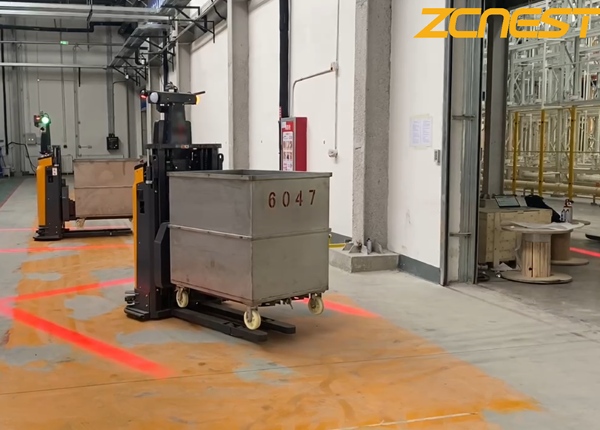
The foundational question for a warehouse operator is never “Can they deliver a simulation?” It is: “Does this simulation accurately reflect the friction, anomalies, and physical constraints of my actual operating floor?”
⚠️ Low-Tier Marketing Demos
Ideal traffic flow conditions
Theoretical, linear throughput estimates
Zero operational delays or human factors
Simplified FIFO task assignment queues
⚙️ Engineering-Grade Models
Bi-directional traffic bottleneck logging
Dynamic battery opportunity-charging math
Real-world millisecond docking & lift cycles
WMS/ERP prioritizations & rule overrides
Without factoring in system latency, operators run two severe capital risks: either under-buying assets and missing their critical peak-hour goals, or over-buying hardware, which permanently breaks the project's ROI timeline.
A classic purchasing mistake is determining fleet size via simple math: Total Moves ÷ Average Vehicle Speed. In real-world enterprise deployments, two facilities with an identical target of 100 pallet moves per hour may require drastically different fleet configurations (e.g., 4 AGVs vs. 12 AGVs) due to systemic design boundaries.
True throughput is restricted by non-linear variables. A mature model calculates the full Task Cycle Time, mapping the precise acceleration curves, floor flatness friction, multi-vehicle intersection reservation rules, high-bay lift deceleration, and charging infrastructure layout conflicts.
The predictive accuracy of an ROI model depends entirely on the granularity of the operational data fed into the simulation software. To build a robust, deployment-ready simulation, enterprise teams must provide four core data blocks:
📍 Spatial Topology Comprehensive CAD facility layouts detailing exact aisle clearances, structural support pillars, floor gradient variations, staging grid limits, and high-voltage charging drops.
📈 Kinetic Material Volumetrics True peak-hour inbound/outbound flow ratios, seasonal SKU demand fluctuations, precise load dimensions, weight tolerances, and staggered shift schedules.
⚙️ Execution Logic Controls Real-time replenishment request priorities, pick-to-light/drop-off validation time windows, and interaction points shared with manual forklift drivers.
Do not sign an automation procurement contract based solely on fluid 3D playback or pristine digital warehouse walkthroughs. Instruct your internal engineering team to audit the supplier’s simulation logic against the following stress behaviors:
• The Peak Load Strain: What happens to the fleet’s congestion rating when pallet volume increases by 20% or 30% during emergency supply spikes?
• Asset Failure Redundancy: If two AGVs are dropped offline for unscheduled maintenance or a scanner fault, how does the scheduling system reroute missions to prevent total line stoppages?
• Charging Path Contention: Does the simulation model the physical queues that form when multiple low-battery vehicles attempt to access the opportunity-charging layout simultaneously?
Ultimately, a high-quality AGV simulation must function as an unbiased, data-driven operational decision model rather than an aesthetic sales asset. Validating these internal software parameters prior to your deployment phase remains the single best defense against systemic workflow bottlenecks.
Evaluating your facility's layout constraints early protects your long-term ROI. By cross-referencing your target country's specific labor shift patterns, aisle widths, and peak-hour pallet transfer expectations, your technical teams can independently calculate realistic fleet sizes and isolate traffic bottlenecks long before deployment begins.
📖 AGV Forklift Guide — Essential manual for selection and safety.
⚙️ How AGV Systems Work — A deep dive into navigation and logic.
⚖️ AGV vs. AMR Comparison — Choosing the right technology for your facility.
💰 AGV Cost and ROI — Evaluating investment and payback periods.
FREE ENGINEERING SUPPORT Stop Gambling on Generic Platforms. Get an AGV/AMR Tailored to Your Warehouse.Buying automated guided vehicles involves complex safety standards (CE/ANSI), navigation setups (Laser SLAM), and ERP system integration. Don't risk your factory safety with middle-men. ✓ 100% Direct Factory: Customized payload up to 5 Tons. ✓ Free CAD Simulation: Send us your layout, and our engineers will simulate the optimal AGV routes. ✓ Global Support: Overseas installation guidance & local maintenance partners. |





 Chinese
 English