


Deploying automated guided vehicle (AGV) fleets in developing logistics markets across India and Southeast Asia presents distinct environmental challenges, specifically regarding grid voltage instability, brownouts, and sudden blackouts. Chinese AGV suppliers utilize industrial-grade electrical containment, decentralized data mapping, and power synchronization architectures to guarantee continuous operational integrity.
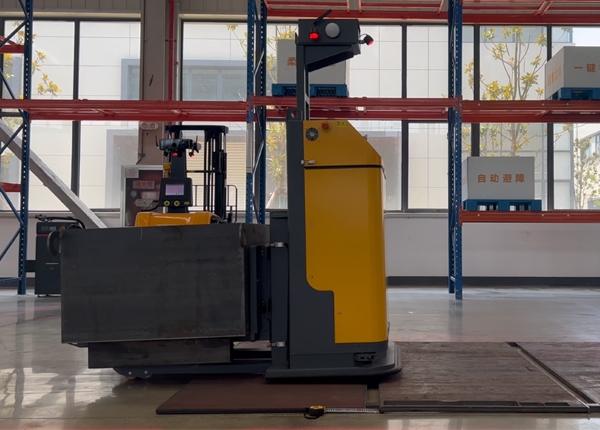
The primary point of vulnerability for any industrial robotic fleet operating on an unstable regional grid is the heavy-current automated charging interface.
Built-In Surge Protection
Industrial charging stations are equipped with heavy-duty Surge Protective Devices (SPDs) to clamp high-voltage spikes caused by grid switching or localized lightning strikes, protecting internal rectifier circuits.
Voltage Regulation Windows
Station transformers feature wide input voltage acceptance windows (typically ±15% to ±20%). Integrated solid-state voltage regulators automatically normalize minor electrical fluctuations before transmitting DC power to the AGV battery cells.
When utility power drops instantly across a facility, localized vehicle control modules and central fleet routing engines utilize isolated safety memory storage to prevent structural map loss or order drops.
What happens to the AGV's data if there is a sudden warehouse power outage?
Zero data loss occurs on the physical vehicles. Onboard industrial computers utilize non-volatile flash memory architectures that continuously stream telemetry, coordinate positions, and task queues to solid-state logs. The vehicles safely execute an automated controlled braking sequence, maintaining their absolute position coordinates on the digital map grid until communication with the central system is restored.
Seamless transition from a dying utility grid to secondary facility backups requires synchronized software handshakes to avoid system-wide safety resets.
Backup Power Synchronization Layout
Central RCS & UPS Setup
The central Robot Control System (RCS) server is integrated with the facility's Uninterruptible Power Supply (UPS). This maintains wireless data dispatch lines during the critical 15-to-30-second window while backup power systems initialize.
Generator Load Management
System configurations allow integration with backup diesel generators. The RCS can be programmed to selectively throttle high-amperage charging stations during generator operation, reducing heavy electrical load strains while keeping the mobile fleet active.
When regional energy infrastructure faces peak demand, sub-nominal supply conditions (brownouts) require adaptive operational logic.
Is there a "Low Power" mode for the AGVs during brownout periods? Yes. When the central control center detects incoming voltage drop warnings or restricted backup capacity notifications, it can trigger a system-wide optimization profile.
Adaptive Fleet Optimization: Under this configuration, max travel velocities are scaled down (e.g., restricted to 60% of top speed), acceleration slopes are smoothed to reduce peak current draws on the batteries, and automated opportunistic charging cycles are staggered to prevent multiple vehicles from drawing maximum grid loads simultaneously.
📖 AGV Forklift Guide — Essential manual for selection and safety.
⚙️ How AGV Systems Work — A deep dive into navigation and logic.
⚖️ AGV vs. AMR Comparison — Choosing the right technology for your facility.
💰 AGV Cost and ROI — Evaluating investment and payback periods.
FREE ENGINEERING SUPPORT Stop Gambling on Generic Platforms. Get an AGV/AMR Tailored to Your Warehouse.Buying automated guided vehicles involves complex safety standards (CE/ANSI), navigation setups (Laser SLAM), and ERP system integration. Don't risk your factory safety with middle-men. ✓ 100% Direct Factory: Customized payload up to 5 Tons. ✓ Free CAD Simulation: Send us your layout, and our engineers will simulate the optimal AGV routes. ✓ Global Support: Overseas installation guidance & local maintenance partners. |





 Chinese
 English