
 Chinese
 English

The core question warehouse operators eventually face isn't just about automation—it’s about geography and long-term economics:
“Am I truly saving money by importing AGVs from China—or am I simply shifting costs into other areas?”
The answer goes far beyond comparing initial equipment quotes or calculating basic labor replacement. True AGV Return on Investment (ROI) is a moving target driven by labor economics, software licensing, tariffs, integration complexity, and—above all—operational uptime.
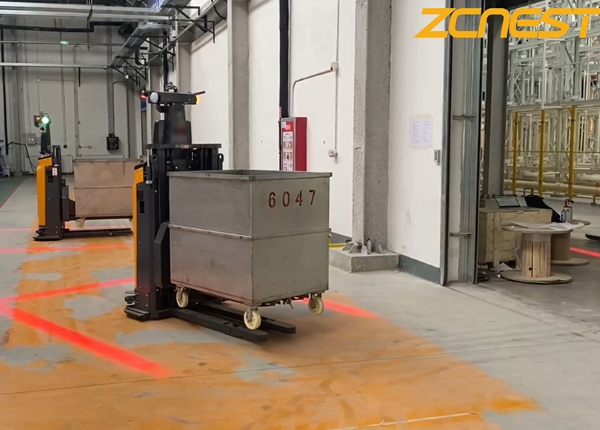
1. The Biggest Misconception About AGV ROI
Many buyers fall into the trap of a simple head-to-head calculation: China AGV Purchase Price vs. Western AGV Purchase Price.
In reality, hardware cost is just the tip of the iceberg. A professional financial comparison must evaluate the entire operational lifecycle:
5-Year Operational Output
— 5-Year Total Cost of Ownership (TCO)
===========================================
= True Automation ROI
The Real TCO Equation Includes:
Upfront Capital: Hardware, shipping, customs duties, and tariffs.
Implementation: Infrastructure upgrades (Wi-Fi, floors, charging), software licensing, and integration complexity.
Lifecycle Operations: Scheduled maintenance, LiDAR/battery replacements, software upgrades, and—critically—the cost of unexpected downtime.
2. Head-to-Head: Chinese AGVs vs. Western Brands
How do overseas manufacturers stack up against domestic US/EU brands? The trade-offs generally split along the lines of capital expenditure versus operational insurance:
| Evaluation Metric | Chinese AGV Systems | Western / Domestic Brands |
|---|---|---|
| Upfront CAPEX | Extremely Competitive; significantly lower initial hardware costs. | Higher initial capital investment. |
| Engineering Flexibility | High; rapid customization to specific warehouse layouts. | Standardized product lines; lower out-of-the-box flexibility. |
| Local Support & Logistics | Dependent on localized dealer networks or remote support. | Strong; mature regional technician networks. |
| Compliance Ecosystem | Rapidly improving; requires vetting for specific regional standards. | Deeply established local compliance and safety certifications. |
| Communication Friction | Potential time-zone and language barriers for complex troubleshooting. | Low; seamless alignment on project management. |
💡 Operational Reality: A lower purchase price does not automatically guarantee a faster payback period. If weak local support leads to systemic downtime, a cheap robot quickly becomes an expensive liability.
3. Calculating the Break-Even Timeline
When analyzing payback periods based on mature market labor rates (e.g., US/EU labor at $25+/hour), high labor costs drastically accelerate AGV economics.
Where AGV ROI Improves Fastest:
High-Volume Environments: 24/7 operations, multi-shift schedules, and predictable, repetitive pallet transport.
Challenging Environments: Cold storage facilities, long-distance internal logistics, and regions facing acute labor shortages.
The Employee Displacement Myth
Most successful AGV deployments do not completely eliminate headcount. Instead, they drive financial returns by:
Reducing reliance on specialized forklift operators.
Stabilizing throughput consistency during peak seasons.
Allowing existing staff to pivot to higher-value operational tasks.
Low Fleet Utilization + Frequent Traffic Stalls = Stagnant ROI
High Fleet Uptime + Optimized Dispatch Flow = Accelerated Payback
4. Unpacking the 5-Year Total Cost of Ownership (TCO)
To build a bulletproof business case, procurement teams must budget across four distinct cost centers over a five-year lifecycle:
1. Initial System & Deployment
AGV units and specialized charging stations.
Robot Control System (RCS) software integration.
Onsite installation and commissioning.
2. Logistics & Importation
Ocean freight and container handling.
Import tariffs, customs clearance, and broker fees.
Inland trucking to the final facility.
3. Infrastructure & Facility Readiness
Industrial Wi-Fi network densification.
Floor preparation (leveling, polished concrete repairs).
Safety zoning and dedicated charging bay modifications.
4. Lifecycle Maintenance & Support
Wear-and-tear parts (drive wheels, batteries, specialized sensors).
Annual software licensing and firmware updates.
Remote engineering retainers or local technician support.
⚠️ The Hidden TCO Area Buyers Miss: Operational Downtime
The single largest hidden cost in automation is a stalled fleet. A failed integration or a two-week delay on a critical spare part from overseas can disrupt upstream manufacturing or downstream shipping schedules, quickly erasing any upfront hardware savings.
5. The Underestimated Advantage: Lightweight AMRs
When moving from traditional heavy forklifts to Autonomous Mobile Robots (AMRs), operators often overlook secondary facility savings. While not the primary driver of ROI, these operational efficiencies accumulate significantly over a five-year timeline:
Reduced Energy Consumption: AMRs feature lower vehicle mass, optimized routing algorithms, and regenerative braking, resulting in lower utility draws than massive counterbalance trucks.
Preserved Facility Assets: Lighter vehicles reduce stress on expansion joints, minimize concrete floor cracking, eliminate tire rutting, and significantly lower the risk of expensive rack impact damage.
6. Strategic Verdict: How to Choose
Does the lower upfront price of a Chinese AGV survive tariffs and international logistics? Often, yes. Even after accounting for shipping and duties, the upfront capital expenditure savings remain substantial.
The decision ultimately hinges on your organizational profile:
Why Warehouses Choose Western Brands:
They are willing to pay a premium for operational peace of mind. They prioritize local spare-parts inventories, rapid onsite service guarantees, and minimal communication friction to ensure maximum uptime.
Why Warehouses Choose Chinese AGVs:
They leverage unmatched capital efficiency and deployment speed. For standardized warehouse workflows, the rapid maturation of Chinese robotics tech offers high performance at a fraction of the cost—especially attractive for operations with strong internal engineering teams capable of handling tier-1 troubleshooting.
Benchmark Your Facility's ROI
The ideal automation investment isn't the cheapest robot on the market, nor is it the most famous brand. It is the system that delivers the most sustainable operational economics for your specific floor.
To help map out a realistic 5-year TCO and determine whether a global or domestic sourcing strategy makes the most sense for your project, let us run the numbers for you.
Drop your facility specs in the comments or contact our engineering team directly with:
💡Automation Insights & Guides
📖 AGV Forklift Guide — Essential manual for selection and safety.
⚙️ How AGV Systems Work — A deep dive into navigation and logic.
⚖️ AGV vs. AMR Comparison — Choosing the right technology for your facility.
💰 AGV Cost and ROI — Evaluating investment and payback periods.