

 Chinese
 English

For most imported automated guided vehicle (AGV) projects, the full timeline from contract signing to the final Site Acceptance Test (SAT) varies drastically. It ranges from a few months for standardized fleets to significantly longer for customized enterprise deployments.
The single biggest mistake buyers make is assuming that the manufacturer's "production lead time" equals the final "go-live timeline."
The real question for warehouse operators is not: “When will the AGVs ship?”
It is: “When will my facility operate reliably at full production capacity?”
In reality, international AGV deployment involves deep engineering, software localization, maritime transport, customs clearance, infrastructure readiness, and onsite stabilization.
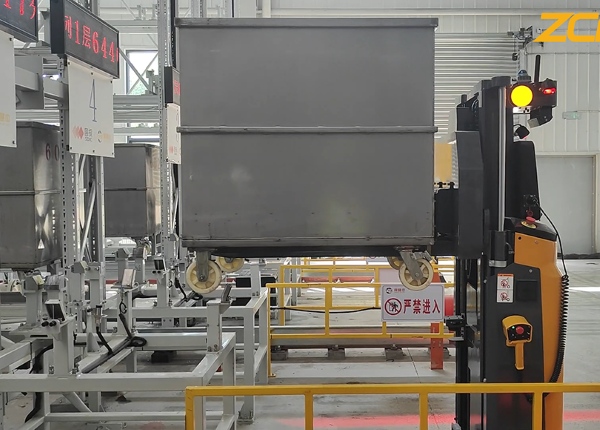
1. Phasing the International AGV Project Lifecycle
A standard international AGV deployment requires strict sequential execution. Delays in early phases cascade directly into delayed site handovers.
1. Contract & Deposit
↓
2. Solution Design
↓
3. Software Customization
↓
4. Hardware Manufacturing
↓
5. Factory Acceptance Test (FAT)
↓
6. Sea Freight & Customs
↓
7. Site Preparation
↓
8. Onsite Installation & Commissioning
↓
9. SAT & Production Go-Live
2. Allocating Time: Hardware Build vs. Software Customization
How many weeks should be allocated for physical assembly versus backend software configuration? While hardware production timelines are highly predictable, software integration frequently surprises buyers by requiring the longest window.
| Development Center | Standardized System Dynamics | Customized Enterprise Dynamics |
|---|---|---|
| Hardware Build | Requires just several weeks for standard chassis assembly and component integration by major Chinese suppliers. | Timelines extend due to custom mast modifications, non-standard payload fixtures, specific battery upgrades, or country-specific compliance adaptations. |
| Software Customization | Fast deployment utilizing out-of-the-box fleet management and simple dispatch logic. | Requires an extensive window for WMS/ERP API development, localized UI conversion, custom traffic rule orchestration, and specialized elevator/automatic door interfaces. |
⚠️ Critical Operational Reality: Most automation project delays are not caused by delayed hardware manufacturing. They are almost entirely driven by incomplete software integration—specifically when connecting to complex tier-1 ERPs (like SAP), orchestrating mixed fleets, or navigating unmapped warehouse business logic.
Common Failure Points in the Software Phase:
Unclear initial operational workflows or late scope modifications.
Gaps in local WMS API documentation.
Customer-side IT security approval delays and firewall restrictions.
Unforeseen PLC (Programmable Logic Controller) interface friction on legacy conveyor lines.
3. International Sea Freight and Customs Risks
Shipping transit times can vary widely depending on the peak shipping season, ocean carrier capacity, and port congestion. However, shipping variability is only part of the risk—customs clearance can introduce significant delays if not managed proactively.
Key Logistics Milestones to Track:
Origin Export Handling: Factory crating, domestic transit to port, container loading, and export clearance.
Ocean Transit: Direct versus transshipment routes, and shipping to the West Coast versus the East Coast.
Import Clearance & Final Mile: Customs inspections, chassis shortages at the terminal, and final container drayage to your warehouse.
💡 The Hidden Logistics Bottleneck: The biggest hidden timeline risk is often the final inland coordination after port arrival, especially when transporting oversized industrial equipment, moving high-capacity lithium batteries, or coordinating delivery to bonded facilities.
4. Facility Site Readiness: Stop Waiting for the Robots to Arrive
A classic deployment error is assuming that facility site preparation can wait until the containers land at the warehouse door. Preparing late guarantees commissioning delays.
Your Site Preparation Master Checklist:
Wireless Infrastructure: Deploying industrial-grade Wi-Fi, optimizing access point layouts, and validating seamless client roaming thresholds across all aisles.
Floor Remediation: Filling cracks, leveling joints, clearing physical obstacles, and applying high-contrast safety striping.
Charging Infrastructure: Executing electrical contractor scheduling, pulling high-voltage drops, and positioning heavy chargers.
Zoning & Safety: Installing perimeter fencing, establishing physical pedestrian zones, and mapping dedicated emergency egress pathways.
IT & Systems Network: Completing server provisioning, setting up isolated automation network segments, and opening secure firewall tunnels.
5. Defining "Go-Live" vs. True Production Stabilization
Many procurement teams mistake the final sign-off for the end of the project. Experienced operators treat execution as three completely distinct milestones:
Shipment Date: The physical fleet clears export and leaves the manufacturer's facility.
Site Acceptance Test (SAT) Date: The system technically passes its contractually defined validation tests in a controlled setting.
Stable Production Go-Live: The fleet runs continuously inside a live, dynamic environment, hitting its target hourly throughput consistently.
The initial weeks following a technical SAT are not plug-and-play. They require a dedicated Stabilization Period used for traffic flow optimization, map tuning, path adjustments, dynamic congestion resolution, and operator adaptation.
Audit Your Project Timeline Realism
An imported AGV deployment should be treated as an operational transformation project—not just an equipment purchase. Success depends on starting software integration early, completing site preparation before the fleet arrives, and budgeting realistic stabilization buffers.
If you are planning an upcoming deployment and want an objective timeline audit, share your parameters with our engineering team:
Tell us about your facility dynamics:
💡Automation Insights & Guides
📖 AGV Forklift Guide — Essential manual for selection and safety.
⚙️ How AGV Systems Work — A deep dive into navigation and logic.
⚖️ AGV vs. AMR Comparison — Choosing the right technology for your facility.
💰 AGV Cost and ROI — Evaluating investment and payback periods.