

Choosing the right navigation technology for your automated guided vehicles (AGVs) depends on your facility's layout, environment, and specific operational needs.
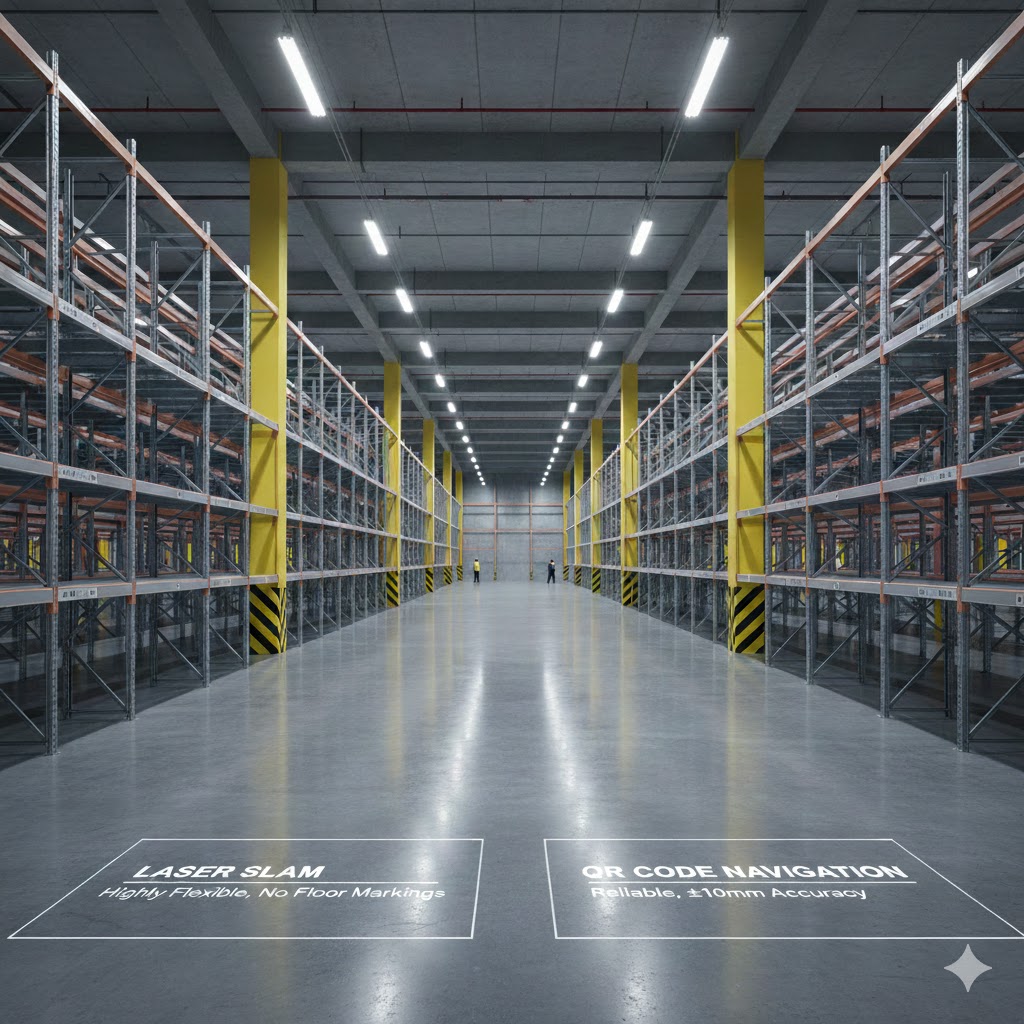
Laser SLAM (Simultaneous Localization and Mapping) and QR codes are both popular, but they serve different priorities.
Laser SLAM:
Pros: Highly flexible. It requires no physical floor markings or infrastructure; the robot "sees" walls and pillars to navigate. This makes it easy to change routes via software.
Cons: More expensive and computationally intensive. It can struggle in wide-open spaces with few "landmarks" or in environments where layouts change constantly (e.g., shifting stacks of pallets).
QR Code Navigation:
Pros: Extremely reliable and cost-effective. It offers very high positioning accuracy (often ±10mm) and works well in dark or dusty environments where lasers might fail.
Cons: Inflexible. Changing a route requires peeling up and re-sticking codes on the floor. The codes can also wear out or get obscured by debris, requiring regular maintenance.
Most AGVs require relatively flat, high-quality industrial floors to operate safely.
Tolerances: Standard AGVs often require floor flatness within ±1.5mm to ±3mm over a 3-meter span.
Risks: Uneven floors can cause the AGV’s safety laser to "see" the ground as an obstacle, triggering emergency stops. It also puts excessive wear on the hard wheels (usually polyurethane) and can lead to drive system failure.
Solutions: If your floors are uneven, you may need a vehicle with a suspension system or larger, pneumatic-style tires. For standard AGVs, "spot grinding" uneven areas is often necessary.
Stopping precision (also called docking accuracy) refers to how close the vehicle gets to its intended target.
Standard Accuracy: Most modern AGVs achieve ±10mm to ±30mm.
High Precision: Systems using laser reflectors or QR codes can reach ±5mm.
Mechanical Aids: If you need sub-millimeter precision (e.g., for high-precision robotic arms), it is common to use mechanical docking pins or V-groove plates at the workstation to physically lock the AGV into a dead-center position.
Yes, and it is becoming the industry standard for high-safety environments.
2D vs. 3D: Traditional 2D LiDAR only "sees" in a single horizontal plane (usually at ankle or knee height). It can miss obstacles above or below that plane, such as overhanging pallet forks or low-profile carts.
3D Capabilities: Using 3D LiDAR or Depth Cameras (TOF), the AGV creates a volumetric "view" of its surroundings. This allows it to detect obstacles at various heights, ensuring it won't crash into a hanging cable or a person crouching.
Availability: Most premium AGVs now offer 3D obstacle avoidance as a standard or optional upgrade. It is highly recommended if the AGV shares space with human workers or irregular equipment.





 Chinese
 English