


Choosing the right attachments allows an AGV to evolve from a simple "transporter" into a "versatile specialist" capable of complex tasks. Unlike manual forklifts, AGV attachments must account for sensor visibility, energy balance, and integrated control logic.
Here are the professional answers to your attachment selection queries:
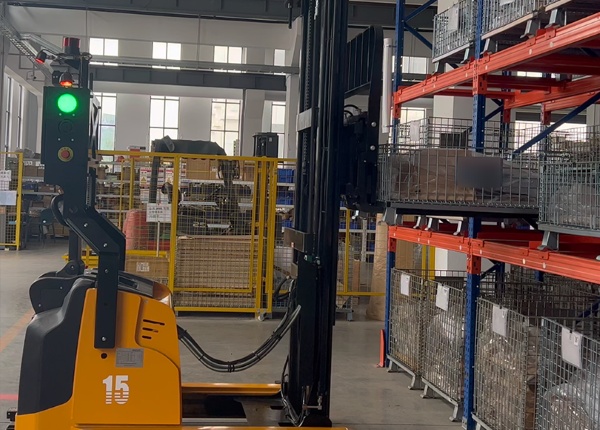
Yes, and it is highly recommended.
Error Tolerance: A side-shifter allows for horizontal adjustment (typically $\pm 100\text{mm}$), compensating for minor parking deviations of the AGV.
High-Level Stacking: For operations at heights above 10 meters, a side-shifter is essential to ensure forks enter pallet pockets precisely, reducing the risk of rack collisions.
Software Synergy: Your AGV control system must support side-shifting logic to automatically trigger physical adjustments when a shelf misalignment is detected.
Protection is achieved through multi-level "Perception + Physical" measures:
Active Clamping: For unstable loads (such as empty bottles or light cartons), a Top Press attachment can be added.
Anti-Slip Surfaces: Forks can be coated with wear-resistant anti-slip material, and a Load Backrest can be installed to prevent cargo from tilting backward during emergency stops.
Smart Monitoring: Integrated 3D vision or laser sensors monitor cargo displacement in real-time. If a shift in the center of gravity is detected, the system immediately slows down or triggers an emergency brake.
Yes, manufacturers offer mature, AGV-specific solutions.
Rotation Capabilities: These attachments typically support 360° rotation, allowing paper rolls to be stacked vertically or placed horizontally—ideal for the paper and printing industries.
Adaptive Pressure: To prevent crushing the roll or dropping it due to insufficient grip, advanced clamps feature digital pressure valves that automatically adjust clamping force based on material and weight.
Visual Centering: The AGV works with vision sensors to automatically locate the center of the roll for precise alignment.
This is the most critical technical point in selection.
Energy Challenges: Hydraulic attachments consume significant battery power. In 2026, many manufacturers are moving toward All-Electric Actuators to replace traditional hydraulics, extending battery life by over 15%.
Interface Consistency: If hydraulics are used, ensure the AGV’s central hydraulic pump station has reserved enough flow and multi-way valve interfaces.
Oil Safety: In food or pharmaceutical industries, verify that the hydraulic oil meets environmental standards and install leak-monitoring systems.





 Chinese
 English