


Actually, evaluating AGV battery life isn't just about reading a spec sheet—it’s about how it fits into your specific "rhythm" at the warehouse. Let’s break it down like we’re grabbing a coffee and talking shop.
Loo, if this were ten years ago, we’d be having a different conversation. But today? Lithium (LiFePO4) is usually the way to go for AGVs.
Here’s why: Lead-acid is cheap upfront, but it’s high-maintenance.
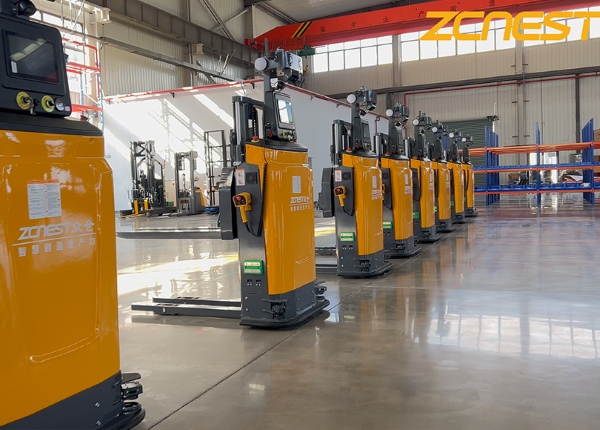
This is the "it depends" part, but typically, you’re looking at 8 to 12 hours of active run time for a standard setup.
But honestly, the "full charge" duration matters less than the Charging Ratio. Most modern AGVs aim for a 1:4 or 1:6 ratio. That means for every 1 hour of charging, you get about 4 to 6 hours of work. Instead of worrying about it lasting all day, most people set the AGV to go "snack" on electricity whenever it’s idle. That way, it basically never hits 0%.
You definitely want to check this before you buy. Most industrial AGVs run on 24V or 48V systems.
The real question is your wall power. Most fast chargers need a three-phase 380V or 480V input to really pump juice into the batteries quickly. If you only have standard 110V or 220V outlets available in certain areas, the charging will be painfully slow. Always make sure your facility’s electrical panel can handle the "draw" of a fast charger—it’s like plugging in a heavy-duty welder.
Yes, but with a caveat: The "Physical" vs. the "Digital."
The Physical: Most AGV batteries are modular. You can physically swap them out using a pallet jack or a small crane. If you buy a standard-sized battery, you can source a replacement from local industrial suppliers.
The Digital: This is where it gets tricky. The AGV’s computer needs to talk to the BMS (Battery Management System). If the new battery speaks a different "language" (CAN bus protocol), the AGV might refuse to move.
Pro Tip: If you want to stay local for replacements, ask the manufacturer for an "open BMS" or the specific communication protocol they use. That way, you aren’t locked into buying their branded batteries forever.











 Chinese
 English




