
 Chinese
 English

Step-by-Step Guide: Mastering Unmanned Forklifts for Material Handling (2026 Edition)
In the era of smart logistics, deploying an unmanned forklift (AGV/AMR) is not just about buying a machine—it is a fundamental restructuring of your warehouse logic. This guide takes you from initial planning to advanced operational stability.
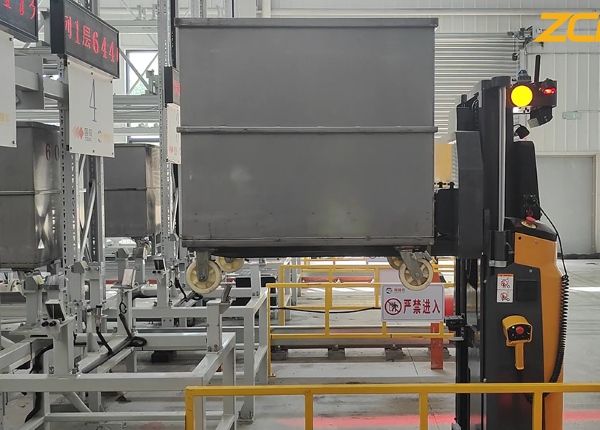
Phase 1: Precision Selection & Environment Auditing
The "Beyond" Factor: Don't just look at the forklift; audit the "Road" and the "Load."
Floor & Load Audit:
Flatness: Unmanned forklifts are extremely sensitive to floor gradients (usually requiring less than or equal to 3%).
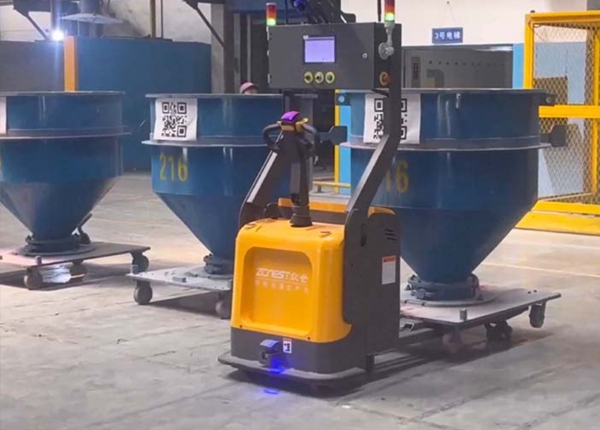
Attachment Matching: If your cargo is cylindrical or oversized, standard forks will cause center-of-gravity shifts. You must specify telescopic forks or side shifters.
Navigation Strategy:
Laser SLAM: Best for flexible lines where environments change; no floor markers needed.
Visual/Hybrid Navigation: In vast, empty "white wall" warehouses where laser points are sparse, hybrid systems prevent the robot from "getting lost."
Phase 2: The Five-Step Implementation
The "Beyond" Factor: Focus on "System Integration" rather than standalone operation.
Digital Twin Mapping: Technicians use LiDAR to scan the site, creating a 1:1 high-precision map defining paths, restricted zones, and one-way traffic.
WMS/MES Deep Integration: When the forklift drops a load, the Warehouse Management System must update in milliseconds to prevent task conflicts.
Precision Pose Recognition: In rack-picking, use vision sensors to identify pallet holes. Demand a docking accuracy within plus/minus 10mm to handle slightly skewed pallets.
Safety Fencing & Logical Zoning: Set dynamic speed zones (e.g., limiting speed to 0.5m/s in human-robot shared areas).
Grayscale Testing: Select a non-critical but representative route for a 2-week stress test before full deployment.
Phase 3: Handling Anomalies & Human-Robot Collaboration
The "Beyond" Factor: Addressing the "Hidden Truths" of production.
Pallet Quality Management: Unlike humans, robots cannot "make do" with broken pallets. Establish a pallet entry standard to prevent wood debris from tripping sensors.
Network Stability: Millisecond drops during Wi-Fi handovers cause "ghost stops." Consider 5G Private Networks or industrial-grade roaming Wi-Fi.
Interactive Protocols: Equip staff with wearable tags or use directional floor projection lights on forklifts so humans can predict the robot's next move.
Phase 4: Maintenance & Lifecycle Management
The "Beyond" Factor: Shifting from "Deployment" to "Continuous Operations."
Sensor Cleaning Schedule: LiDAR and obstacle sensors must be wiped daily with dedicated lint-free cloths. Dust is the number one cause of false alarms.
Battery Health Monitoring: Utilize "shallow charging" during idle gaps and perform a quarterly battery balance to extend lifespan by up to 30%.
Map Iteration: When racks move, use "Incremental Mapping" via the backend instead of rescanning the entire facility.
Summary: From Automation to Intelligence
The success of an unmanned forklift is not measured by its movement, but by its Autonomy: the ability to navigate around obstacles, lock safely during network failures, and optimize traffic flow.
Expert Tip: In your procurement contract, include a "Scenario Pass Rate" clause rather than just "Rated Speed."