


Dynamic Rerouting is a core capability in modern AGV systems that allows fleets to continuously adapt their paths based on real-time warehouse conditions such as obstacles, congestion, task priority changes, and battery constraints.
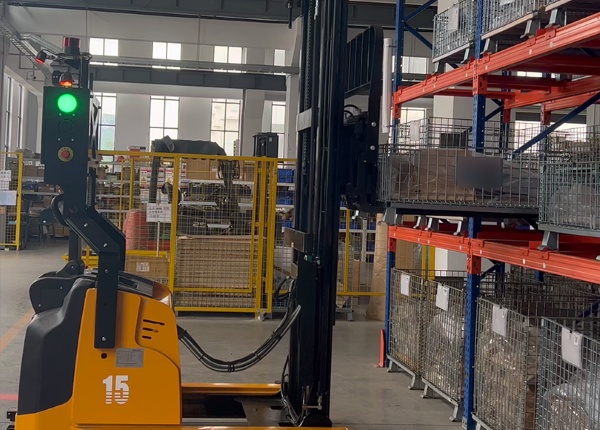
Dynamic Rerouting enables AGVs to automatically adjust navigation paths when the environment changes during operation.
Key capabilities to verify with your supplier include:
Real-time path recalculation based on live warehouse conditions
Obstacle detection integration (LiDAR, vision cameras, ultrasonic sensors)
Task prioritization logic (urgent vs. standard missions)
Energy-aware routing based on remaining battery capacity
Most Robot Control Systems (RCS) use a layered response strategy depending on how long an obstacle remains in the AGV’s path.
Short-term obstruction (< 30–60 seconds)
AGV slows down or stops
Sends alert to RCS dashboard
Medium-term obstruction (1–2 minutes)
Attempts dynamic rerouting via alternative paths
Logs blocked segment for system optimization
Long-term obstruction (5–10+ minutes)
Marks path as temporarily restricted
Waits for human intervention or route reallocation
Procurement Tip: Ask whether obstacle persistence thresholds are configurable per zone (high-traffic vs. low-traffic aisles).
A mature RCS maintains multiple route options in parallel and evaluates them in real time.
Primary route: fastest optimal path
Secondary route: slightly longer but unblocked alternative
Battery-aware route: optimized for remaining energy capacity
Before selecting a reroute, the system evaluates:
Estimated Time of Arrival (ETA)
Real-time congestion from other AGVs
Task priority level
Battery State of Charge (SOC)
Dynamic rerouting is tightly integrated with task scheduling systems.
Typical behaviors include:
High-priority shipments overriding routine tasks
Mid-route task switching for urgent orders
Automatic reassignment to available AGVs
Resume capability for interrupted tasks
Operators should have full visibility of priority overrides via the RCS dashboard.
Modern AGV systems incorporate battery intelligence into routing decisions to avoid mission failure.
Before rerouting, the system evaluates:
Remaining battery capacity (SOC)
Estimated energy consumption of alternative routes
Distance to nearest charging station
If battery constraints are detected, the system may:
Redirect AGV to charging station first
Assign task to another AGV
Delay execution until sufficient charge is available
Best Practice: Battery-aware routing significantly reduces mid-mission failures and improves fleet utilization efficiency.
| Feature | Verification Question |
|---|---|
| Obstacle Persistence | Can blockage thresholds be configured by time and zone? |
| Alternative Routing | Does the system calculate ETA for multiple route options? |
| Task Prioritization | Can urgent tasks override active missions in real time? |
| Battery Awareness | Does routing logic consider remaining SOC before execution? |
| System Logging | Are rerouting events recorded for analysis and KPI tracking? |
Dynamic rerouting is essential for high-density AGV operations
Obstacle persistence logic should be configurable by environment
Route selection must consider congestion, ETA, and battery level
Task prioritization improves warehouse responsiveness
Battery-aware logic prevents mission failure and downtime
Full visibility through RCS dashboards is critical for operations control
In modern warehouse automation, flexibility in routing logic is as important as hardware performance.
FREE ENGINEERING SUPPORT Stop Gambling on Generic Platforms. Get an AGV/AMR Tailored to Your Warehouse.Buying automated guided vehicles involves complex safety standards (CE/ANSI), navigation setups (Laser SLAM), and ERP system integration. Don't risk your factory safety with middle-men. ✓ 100% Direct Factory: Customized payload up to 5 Tons. ✓ Free CAD Simulation: Send us your layout, and our engineers will simulate the optimal AGV routes. ✓ Global Support: Overseas installation guidance & local maintenance partners. |





 Chinese
 English