


Understanding braking behavior and safe manual handling procedures is critical for warehouse safety, especially during power loss or emergency situations.
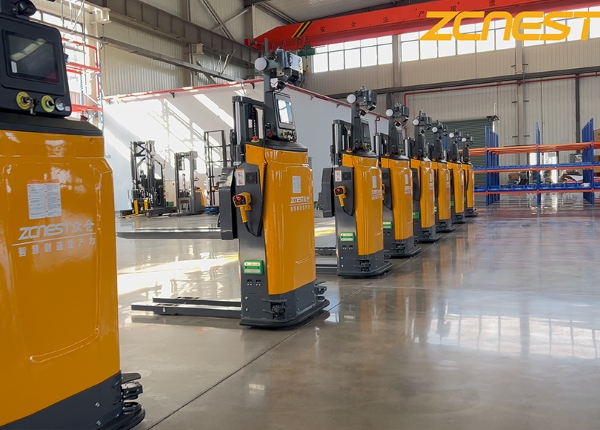
Braking distance depends on AGV weight, speed, floor surface, and brake type. Typical values for mid-sized China AGVs (1–2 ton payloads) are:
| AGV Speed | Load | Floor Type | Braking Distance |
|---|---|---|---|
| 1 m/s (~2.2 mph) | Empty | Epoxy | 0.5–0.7 m |
| 1 m/s | Full | Epoxy | 0.7–1.0 m |
| 2 m/s (~4.5 mph) | Full | Polished Concrete | 1.5–2.0 m |
Tip: Always request the manufacturer’s certified braking test report for your specific AGV model.
Most AGVs use fail-safe electromagnetic brakes: default state when power is lost is locked.
During normal operation, brakes are released via RCS commands.
Some models have dual-redundant brakes for heavy loads or critical lifts.
This prevents uncontrolled rolling in power-loss scenarios.
If an AGV loses all power and blocks an aisle:
Manual release lever: Unlock the brake via side panel or under-cover lever.
Tow bar: Use factory-supplied tow eye with forklift or hand trolley if allowed.
Powered cart: Another AGV or tug can reposition safely if protocols permit.
Important: Never attempt to roll an engaged brake manually—it may cause permanent damage.
Location: Side panel, battery compartment, or near caster wheels.
Operation: Mechanical lever or key turn; may require neutral mode or lock pin removal.
Documentation: Supplier must provide step-by-step instructions in the US user manual.
Even with electromagnetic brakes, epoxy, polished concrete, or wet floors increase skid risk.
Factors: AGV speed, load, tire material (polyurethane vs. rubber), floor slope.
Mitigation Strategies:
Reduce max speed in critical zones
Use high-friction tires
Regular brake inspection & adjustment
Optional: Floor traction mats in high-risk areas
Braking distance varies with speed, load, and floor type; always refer to manufacturer data.
Fail-safe electromagnetic brakes lock by default during power loss.
Manual brake release is critical for emergency aisle clearance.
Skid risk exists on smooth floors—mitigate with speed limits, tire choice, and floor traction improvements.
Train US staff on emergency procedures, including safe handling of dead AGVs.
FREE ENGINEERING SUPPORT Stop Gambling on Generic Platforms. Get an AGV/AMR Tailored to Your Warehouse.Buying automated guided vehicles involves complex safety standards (CE/ANSI), navigation setups (Laser SLAM), and ERP system integration. Don't risk your factory safety with middle-men. ✓ 100% Direct Factory: Customized payload up to 5 Tons. ✓ Free CAD Simulation: Send us your layout, and our engineers will simulate the optimal AGV routes. ✓ Global Support: Overseas installation guidance & local maintenance partners. |





 Chinese
 English