


Key Insight: 5G does not fundamentally change AGV safety or navigation logic. Instead, it improves communication consistency, fleet coordination, and system scalability in large deployments.
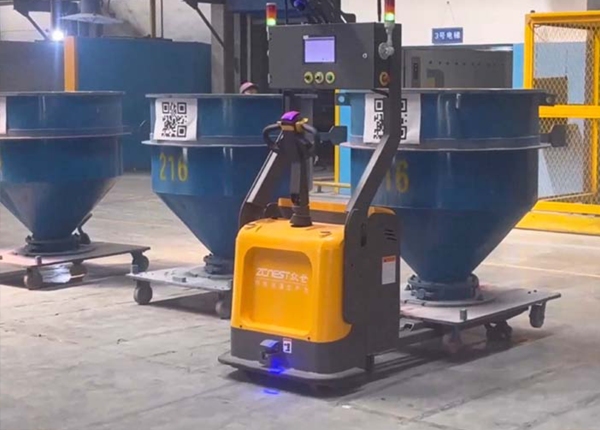
In modern AGV systems, communication supports three core functions:
Task dispatch between RCS and AGVs
Real-time telemetry updates
Multi-robot coordination in congested environments
5G improves predictability rather than raw speed.
Wi-Fi: ~20–200 ms (variable)
5G SA: ~10–30 ms (more stable)
Private 5G: highly deterministic under load
👉 The real advantage is consistency in communication latency.
Better handling of high device density
Improved fleet-wide coordination
Faster system-wide task updates
More stable congestion resolution in large warehouses
Important: Safety-critical functions (like obstacle avoidance and emergency braking) are always handled locally on the AGV, not via network communication.
AGV hardware support for 5G varies by vendor and model tier.
| Tier | Connectivity | Description |
|---|---|---|
| Tier 1 | Wi-Fi only | Basic AGV models with no cellular module |
| Tier 2 | Optional 4G/5G gateway | Industrial router with SIM slot integration |
| Tier 3 | Built-in 5G module | Dual connectivity: Wi-Fi + 5G redundancy |
Reality Check: Most deployments still rely on Wi-Fi as the primary network, with 5G used as backup or auxiliary communication.
Yes—but only in specific layers of the system.
RCS task dispatch consistency
Fleet congestion coordination
Remote monitoring dashboards
Cloud-based analytics updates
LiDAR-based obstacle avoidance
Emergency braking systems
Onboard safety zone triggers
Core Insight: 5G improves the coordination layer, not the safety layer.
Low upfront cost
Simple deployment
Variable indoor performance
Less control over latency and routing
Deterministic latency
Full traffic control
Better SLA for automation systems
Higher CAPEX and complexity
Industry Reality: Most warehouses still prefer Wi-Fi 6/6E due to cost efficiency and proven AGV compatibility.
No. Even with 5G, Wi-Fi remains essential in most AGV architectures.
Indoor localization support
Low-cost deployment
Existing warehouse infrastructure
Edge control dependencies
Primary: Wi-Fi 6 / 6E
Backup: 5G connectivity
Edge: Onboard LiDAR + local autonomy
Control: Central RCS system
Large-scale fleets (50–200+ AGVs)
Multi-warehouse operations
Outdoor + indoor hybrid logistics
AI-driven fleet optimization systems
High-density traffic environments
Small warehouses (
<20 agvs="">
Low-frequency logistics operations
Simple point-to-point transport systems
Wi-Fi 6 already stable deployments
5G improves coordination, not AGV safety logic
Most AGVs support 5G optionally, not as default architecture
Wi-Fi roaming design is still required in nearly all deployments
Private 5G is valuable only at large operational scale
What functions run over 5G vs Wi-Fi?
Is 5G required for safety-critical operations?
Can the system fully operate without 5G?
Is the system using private 5G or public SIM networks?
Final Insight: The real performance drivers in AGV systems are still RCS logic, warehouse layout, and fleet orchestration—not the communication network alone.
FREE ENGINEERING SUPPORT Stop Gambling on Generic Platforms. Get an AGV/AMR Tailored to Your Warehouse.Buying automated guided vehicles involves complex safety standards (CE/ANSI), navigation setups (Laser SLAM), and ERP system integration. Don't risk your factory safety with middle-men. ✓ 100% Direct Factory: Customized payload up to 5 Tons. ✓ Free CAD Simulation: Send us your layout, and our engineers will simulate the optimal AGV routes. ✓ Global Support: Overseas installation guidance & local maintenance partners. |





 Chinese
 English