


As warehouse automation evolves, many AGV suppliers now advertise "5G-ready" solutions. However, experienced procurement teams know that the real question is not whether an AGV supports 5G— it's what 5G actually improves inside a real warehouse operation.
Executive Summary
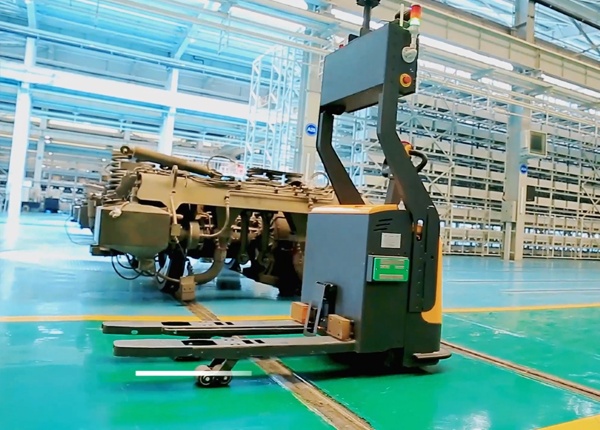
For most warehouses today, the optimal architecture remains:
Primary Network: Industrial Wi-Fi 6 / 6E
Secondary Network: Optional 5G backup or overlay
Local Intelligence: Onboard LiDAR and safety controller
Fleet Management: Centralized RCS platform
5G enhances fleet coordination—but it does not replace Wi-Fi or onboard safety processing.
Most Chinese AGV manufacturers offer 5G capability as an optional configuration rather than a standard feature.
Typical export models continue to use industrial Wi-Fi as the primary communication method, while 5G serves as a future-proof expansion option.
Before signing a contract, request documentation confirming:
Industrial 5G communication module
Integrated SIM slot configuration
Supported frequency bands
Compatibility with US 5G bands (n41, n77, n78)
Procurement Tip:
Don't simply ask, "Does it support 5G?"
Ask instead:
"Can you provide the industrial 5G module specification and US carrier compatibility sheet?"
Yes—but mainly at the fleet management layer.
Typical communication latency comparison:
| Network Type | Typical Latency | Operational Impact |
|---|---|---|
| Traditional Wi-Fi | 20–200 ms | Variable under congestion |
| 5G Standalone | 10–30 ms | More stable and predictable |
| Private 5G | Ultra-low deterministic latency | Best for enterprise-scale automation |
Lower latency primarily benefits:
Task dispatch from RCS
Dynamic rerouting
Traffic congestion management
Fleet-wide status synchronization
Reality Check:
Emergency braking, obstacle detection, and LiDAR processing are all executed locally on the AGV.
5G does not make the robot physically stop faster.
It simply allows the fleet management system to coordinate robots more efficiently.
The answer depends largely on fleet size and operational complexity.
| Deployment Option | Advantages | Limitations |
|---|---|---|
| Public 5G (Carrier SIM) | Easy deployment, lower cost | Indoor coverage may vary |
| Private 5G Network | Guaranteed latency, bandwidth prioritization, full control | Higher CAPEX and telecom expertise required |
Private 5G becomes increasingly attractive for:
50+ AGV fleets
Multi-floor warehouses
Campus-wide logistics operations
Mixed indoor/outdoor transportation routes
No.
Despite marketing claims, modern AGV systems still depend heavily on industrial Wi-Fi.
Wi-Fi remains responsible for:
High-frequency telemetry
Local AGV communications
Sensor data exchange
Network redundancy
Localization support
In most real-world deployments, 5G functions as a backup network or fleet coordination overlay rather than a complete replacement.
Best Practice:
Most enterprise warehouses currently operate using:
Wi-Fi 6 / 6E as the primary network
Optional 5G backup connectivity
Onboard autonomous safety logic
Centralized RCS fleet orchestration
| Area | 5G Benefit | Practical Limitation |
|---|---|---|
| Fleet Coordination | Lower latency and smoother rerouting | Safety logic remains onboard |
| Large AGV Fleets | Handles higher device density | Requires private network investment |
| Wi-Fi Congestion | Can reduce network pressure | Does not eliminate AP planning |
| Emergency Stops | Minimal impact | Processed locally by AGV controller |
Which functions run over 5G and which rely on Wi-Fi?
Can the AGV continue operating if the 5G connection is lost?
Is 5G used for safety functions or only fleet coordination?
Does the system support private 5G deployment?
Can the supplier provide US-band compatibility documentation?
When a supplier says:
"Our AGVs support 5G."
The real evaluation criteria should be:
How does 5G improve operational efficiency?
Can the warehouse still operate without it?
Is the architecture designed around reliability rather than marketing?
For most B2B warehouse projects today, the winning strategy is not replacing Wi-Fi with 5G.
It is combining a well-designed Wi-Fi infrastructure with optional 5G redundancy to maximize uptime, scalability, and long-term operational stability.
FREE ENGINEERING SUPPORT Stop Gambling on Generic Platforms. Get an AGV/AMR Tailored to Your Warehouse.Buying automated guided vehicles involves complex safety standards (CE/ANSI), navigation setups (Laser SLAM), and ERP system integration. Don't risk your factory safety with middle-men. ✓ 100% Direct Factory: Customized payload up to 5 Tons. ✓ Free CAD Simulation: Send us your layout, and our engineers will simulate the optimal AGV routes. ✓ Global Support: Overseas installation guidance & local maintenance partners. |











 Chinese
 English




