


As AGV deployments scale from a few robots to dozens or even hundreds of vehicles, warehouse traffic management becomes far more complex than simple point-to-point navigation.
Modern Robot Control Systems (RCS) must coordinate multiple operational areas, manage traffic flow, control access to restricted environments, and ensure safe interaction between AGVs, forklifts, and pedestrians.
This article explains how advanced AGV fleet management systems handle cross-zone operations, traffic control, Wi-Fi roaming, and access permissions in large-scale facilities.
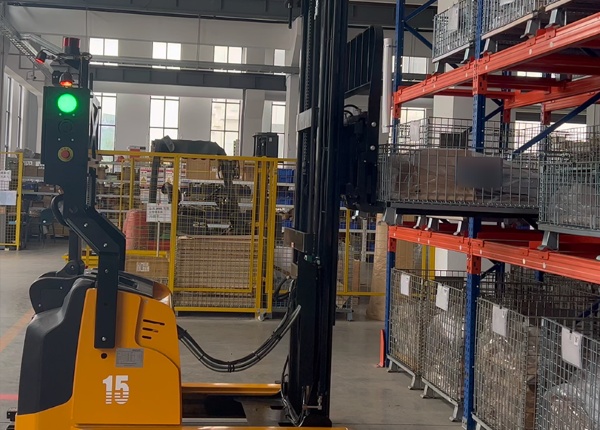
Large warehouses are typically divided into operational zones:
Receiving Zone
↓
Storage Zone
↓
Production Zone
↓
Cold Storage Zone
↓
Shipping Zone
Instead of allowing AGVs to move freely between areas, the RCS manages:
Task ownership
Route reservations
Traffic congestion control
Cross-zone task handoff
Resource allocation
Before entering a new zone, the AGV typically requires:
Available route confirmation
Destination availability
Zone access authorization
Safety condition verification
Only after all requirements are satisfied will the RCS authorize movement.
Cold storage facilities and clean rooms usually operate under strict environmental and access requirements.
Modern AGV systems use permission-based workflows.
AGV Arrives at Door
↓
RCS Requests Access
↓
PLC Verifies Conditions
↓
Door Unlocks
↓
AGV Enters
↓
Door Closes Automatically
Temperature control active
Door status confirmed
No conflicting vehicle traffic
Zone reservation successful
Airlock sequence completed
Contamination protocols verified
Occupancy limits respected
Environmental conditions validated
The AGV typically never controls the room directly.
AGV → RCS → PLC → Door / Clean Room System
Many manufacturing facilities require AGVs to share space with human workers.
Modern RCS platforms can integrate with:
Traffic lights
Warning beacons
Audio alarms
Pedestrian gates
Safety barriers
AGV Approaches Crossing
↓
RCS Reserves Intersection
↓
Pedestrian Signal Turns Red
↓
AGV Crosses Safely
↓
Crossing Released
↓
Pedestrian Traffic Resumes
Advanced systems support:
Dynamic crossing priorities
Queue management
Multi-AGV coordination
Peak-hour congestion control
A properly designed industrial wireless network allows seamless roaming between access points.
Recommended technologies include:
802.11r Fast Roaming
802.11k Neighbor Reports
802.11v Network Steering
When configured correctly, AGVs continue operating without interruption.
| Communication Status | Typical AGV Behavior |
|---|---|
| 1–5 Seconds | Continue movement using onboard map and reconnect automatically |
| 5–30 Seconds | Complete current motion segment and pause safely |
| Extended Loss | Enter controlled stop mode and wait for reconnection |
Important procurement question:
How long can the AGV continue operating autonomously after losing communication with the RCS?
Yes. One-way routing is one of the most effective ways to improve fleet throughput.
Aisle 1 → Eastbound Only
Aisle 2 → Westbound Only
Cross Aisle → Bidirectional
Benefits include:
Reduced traffic conflicts
Shorter waiting times
Higher fleet utilization
More predictable routing
| Rule Type | Example |
|---|---|
| One-Way Traffic | Single-direction aisle movement |
| Time-Based Rules | AGV priority during daytime shifts |
| Vehicle-Specific Lanes | Stacker AGVs only |
| Forklift Restrictions | No manual vehicles allowed |
| Speed-Control Zones | Pedestrian crossings limited to 0.5 m/s |
When comparing Chinese AGV fleet management systems, look for the following capabilities:
| Feature | Purpose |
|---|---|
| Zone Reservation | Prevents multiple AGVs entering critical areas simultaneously |
| Deadlock Prevention | Avoids robots blocking each other |
| Dynamic Rerouting | Automatically selects alternative routes during congestion |
| Priority Queue Management | Prioritizes urgent production tasks |
| Multi-Floor Coordination | Manages elevators and floor transitions |
Multi-floor warehouses require close coordination between AGVs, elevators, and destination zones.
Zone A
↓
Elevator Reservation
↓
Destination Zone Reservation
↓
AGV Dispatch
The RCS typically reserves both the elevator and the destination area before movement begins, preventing congestion and reducing waiting times.
Experienced buyers should request detailed information on:
Maximum number of supported zones
Maximum simultaneous route reservations
One-way traffic management capabilities
Traffic light and PLC integration support
Deadlock prevention methodology
Wi-Fi roaming and communication loss behavior
Cross-zone task handoff logic
Cold-room and clean-room integration experience
Elevator and fire-door integration references
As AGV fleets scale, navigation accuracy alone is no longer enough. The true performance differentiator becomes the intelligence of the Robot Control System (RCS).
A modern RCS should provide:
Cross-zone coordination
Traffic management
Permission-based access control
Wi-Fi resilience
Deadlock prevention
Dynamic rerouting
Multi-floor automation support
For large warehouses, manufacturing plants, pharmaceutical facilities, and cold-storage operations, these capabilities often have a greater impact on productivity than AGV hardware specifications alone.
FREE ENGINEERING SUPPORT Stop Gambling on Generic Platforms. Get an AGV/AMR Tailored to Your Warehouse.Buying automated guided vehicles involves complex safety standards (CE/ANSI), navigation setups (Laser SLAM), and ERP system integration. Don't risk your factory safety with middle-men. ✓ 100% Direct Factory: Customized payload up to 5 Tons. ✓ Free CAD Simulation: Send us your layout, and our engineers will simulate the optimal AGV routes. ✓ Global Support: Overseas installation guidance & local maintenance partners. |





 Chinese
 English