


Safety sensors are the first line of defense between an AGV and warehouse personnel. When evaluating a Chinese AGV supplier, buyers should look beyond marketing materials and focus on the actual functional safety architecture used on the vehicle.
A complete safety review should cover:
Safety laser scanners
Safety PLC systems
Emergency stop circuitry
Safety bumpers
Risk assessment documentation
Functional safety validation records
Understanding these elements before purchase can help reduce operational risks and simplify compliance reviews later.
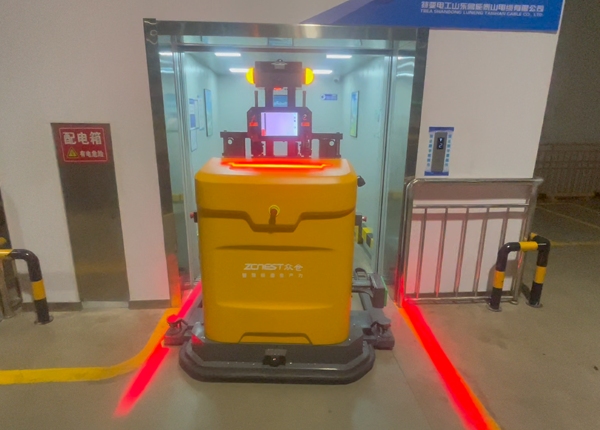
Many export-oriented AGV manufacturers integrate internationally recognized safety components from established suppliers.
Common brands include:
SICK
Pepperl+Fuchs
Keyence
Omron
Leuze
When reviewing a supplier, request:
Scanner manufacturer
Scanner model number
Product datasheets
Safety certification documents
Electrical integration drawings
The scanner model should appear on the official Bill of Materials (BOM), not just in sales presentations.
The actual detection range depends on:
Scanner specifications
Vehicle speed
Load weight
Warehouse environment
Safety field configuration
Typical safety field settings include:
| Safety Zone | Typical Range |
|---|---|
| Emergency Stop Zone | 0.3–1.5 m |
| Warning Zone | 1–3 m |
| Reduced Speed Zone | 3–8 m |
| Extended Detection Zone | Up to 10–20 m |
Modern AGVs often adjust safety zones automatically.
When stationary:
Smaller protection area
Reduced operating footprint
When moving at higher speed:
Larger safety field
Earlier obstacle detection
Increased stopping distance allowance
Always request actual safety field drawings rather than relying on generic specifications.
Many AGV buyers encounter terms such as Category 3 and Category 4 but are unsure of the differences.
Commonly used for:
Autonomous pallet trucks
Stacker AGVs
Standard warehouse AGVs
Features include:
Redundant safety channels
Continuous fault monitoring
Reliable protection for most warehouse applications
Typically used for:
High-speed AGVs
Heavy-load vehicles
Automotive manufacturing environments
High-risk industrial facilities
Provides:
Higher fault tolerance
Enhanced diagnostic coverage
Greater protection against safety system failures
Before purchase, request confirmation of:
Safety category level
Achieved Performance Level (PL)
Safety PLC model
Risk assessment documentation
Avoid accepting claims without supporting technical evidence.
A properly engineered AGV should never depend on a single front-facing scanner.
Modern systems typically use multiple protection layers.
Typical configuration includes:
Front safety scanner
Rear safety scanner
Side protection fields
Corner monitoring zones
When a person enters a warning zone, the AGV may:
Reduce speed
Activate audible alarms
Trigger visual warning indicators
When a person enters the safety protection zone, the AGV should:
Execute a safety stop
Disable drive motion
Require a controlled restart procedure
One common misconception is that AGVs can stop instantly.
Actual stopping distance depends on:
Vehicle speed
Payload weight
Floor surface conditions
Brake performance
Safety scanner configuration
For this reason, safety field settings must be calculated based on real operating conditions rather than theoretical values.
Ask suppliers for documented stopping-distance calculations at maximum operating speed.
Safety bumpers act as secondary protection if an object reaches the vehicle before the laser scanner stops it.
Check:
Physical condition
Mounting integrity
Cable protection
Damage indicators
Apply controlled pressure to the bumper and verify:
Motion stops immediately
Safety alarms activate
Fault events are recorded
After activation:
Remove obstruction
Reset safety circuit
Confirm restart follows approved procedures
Professional AGV suppliers should be able to provide a complete safety package.
Risk Assessment Report
Safety Circuit Diagram
Safety PLC Documentation
Emergency Stop Architecture
Laser Scanner Certificates
Safety Component Certifications
Functional Safety Validation Reports
Factory Acceptance Test (FAT) Reports
Safety Verification Records
Stopping Distance Validation Reports
Consider additional due diligence if a supplier:
❌ Cannot identify the safety scanner manufacturer
❌ Refuses to provide safety documentation
❌ Cannot explain stopping-distance calculations
❌ Has no documented risk assessment process
❌ Uses non-certified industrial sensors in safety applications
These are often indicators of an immature safety engineering process.
Before placing an order, ask suppliers:
What laser scanner brand and model is installed?
What safety PLC is used?
Which safety certifications are available?
What is the maximum detection range?
What Performance Level (PL) is achieved?
What is the validated stopping distance?
Can safety field maps be provided?
How are blind spots protected?
How is bumper functionality tested during FAT?
When comparing Chinese AGV suppliers, focus on documented safety performance rather than marketing claims.
A qualified supplier should be able to demonstrate:
✔ Certified safety laser scanners
✔ Formal risk assessment reports
✔ Category 3 or Category 4 safety architecture
✔ Documented stopping-distance calculations
✔ FAT and SAT safety validation procedures
✔ Complete functional safety documentation
The safest AGV is not necessarily the one with the most sensors—it is the one with a properly engineered, validated, and documented safety system that matches your warehouse environment, vehicle speed, and operational requirements.
FREE ENGINEERING SUPPORT Stop Gambling on Generic Platforms. Get an AGV/AMR Tailored to Your Warehouse.Buying automated guided vehicles involves complex safety standards (CE/ANSI), navigation setups (Laser SLAM), and ERP system integration. Don't risk your factory safety with middle-men. ✓ 100% Direct Factory: Customized payload up to 5 Tons. ✓ Free CAD Simulation: Send us your layout, and our engineers will simulate the optimal AGV routes. ✓ Global Support: Overseas installation guidance & local maintenance partners. |





 Chinese
 English