


When evaluating AGV forklifts—especially reach trucks and counterbalanced models—the most common mistake buyers make is assuming:
Rated load = safe operating load
In reality, structural safety depends on stability engineering, mast dynamics, hydraulic protection, and load moment control, not just nominal tonnage.
A proper evaluation should follow industrial forklift engineering standards, not light robotics assumptions.
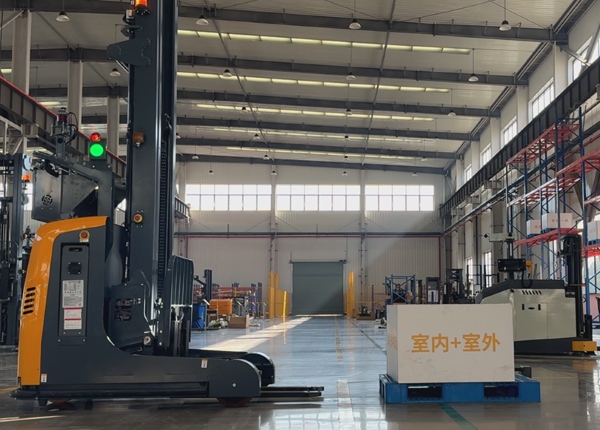
Applies to:
Mast frame
Fork carriage
Chassis structure
Typical engineering safety factor:
1.5× – 2.5×
Meaning:
A 1.5-ton AGV should withstand approximately 2.25T – 3.75T equivalent static stress
During real operation, forces increase due to:
Acceleration
Emergency braking
Turning with load
Lifting/lowering transitions
Typical dynamic multiplier:
1.2× – 2.0×
➡ In real conditions, structural load can temporarily approach 2× rated load
For reach trucks, the main failure risk is not vertical load—but tipping moment (torque).
You must verify:
Rated load moment (kg·m / Nm)
Load center vs mast extension curve
Deflection at maximum height
Industry expectation:
1.3× – 1.6× stability margin at maximum lift height
Hydraulic systems must exceed working pressure by design:
Working vs burst pressure ratio: 3:1 – 4:1
Key components:
Lift cylinders
Tilt cylinders
Hydraulic hoses
Valve block system
A compliant AGV mast system should provide verified stability documentation, including:
Static load tilt test results
Load moment curve analysis
Full extension deflection test
Finite Element Analysis (FEA) report
Maximum lift height
Rated load + overload conditions
Full mast extension
Worst-case load offset
“What is the residual stability margin at maximum lift height with maximum load eccentricity?”
⚠️ If no load stability chart is available, this is a major red flag.
Industrial AGV forklifts typically follow:
Static pressure margin: 2.5× – 4×
Burst pressure margin: up to 4× working pressure
Pressure relief valves
Load-holding valves
Counterbalance valves
Over-center protection
These prevent uncontrolled mast movement during failure.
A properly designed AGV should respond as follows:
Pressure drop detected
Load-holding valve isolates cylinder
Spring-applied brakes engage
Vehicle stops immediately
Fault alarm triggered
You must confirm:
Load-holding valves installed on lift cylinders
Spring-applied fail-safe braking system
Pressure monitoring redundancy
⚠️ Not all low-cost systems implement full redundancy.
Tipping risk is managed through real-time stability control, not mechanical strength alone.
The system continuously tracks:
Center of gravity (CG)
Load position
Mast angle
Vehicle acceleration
If instability is detected:
Speed is reduced
Lift height is restricted
Turning radius is limited
Advanced AGVs use:
Load sensors
Mast encoders
Tilt sensors
to calculate real-time stability margin.
Automatic deceleration in curves
Lift restriction during movement
Speed limitation at high mast height
Emergency stop if thresholds are exceeded
System can only mitigate risk, not correct improper loading:
Reduced acceleration
Controlled steering curves
Load-aware speed limits
Be cautious if the supplier cannot provide:
❌ Load stability curve (height vs load center)
❌ Hydraulic pressure safety documentation
❌ FEA or structural simulation report
❌ Brake fail-safe architecture details
❌ Load moment monitoring explanation
❌ Hydraulic failure response logic
What is the stability margin at full lift height?
What is the maximum allowable load center deviation?
What is the cylinder burst safety factor?
Are load-holding valves installed on all lift cylinders?
Are brakes spring-applied fail-safe type?
What happens during hydraulic pressure loss?
Does the AGV reduce speed based on mast height?
Does it detect load imbalance in real time?
Structural safety in AGV forklifts is defined by system-level engineering integrity, not just rated capacity or steel strength.
A properly engineered AGV should demonstrate:
✔ Verified static + dynamic load margins
✔ Complete mast stability curve at maximum height
✔ Hydraulic fail-safe protection system
✔ Spring-applied emergency braking
✔ Real-time load moment monitoring
✔ Integrated anti-tip control logic
FREE ENGINEERING SUPPORT Stop Gambling on Generic Platforms. Get an AGV/AMR Tailored to Your Warehouse.Buying automated guided vehicles involves complex safety standards (CE/ANSI), navigation setups (Laser SLAM), and ERP system integration. Don't risk your factory safety with middle-men. ✓ 100% Direct Factory: Customized payload up to 5 Tons. ✓ Free CAD Simulation: Send us your layout, and our engineers will simulate the optimal AGV routes. ✓ Global Support: Overseas installation guidance & local maintenance partners. |





 Chinese
 English