


VDA 5050 is an open communication standard designed to enable interoperability between different AGV/AMR brands under a unified fleet management system.
It allows:
Multi-brand AGV coordination
Centralized task dispatching
Standardized vehicle status communication
📥 "Planning to automate your warehouse? Send us a simple layout sketch or channel dimensions, and our engineers will design a FREE AGV Route Simulation for you."
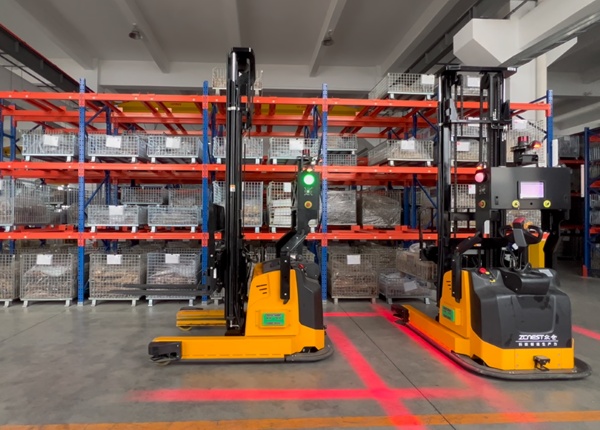
Automotive manufacturing plants
Large-scale intralogistics systems
Multi-vendor AMR deployments
Standardized warehouse automation projects
✔ Unified fleet control
✔ Standardized communication
✔ Vendor-neutral orchestration capability
Yes — but implementation levels vary significantly.
Chinese AGV suppliers generally fall into three categories:
This is the most advanced implementation level.
Native JSON / MQTT VDA message structure
Direct integration with European master systems
No protocol translation required
Validated interoperability in real projects
✔ True plug-and-play interoperability
✔ Minimal integration complexity
✔ Highest stability in mixed fleets
Automotive OEM factories
European-standard logistics systems
Large-scale multi-vendor environments
This is the mainstream implementation in China.
VDA 5050 Master System
        │
        ▼
Middleware / Gateway Layer
        │
        ▼
Chinese RCS Internal Protocol
        │
        ▼
AGV Fleet
Converts VDA 5050 commands into internal AGV protocol
Acts as a translation layer between systems
Enables partial interoperability
✔ Practical and widely deployable
✔ Lower implementation cost
✔ Flexible integration approach
⚠ Some advanced fleet functions may not map perfectly
⚠ Behavior consistency depends on vendor design
Some suppliers claim VDA 5050 compatibility but only provide basic functionality.
Basic task execution only
Simplified status reporting
No real multi-vendor validation
❌ Not suitable for real mixed fleets
❌ Limited interoperability
❌ No standardized traffic coordination
Yes — if proper integration is implemented.
VDA 5050 protocol (preferred)
REST API interface
MQTT message bus
OPC UA industrial gateway
Custom middleware layer
✔ External task control capability
✔ Real-time status reporting
✔ Standard coordinate system alignment
✔ Fleet-level command override support
          VDA 5050 Master System
                 │
   ┌─────────────┼─────────────┐
   ▼             ▼             ▼
Chinese AGVs   European AMRs   US Robots
This is the preferred architecture for enterprise-scale deployments.
Even with VDA 5050, full standardization is not guaranteed.
Right-of-way rules vary
Intersection handling differs
Congestion behavior is not standardized
Acceleration/deceleration curves differ
Turning behavior varies
Load response is inconsistent across vendors
Different obstacle response strategies
Different emergency stop behaviors
VDA 5050 does NOT fully define:
Battery management strategies
Charging logic
Advanced SLAM behavior
Predictive routing algorithms
VDA 5050 support is typically offered in three ways:
Included in premium enterprise packages (rare)
Optional software module license (common)
Custom integration project (most common)
Fleet size
Depth of protocol implementation
Multi-vendor integration complexity
Is VDA 5050 native or gateway-based?
Which version of VDA 5050 is supported?
Has interoperability been tested in real deployments?
Which third-party robots have been integrated?
Do you have live multi-vendor reference projects?
Can the system act as master or slave?
Is VDA 5050 a paid module?
Is licensing per robot or per system?
Are updates included?
Be cautious if a supplier:
❌ Claims VDA 5050 support without technical documentation
❌ Has no real multi-vendor case studies
❌ Only provides demo-level integration
❌ Cannot explain message structure or protocol behavior
❌ Requires full payment before sharing interface details
❌ Has no experience with European fleet systems
VDA 5050 adoption in Chinese AGV systems is:
✔ Widely supported
✔ Uneven in maturity
✔ Often implemented via middleware rather than native integration
VDA 5050 standardizes communication, but it does NOT standardize:
Traffic intelligence
Safety logic
Fleet optimization behavior
📥 "Planning to automate your warehouse? Send us a simple layout sketch or channel dimensions, and our engineers will design a FREE AGV Route Simulation for you."
The real evaluation question is not:
“Do you support VDA 5050?”
But:
“Can your system operate reliably in a real-world multi-vendor warehouse environment at scale?”





 Chinese
 English