


Very Narrow Aisle (VNA) automation is one of the most challenging applications in warehouse robotics.
When importing AGV forklifts from China, buyers often ask:
Can automated stackers safely operate in extremely narrow aisles?
What is the minimum aisle width requirement?
How high can they lift safely at full load?
Which navigation technology is suitable for deep racking?
How is pallet scanning ensured at 10-meter height?
The answer is not a simple specification—it depends on system design, navigation architecture, and structural stability engineering.
📥 "Planning to automate your warehouse? Send us a simple layout sketch or channel dimensions, and our engineers will design a FREE AGV Route Simulation for you."
Standard warehouse AGVs are NOT suitable for VNA environments.
A proper VNA AGV forklift must include:
High-precision steering control
Mast stability reinforcement
Tight navigation tolerance (±10–20 mm)
Rack-aware positioning logic
Anti-sway load control
VNA automation is not about “driving in narrow space”—it is about:
Maintaining millimeter-level positioning accuracy at height under dynamic load conditions
| System Type | Minimum Aisle Width |
|---|---|
| Standard reach truck AGV | 3.2 – 3.8 m |
| Narrow aisle AGV forklift | 2.8 – 3.2 m |
| VNA dedicated AGV system | 1.8 – 2.2 m |
Minimum aisle width depends on:
Pallet size (e.g. 1200×1000 mm or 48×40 inch)
Turning radius of the AGV
Mast swing tolerance
Rack clearance safety margin
Navigation accuracy (SLAM or guided system)
In real VNA deployments, aisle width is not only a vehicle parameter—it is a combined system design between AGV + racking + navigation precision.
| AGV Type | Safe Lift Height |
|---|---|
| Standard AGV forklift | 3 – 6 m |
| Narrow aisle AGV | 6 – 10 m |
| VNA reach truck AGV | 8 – 12+ m |
At high lift levels, performance depends on:
Mast rigidity
Load moment control
Center of gravity monitoring
Floor flatness (FF/FL rating)
Dynamic braking behavior
The higher the lift, the more critical lateral stability becomes—not vertical load capacity.
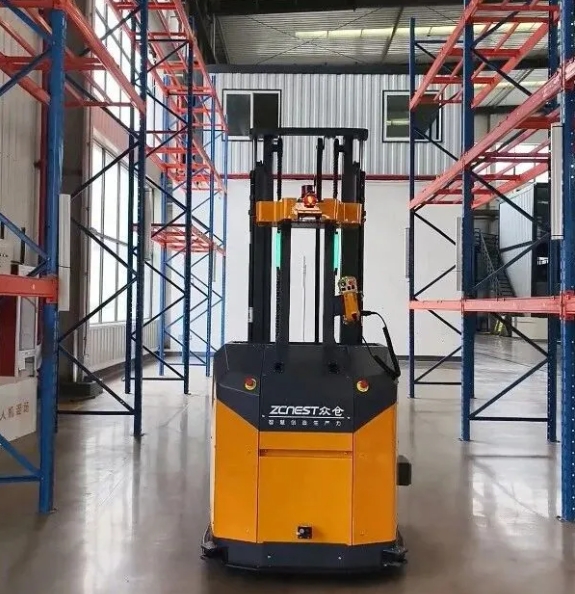
Most modern VNA AGVs use:
No infrastructure required
Dynamic path adjustment
Suitable for flexible warehouses
Very high repeatability
Ideal for fixed-layout VNA warehouses
Requires reflector installation
SLAM + reflectors + IMU fusion
Used in high-precision deep-rack environments
Magnetic wire guidance is largely obsolete in modern Chinese VNA AGV deployments.
The AGV confirms:
Rack slot ID
X/Y alignment accuracy
Fork positioning centerline
Load target confirmation
During lift:
Encoder-based mast height tracking
Anti-sway algorithm activation
Load tilt compensation control
At 10-meter height, systems use:
Industrial barcode scanners (long-range)
Vision AI cameras with zoom optics
Laser position confirmation (rack reference points)
A valid pick/drop requires:
Slot ID match
Pallet ID match
Position tolerance within range
No mast instability detected
If any parameter deviates, the system stops before load release.
Even a 5–10 cm error can cause:
Rack collision
Navigation instability
Reduced throughput
VNA AGVs require:
High floor precision (FF/FL compliance)
Minimal slope variation
Stable load distribution
At 8–12 meters:
Small acceleration = large load swing
Turning speed must be restricted
Emergency braking logic must be softened
At high racks:
Barcode visibility decreases
Lighting conditions affect accuracy
Dust or reflection can reduce scan reliability
What is positioning accuracy in VNA mode?
Is navigation SLAM or reflector-based?
How is drift corrected in narrow aisles?
What is maximum safe lift height under full load?
How is mast sway controlled at 10m?
What is the stability safety margin?
What is the minimum required aisle width?
What pallet sizes are supported?
What floor flatness standard is required?
What scanners are used for high-level racks?
Can the system read damaged or angled labels?
Is vision AI included?
Be cautious if a supplier:
❌ Claims VNA operation without specifying aisle width
❌ Cannot provide lift stability data
❌ Uses only “standard reach truck design” for deep racks
❌ Has no high-lift reference projects
❌ Cannot explain scanning logic at height
❌ Uses outdated magnetic wire guidance claims
📥 "Planning to automate your warehouse? Send us a simple layout sketch or channel dimensions, and our engineers will design a FREE AGV Route Simulation for you."
Safe deployment of AGV forklifts in very narrow aisle environments requires system-level engineering, not just a narrow chassis design.
A proper Chinese VNA AGV solution should include:
✔ High-precision SLAM or hybrid navigation
✔ Dedicated mast stability engineering
✔ Tight aisle positioning control (±10–20 mm)
✔ High-lift load swing suppression
✔ Multi-layer pallet scanning system
✔ Floor and rack compatibility validation
✔ Proven VNA warehouse case studies
FREE ENGINEERING SUPPORT Stop Gambling on Generic Platforms. Get an AGV/AMR Tailored to Your Warehouse.Buying automated guided vehicles involves complex safety standards (CE/ANSI), navigation setups (Laser SLAM), and ERP system integration. Don't risk your factory safety with middle-men. ✓ 100% Direct Factory: Customized payload up to 5 Tons. ✓ Free CAD Simulation: Send us your layout, and our engineers will simulate the optimal AGV routes. ✓ Global Support: Overseas installation guidance & local maintenance partners. |





 Chinese
 English