

As warehouse operators continue to maximize storage density, double-deep pallet racking has become a popular solution across manufacturing, 3PL logistics, cold storage, and distribution centers.
However, when companies evaluate AGV forklifts from China, one question frequently arises:
Can an autonomous forklift reliably store and retrieve pallets from the second position of a double-deep rack?
The answer is yes—provided that the AGV system is specifically engineered for double-deep storage applications.
This article explains how modern Chinese AGV forklift manufacturers solve the key technical challenges involved in double-deep warehouse operations.
📥 "Planning to automate your warehouse? Send us a simple layout sketch or channel dimensions, and our engineers will design a FREE AGV Route Simulation for you."
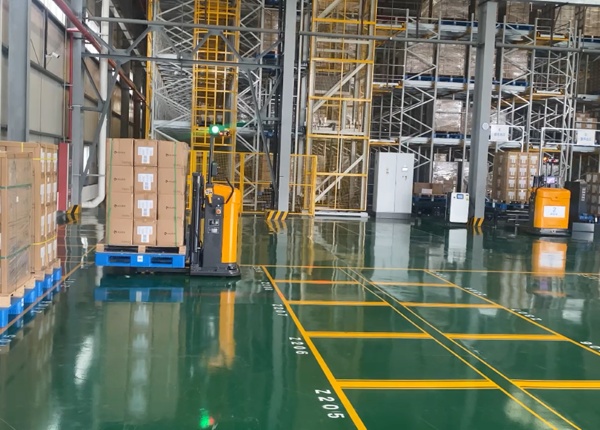
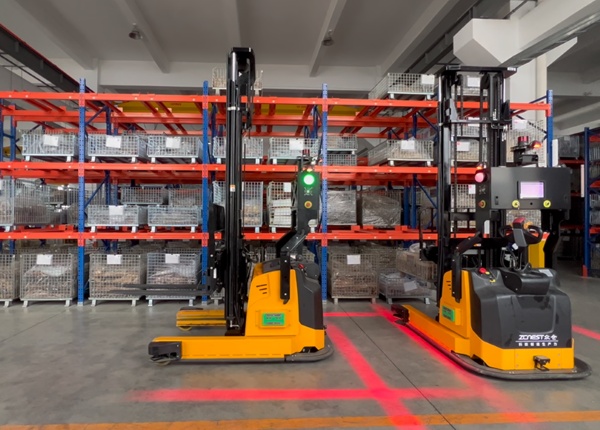
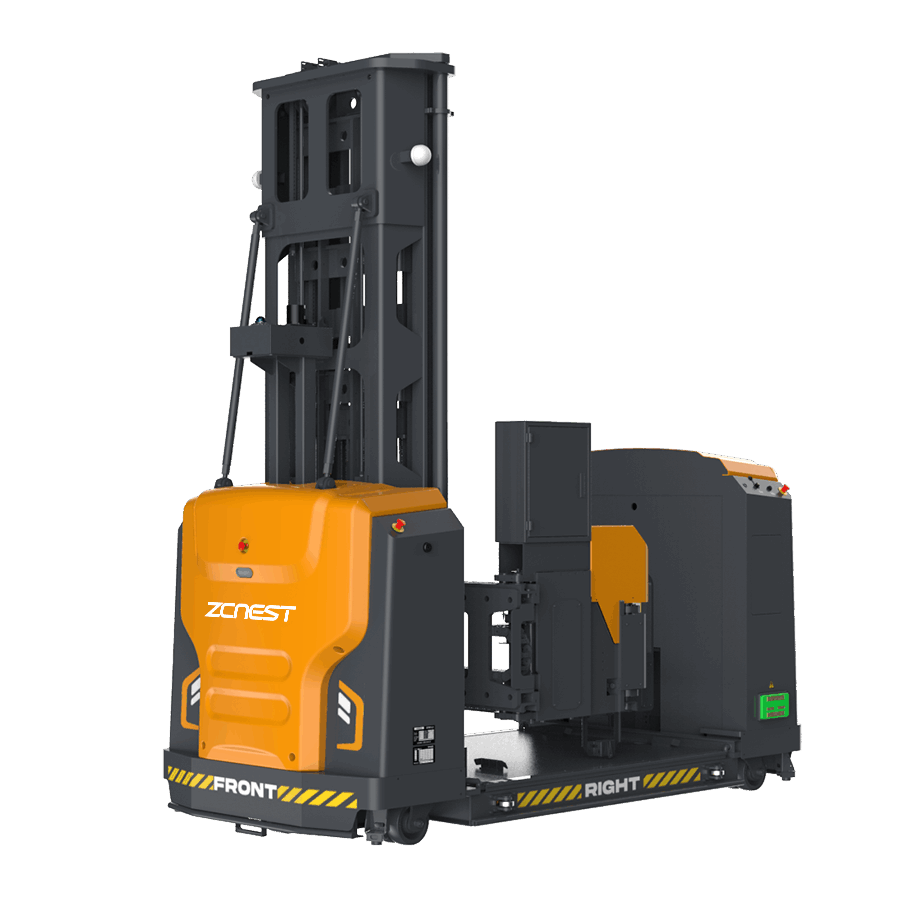
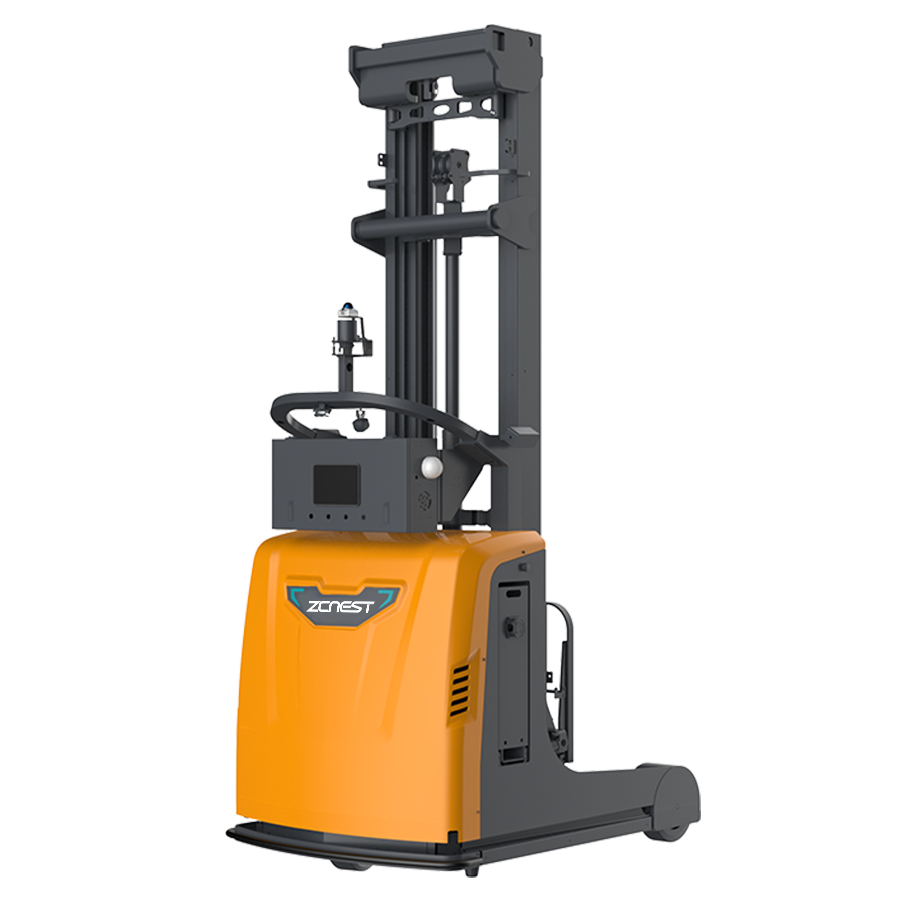
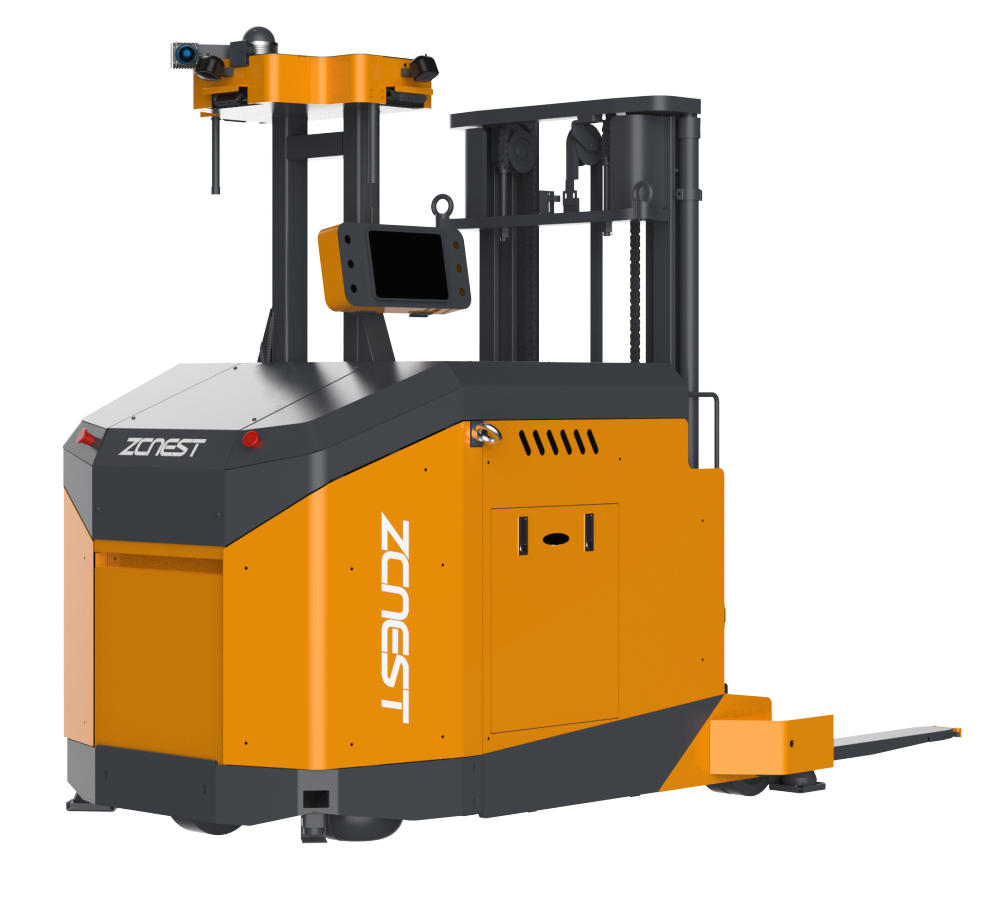
Standard pallet trucks and stacker AGVs can only access the front pallet position. To reach a second pallet located behind the first storage location, automated reach trucks typically utilize a telescoping pantograph fork mechanism.
The pantograph system extends the fork carriage forward, allowing the AGV to:
Store pallets in rear rack positions
Retrieve pallets from second-deep locations
Maintain vehicle stability without entering the rack structure
Reduce aisle width requirements
Most advanced Chinese AGV forklift suppliers offer double-deep reach truck configurations with:
Single-stage pantograph systems
Dual-extension pantograph forks
High-precision servo-controlled extension mechanisms
Automatic fork position verification sensors
For warehouses seeking maximum storage density without expanding facility footprint, this technology is often the preferred solution.
One of the most important considerations during procurement is load capacity reduction.
When the load center moves farther away from the forklift mast, leverage forces increase significantly. As a result, lifting capacity decreases when operating in double-deep mode.
| Rated Capacity | Front Position | Rear Position |
|---|---|---|
| 1,500 kg | 1,500 kg | 1,100-1,300 kg |
| 2,000 kg | 2,000 kg | 1,500-1,700 kg |
| 2,500 kg | 2,500 kg | 1,900-2,100 kg |
Actual values depend on:
Lift height
Pallet dimensions
Load center distance
Pantograph extension length
Counterweight design
Before importing AGV forklifts from China, buyers should always request the official load chart rather than relying solely on nominal capacity specifications.
Double-deep storage introduces a visibility challenge.
Unlike front pallet positions, rear pallets may be partially obscured by:
Front pallets
Rack beams
Low-light warehouse environments
Deep storage shadows
To overcome this issue, modern Chinese AGV reach trucks combine multiple sensing technologies.
The AGV continuously compares real-time LiDAR data against its warehouse map to maintain millimeter-level positioning accuracy.
Dedicated laser sensors mounted near the fork tips verify pallet opening locations before insertion.
Advanced systems utilize industrial depth cameras to identify:
Pallet orientation
Pallet deformation
Entry pocket position
Fork alignment
For cold storage and low-light facilities, integrated LED lighting assists machine vision systems in detecting pallet features consistently.
The result is highly reliable pallet engagement even at heights exceeding 10 meters.
Hardware alone is not enough.
The warehouse management software must understand the relationship between front and rear pallet locations.
Modern AGV software platforms typically support nested location structures such as:
Warehouse A → Aisle 05 → Bay 18 → Level 04 → Front Position
Warehouse A → Aisle 05 → Bay 18 → Level 04 → Rear Position
This enables:
Double-deep inventory tracking
FIFO inventory strategies
FEFO inventory management
Automatic pallet relocation tasks
Dynamic slot allocation
Real-time WMS integration
If a rear pallet is required, the system can automatically generate a relocation mission for the front pallet before completing retrieval.
This process occurs without human intervention.
Before selecting a double-deep AGV forklift solution, procurement teams should verify the following:
Does the reach truck include a telescopic pantograph fork?
What is the rear-position lifting capacity?
What is the maximum lift height under full load?
Can the system identify damaged pallets automatically?
Which navigation technology is used?
Does the software support front/rear location management?
Can the AGV integrate with existing WMS or ERP systems?
What retrieval accuracy is guaranteed at maximum rack height?
Obtaining clear answers to these questions can significantly reduce project risk and ensure long-term warehouse automation success.
📥 "Planning to automate your warehouse? Send us a simple layout sketch or channel dimensions, and our engineers will design a FREE AGV Route Simulation for you."
Chinese AGV forklift manufacturers have made significant advances in double-deep warehouse automation. Through the combination of telescopic pantograph forks, LiDAR navigation, 3D vision systems, and intelligent warehouse software, automated reach trucks can safely and accurately operate within high-density storage environments.
For companies looking to maximize pallet positions while minimizing warehouse expansion costs, double-deep AGV solutions offer an attractive balance between storage density, operational efficiency, and automation ROI.
When evaluating suppliers, focus not only on forklift specifications but also on sensing technology, software capabilities, and real-world double-deep deployment experience.
FREE ENGINEERING SUPPORT Stop Gambling on Generic Platforms. Get an AGV/AMR Tailored to Your Warehouse.Buying automated guided vehicles involves complex safety standards (CE/ANSI), navigation setups (Laser SLAM), and ERP system integration. Don't risk your factory safety with middle-men. ✓ 100% Direct Factory: Customized payload up to 5 Tons. ✓ Free CAD Simulation: Send us your layout, and our engineers will simulate the optimal AGV routes. ✓ Global Support: Overseas installation guidance & local maintenance partners. |





 Chinese
 English