


Understanding how to diagnose and recalibrate drive wheel encoders is essential for maintaining stable automation performance.
Is the drift caused by encoder error, tire wear, or software calibration? And can local technicians safely correct it without factory intervention?
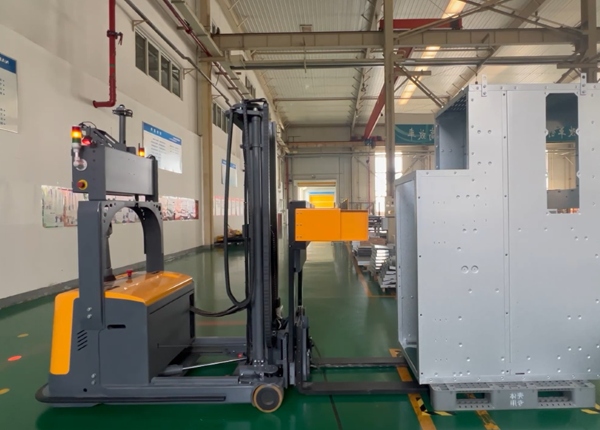
AGV steering drift is typically not caused by a single failure point, but rather a combination of mechanical and electronic factors.
Common causes include:
Drive wheel encoder misalignment or signal drift
Uneven or worn polyurethane tires
Floor friction inconsistency
Load imbalance during movement
Software map calibration mismatch
In most Chinese AGV systems, the navigation model assumes consistent wheel rotation feedback. When this breaks, positional errors accumulate over time.
Before performing calibration, it is critical to identify the root cause.
Sudden positional jumps in system logs
Inconsistent travel distance readings
Error codes related to motor feedback
Drift appears even on smooth floors
Gradual directional drift over time
Uneven turning radius
Visible wear or flattening of wheels
Increased slippage during acceleration
Rule of thumb: sudden errors usually indicate encoder issues, while gradual drift is usually mechanical wear.
Most modern Chinese AGV forklifts include built-in calibration and diagnostic tools accessible via the onboard HMI (Human-Machine Interface).
Typical functions include:
Wheel encoder zero-point reset
Travel distance recalibration
Motor synchronization alignment
Manual jog and test movement mode
Real-time position tracking visualization
Error log and diagnostic history
These tools are designed so that trained technicians can perform calibration without external engineering equipment.
Zero-point calibration resets encoder baseline values so the system re-establishes accurate movement references.
Typical procedure includes:
Place AGV on a flat, level surface
Ensure no load is applied to forks
Switch system to maintenance/calibration mode
Reset left and right encoder baseline values
Perform slow forward and reverse test movement
Verify position consistency in HMI display
Most systems allow local teams to complete this process in under 20–40 minutes.
Important: Calibration should always be performed after wheel replacement, encoder replacement, or firmware update.
In most Chinese AGV systems, no special factory tools are required for standard encoder calibration.
However, advanced recalibration scenarios may require:
Laser alignment reference tools (for high-precision systems)
Factory-level diagnostic software access
Map rebuilding tools for SLAM-based navigation
For 80–90% of real-world drift cases, onboard HMI tools are sufficient.
Regular validation helps maintain millimeter-level accuracy in warehouse automation environments.
Recommended inspection intervals:
Daily: Quick movement check and error log review
Weekly: Short calibration validation test run
Monthly: Full encoder accuracy verification
After maintenance: Mandatory recalibration
High-intensity 24/7 logistics operations may require more frequent checks depending on floor conditions and load cycles.
Does the AGV support zero-point encoder calibration via HMI?
What are the built-in wheel alignment tools?
How is drift detection handled in software?
Can local technicians perform calibration without factory access?
How is encoder data validated over time?
What causes long-term positional drift?
Is calibration required after wheel replacement?
Does the system log encoder errors automatically?
Drive wheel encoder calibration is a critical part of maintaining AGV accuracy in real warehouse environments. While Chinese AGV systems generally include user-friendly HMI-based calibration tools, long-term precision depends on consistent validation, proper mechanical maintenance, and timely correction of wheel wear or sensor drift.
When properly maintained, modern AGV systems can sustain millimeter-level navigation accuracy even under continuous industrial operation.
Before deploying AGV forklifts from China, ensure your team is trained in encoder calibration procedures and understands how to distinguish mechanical wear from sensor errors. Precision maintenance is key to stable automation performance.
FREE ENGINEERING SUPPORT Stop Gambling on Generic Platforms. Get an AGV/AMR Tailored to Your Warehouse.Buying automated guided vehicles involves complex safety standards (CE/ANSI), navigation setups (Laser SLAM), and ERP system integration. Don't risk your factory safety with middle-men. ✓ 100% Direct Factory: Customized payload up to 5 Tons. ✓ Free CAD Simulation: Send us your layout, and our engineers will simulate the optimal AGV routes. ✓ Global Support: Overseas installation guidance & local maintenance partners. |





 Chinese
 English