

For companies importing AGV forklifts from China, the key challenge is not only identifying the fault—but restoring system operation quickly with minimal disruption.
Are AGV motors standardized or proprietary? How fast can replacements be sourced? And can local repair shops safely rebuild them?
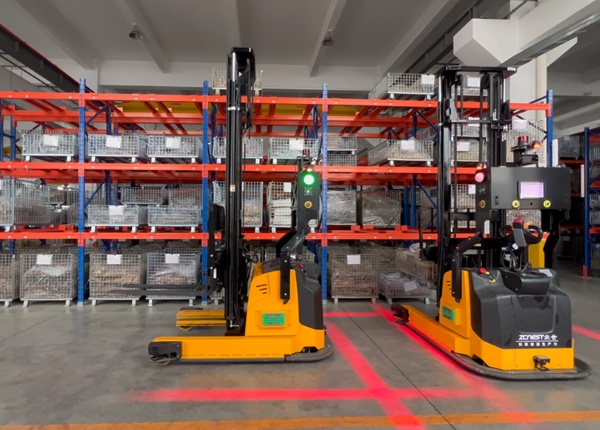
In most modern Chinese AGV forklifts, motor architecture follows a hybrid approach:
Standard industrial frames (preferred): widely used AC induction or brushless servo motors
Semi-custom configurations: modified mounting, encoder integration, or gear reduction systems
Fully proprietary designs: rare, mostly in compact or high-end navigation systems
This means that while the internal design may be customized, many core components follow global industrial standards.
The more standardized the motor frame, the easier it is to source local replacements.
If a motor burns out in a Chinese AGV system, there are typically three sourcing pathways:
Supplied directly by AGV manufacturer
Guaranteed compatibility
Longer shipping time if no local warehouse exists
Requires matching motor specification (voltage, torque, frame size)
Faster procurement time
May require adapter or encoder recalibration
Used when OEM model is unavailable
Must ensure mechanical and electrical compatibility
Requires engineering validation
For critical AGV fleets, most operators maintain at least one spare motor per key vehicle type.
Lead time depends on stock availability and sourcing method:
Local stock (distributor): 1–5 days
Factory express shipment: 5–10 days (air freight)
Standard production replacement: 2–5 weeks
In high-automation warehouses, downtime cost usually exceeds shipping cost, making air freight the preferred emergency solution.
Yes—but with important technical limitations.
Industrial motor rewind is possible in most cases, but AGV motors are more sensitive than conventional industrial motors due to integrated control systems.
Key considerations:
Encoder alignment must be preserved
Winding resistance must match OEM specification
Thermal protection thresholds must remain unchanged
Dynamic balance must be re-verified after repair
Improper rewinding may result in reduced torque accuracy or navigation instability in AGV systems.
For critical automation systems, rewinding is usually considered a temporary or secondary solution rather than a long-term replacement.
Before and after installation, motor health should be validated using standard industrial testing methods:
Insulation resistance (Megger test): checks winding insulation integrity
Phase resistance balance: ensures uniform coil condition
Vibration analysis: detects mechanical imbalance
No-load current test: identifies abnormal power draw
Temperature rise test: verifies thermal stability under load
For AGV-specific systems, additional checks may include:
Encoder signal consistency
Drive controller communication stability
Torque response linearity
Early detection of motor degradation significantly reduces cascading failures in AGV fleets.
To ensure operational stability, warehouse operators should consider:
At least 1–2 spare drive motors per 10 AGVs
Critical hydraulic pump motor backup for reach trucks
On-site compatibility documentation for each motor type
Pre-approved local substitute models
This reduces downtime from weeks to hours in critical failure scenarios.
Are AGV motors standard industrial models or proprietary?
What is the exact motor specification (frame, voltage, torque)?
Can local equivalents be used safely?
What is the replacement lead time for critical motors?
Are spare motors stocked locally or only at factory?
Can motors be repaired or must they be replaced?
What testing is required after motor replacement?
Does motor failure affect calibration or navigation accuracy?
Motor reliability is a core pillar of AGV forklift performance. While Chinese AGV manufacturers increasingly adopt standardized industrial motor platforms, real-world uptime depends heavily on spare part strategy, repair capability, and system-level compatibility planning.
A well-prepared maintenance strategy ensures that even in the event of motor failure, AGV systems can be restored quickly without disrupting warehouse operations.
Before importing AGV forklifts from China, confirm motor standardization, local sourcing options, and repair feasibility. These factors determine how fast your system recovers from critical failures.
FREE ENGINEERING SUPPORT Stop Gambling on Generic Platforms. Get an AGV/AMR Tailored to Your Warehouse.Buying automated guided vehicles involves complex safety standards (CE/ANSI), navigation setups (Laser SLAM), and ERP system integration. Don't risk your factory safety with middle-men. ✓ 100% Direct Factory: Customized payload up to 5 Tons. ✓ Free CAD Simulation: Send us your layout, and our engineers will simulate the optimal AGV routes. ✓ Global Support: Overseas installation guidance & local maintenance partners. |





 Chinese
 English