


Even advanced navigation systems can underperform if the floor surface introduces vibration, slippage, or sensor interference.
How flat does your floor need to be? Can AGVs cross expansion joints? Does epoxy coating affect traction? And how do you maintain sensor accuracy through proper floor cleaning?
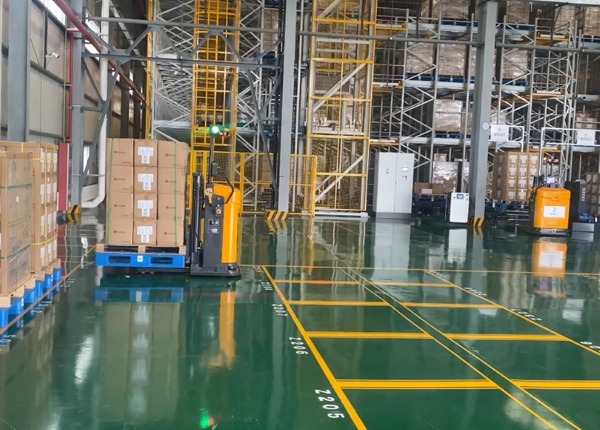
AGV forklifts rely on a combination of wheel odometry, laser navigation (LiDAR), vision systems, and inertial sensors. All of these systems assume a stable and predictable ground environment.
Poor floor conditions can lead to:
Navigation drift and positioning errors
Wheel slip and inconsistent acceleration
Increased sensor noise and recalibration frequency
Load instability during lifting and transport
In automated warehouses, the floor is effectively part of the navigation system.
For laser-guided AGVs and pallet AMRs from China, floor flatness is typically specified using:
FF (Floor Flatness): surface smoothness over short distances
FL (Floor Levelness): overall slope and long-range deviation
Typical recommended values:
Basic AGV operation: FF 25–35 / FL 20–30
High-precision navigation: FF 35–45 / FL 30–40
Narrow aisle / high-rack systems: FF 45+ / FL 35+
Lower flatness leads directly to odometry error accumulation and docking misalignment in AGV systems.
Before deployment, professional floor laser scanning is strongly recommended.
AGVs can generally handle minor floor imperfections, but expansion joints and cracks must be evaluated carefully.
Typical behavior:
Small cracks (<3mm): usually safe with minimal impact
Standard expansion joints: safe if crossing speed is controlled
Wide gaps or uneven joints: may cause vibration, wheel shock, or sensor disturbance
Repeated crossing of poorly filled joints can lead to:
Tire deformation
Encoder signal fluctuation
Load instability during transport
Best practice: treat expansion joints as planned traffic zones and optimize AGV routes to minimize crossing frequency.
High-gloss epoxy floors are common in modern warehouses, but they can affect AGV traction performance.
Potential issues include:
Reduced friction under acceleration
Wheel spin during heavy load starts
Braking distance increase
Performance variation under dust or moisture
However, epoxy floors are still widely used if properly specified.
Recommended solutions:
Use anti-slip epoxy finishes in AGV lanes
Select appropriate polyurethane wheel hardness
Adjust acceleration curves in software
Floor friction consistency is more important than absolute smoothness for stable AGV operation.
Cleanliness directly affects LiDAR, camera, and reflective sensor performance in AGV systems.
Common contamination sources include:
Fine dust accumulation
Oil or lubricant spills
Reflective debris or packaging waste
Water streaks or cleaning residue
These can cause:
False obstacle detection
Laser reflection distortion
Navigation map drift
Increased sensor recalibration frequency
Recommended cleaning strategy:
Daily dry dust removal in AGV paths
Weekly industrial floor scrubbing
Immediate cleaning of spills in navigation zones
Avoid high-reflective residue buildup
Conduct laser-based FF/FL floor measurement
Repair cracks and uneven expansion joints
Apply consistent anti-slip surface treatment
Define AGV navigation lanes clearly
Ensure dust-free commissioning environment
Validate floor reflectivity for LiDAR compatibility
Mark high-risk crossing zones
Test AGV empty and loaded travel stability
What floor flatness is required for this AGV model?
Can AGVs handle expansion joints in my warehouse?
Is epoxy flooring compatible with traction requirements?
How does floor quality affect navigation accuracy?
What cleaning standards are required for sensors?
Do I need to modify floor coating before deployment?
Will poor floor conditions void performance guarantees?
Is floor laser mapping required before commissioning?
Warehouse floor quality is a foundational factor in AGV forklift performance. Even the most advanced Chinese automation systems depend on consistent, well-prepared flooring to achieve accurate navigation, stable lifting, and reliable sensor operation.
By ensuring proper flatness, managing expansion joints, selecting appropriate coatings, and maintaining clean surfaces, businesses can significantly improve AGV reliability and reduce long-term maintenance costs.
Before importing AGV forklifts from China, treat your warehouse floor as part of the automation system—not just infrastructure. Floor quality directly determines navigation accuracy and fleet stability.
FREE ENGINEERING SUPPORT Stop Gambling on Generic Platforms. Get an AGV/AMR Tailored to Your Warehouse.Buying automated guided vehicles involves complex safety standards (CE/ANSI), navigation setups (Laser SLAM), and ERP system integration. Don't risk your factory safety with middle-men. ✓ 100% Direct Factory: Customized payload up to 5 Tons. ✓ Free CAD Simulation: Send us your layout, and our engineers will simulate the optimal AGV routes. ✓ Global Support: Overseas installation guidance & local maintenance partners. |





 Chinese
 English