


Warehouse automation depends on uninterrupted communication. Before comparing antennas or wireless specifications, buyers should understand how an AGV continues operating safely when network conditions become less than perfect.
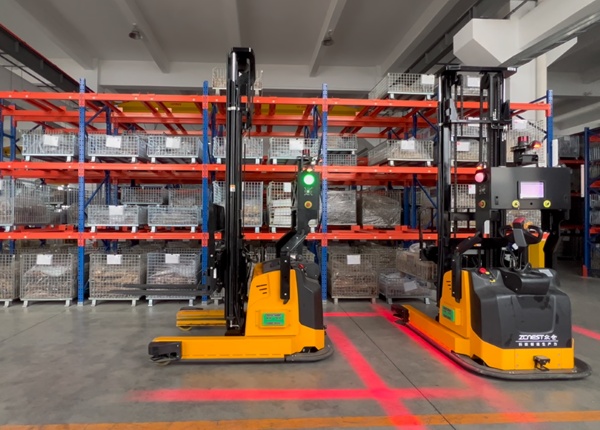
When overseas companies evaluate Chinese AGV forklifts, they rarely worry about the wireless radio hardware itself.
Their real concern is operational continuity. They want to know whether communication failures will interrupt production, delay deliveries, or create safety risks inside the warehouse.
Will an AGV stop safely if Wi-Fi coverage is temporarily lost?
Can the vehicle reconnect automatically without technician intervention?
Will metal racks reduce communication reliability?
Can our existing IT infrastructure support the fleet?
Industrial wireless communication is very different from office networking. Forklifts constantly move through aisles, pass behind steel shelving, and operate alongside other wireless equipment.
Instead of asking whether a supplier uses one antenna or two, buyers should evaluate whether the complete communication architecture is designed for continuous warehouse operation.
Stable communication while vehicles are moving.
Automatic recovery after temporary signal interruptions.
Secure communication with warehouse management software.
Scalable performance as additional AGVs are deployed.
Simple diagnostics for local IT personnel.
Temporary communication interruptions can occur in any industrial facility due to environmental conditions or infrastructure changes.
The more important question is how the AGV responds.
The system recognizes communication interruptions and changes operating status accordingly.
Vehicle behavior should prioritize safe operation while awaiting communication recovery.
Once connectivity returns, the AGV should resume normal communication without unnecessary manual intervention whenever system design allows.
Modern AGVs are connected industrial devices operating within enterprise networks. Buyers increasingly expect wireless communication to align with their organization's cybersecurity policies.
When evaluating suppliers, discuss support for enterprise authentication, encryption methods, software update policies, user access management, and secure communication between the AGV fleet manager and warehouse systems.
| IT Evaluation Area | Business Value |
|---|---|
| Wireless Coverage | Reduces communication interruptions |
| Roaming Performance | Maintains smooth vehicle movement |
| Network Security | Protects operational data |
| Monitoring Tools | Simplifies troubleshooting |
| Expansion Capacity | Supports future fleet growth |
How does the AGV behave during temporary communication loss?
How is network recovery managed?
Can local IT teams diagnose communication issues?
What enterprise security features are supported?
Can the communication system scale with fleet expansion?
What documentation and technical support are provided?
Reliable wireless communication is not about achieving the strongest signal—it is about ensuring uninterrupted warehouse operations. The right AGV communication system should support safe operation, automatic recovery, secure integration with enterprise networks, and long-term scalability as your automation project grows.
When comparing Chinese AGV suppliers, evaluate how their communication architecture supports your business continuity objectives rather than focusing only on wireless hardware specifications.
FREE ENGINEERING SUPPORT Stop Gambling on Generic Platforms. Get an AGV/AMR Tailored to Your Warehouse.Buying automated guided vehicles involves complex safety standards (CE/ANSI), navigation setups (Laser SLAM), and ERP system integration. Don't risk your factory safety with middle-men. ✓ 100% Direct Factory: Customized payload up to 5 Tons. ✓ Free CAD Simulation: Send us your layout, and our engineers will simulate the optimal AGV routes. ✓ Global Support: Overseas installation guidance & local maintenance partners. |











 Chinese
 English




