


Handling Oversized and Special-Format Loads in Warehouses
Not all warehouse loads fit standard pallet dimensions. Machinery components, long materials, industrial assemblies, and special transport frames may extend beyond conventional pallet footprints. Before automating these movements, warehouse operators need to evaluate the complete load envelope, fork access, aisle clearance, and storage arrangements.
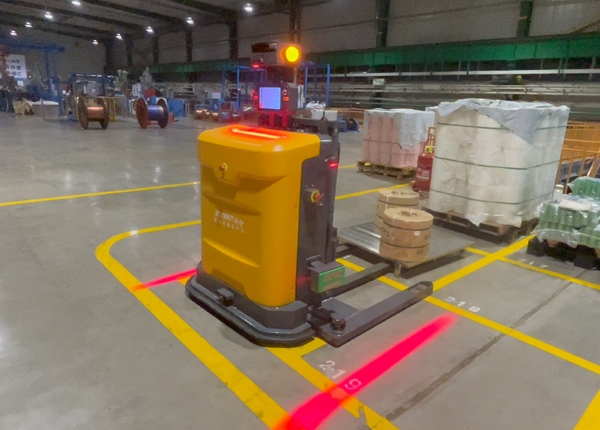
Many AGV forklift projects begin with standard pallet dimensions. However, warehouses that handle industrial equipment, long products, or special transport frames may need to move loads that extend beyond the usual footprint.
An oversized load can change the vehicle's total occupied space during travel and turning. It may also affect fork spacing, support points, load center, and the available clearance around racks or other equipment.
The equipment supplier should therefore receive the complete external dimensions of the load, including any parts that extend beyond the base carrier.
The complete load envelope includes the overall length, width, and height of the goods and their carrier. It should also include any protruding components, handles, protective structures, or temporary packaging.
Measure the load in the orientation in which it will be transported. A long component placed across the forks may occupy a different turning envelope from the same component positioned along the direction of travel.
If a load has several permitted orientations, record each one separately and confirm which orientations are suitable for the proposed equipment and route layout.
Non-standard loads may use dedicated frames, steel bases, transport skids, or custom pallets. Their fork-entry openings and support points may differ from standard wooden or plastic pallets.
Review fork spacing, fork length, insertion depth, and the position of the load's support structure. The equipment must provide appropriate support without contacting vulnerable parts of the product or carrier.
If the carrier is designed specifically for a manual forklift, it should be assessed for AGV compatibility before being introduced into the automated process.
The vehicle's standard dimensions do not represent the full space occupied when carrying an oversized load. The load may extend beyond the front, rear, or sides of the vehicle and create additional clearance requirements.
Route planning should consider straight travel, turning movements, intersections, doorway openings, and approach positions at pickup and delivery stations. A route that accommodates an unloaded vehicle may not be suitable when the vehicle carries a long or wide load.
For narrow-aisle warehouses, the complete loaded turning envelope should be evaluated against the actual aisle geometry. Do not use standard vehicle width alone to determine whether an oversized load can pass through an aisle.
Some oversized loads can be handled using a suitable standard fork-type AGV forklift, while others may require customized forks, a special carrier interface, or a different vehicle structure.
The decision should be based on load dimensions, weight, center of gravity, support points, and the route environment. The supplier should also confirm whether the proposed configuration affects rated capacity, turning performance, or lifting height.
Where different load families have substantially different dimensions, separate handling profiles or dedicated transport equipment may be more practical than one universal configuration.
Non-standard loads may not fit conventional rack locations. Some may require floor storage, dedicated support frames, or specially dimensioned rack openings.
The storage design should consider the load's full dimensions and the space needed for the AGV forklift to approach, insert its forks, lift, and withdraw safely. Pickup and delivery stations should provide consistent positioning references.
If the warehouse uses different storage rules for standard and oversized goods, the WMS should distinguish these location types and prevent unsuitable task assignments.
Key Project Checkpoint
Provide full load dimensions in the actual transport orientation, not just the carrier dimensions. Validate fork access, loaded turning clearance, route geometry, and storage positions using the real load or a representative test frame.
Overall load length, width, and height.
Maximum load weight and center-of-gravity information.
Carrier or transport-frame design.
Fork-entry openings and support-point locations.
Required transport orientation.
Minimum aisle width and turning space.
Storage location and pickup station dimensions.
Daily movement volume for each load type.
Automating non-standard loads requires a project-specific assessment of the vehicle, carrier, route, and storage arrangement. Selecting equipment based only on the maximum weight or standard pallet size can leave important handling requirements unresolved.
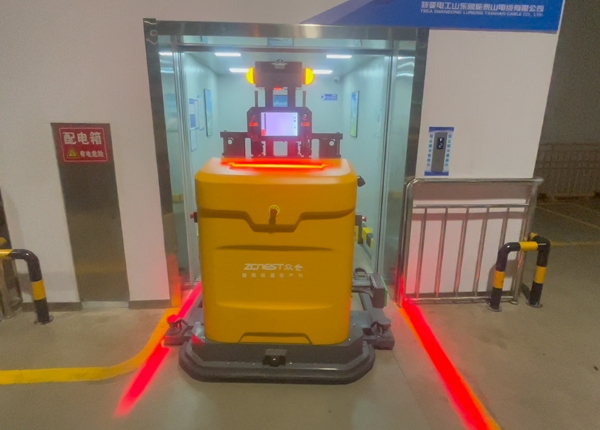
ZCNest Robotics provides AGV and AMR forklift solutions, including customized equipment configurations for warehouse material handling. Projects can be evaluated according to special load dimensions, fork requirements, aisle conditions, and storage layouts.
Send your load drawings, dimensions, weight, and warehouse layout to discuss a suitable AGV forklift configuration.












 Chinese
 English





