


In modern AGV deployments from China, material tracking is not a separate subsystem—it is tightly integrated into the AGV perception system, fleet management system (RCS/FMS), and your ERP/WMS.
📥 "Planning to automate your warehouse? Send us a simple layout sketch or channel dimensions, and our engineers will design a FREE AGV Route Simulation for you."
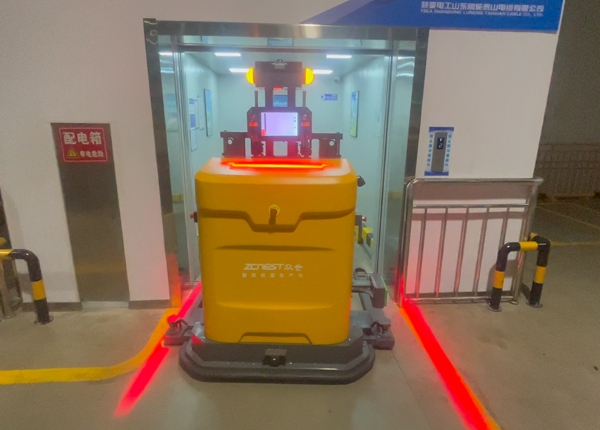
The core objective is simple but critical:
Every pallet movement = automatically verified + digitally recorded + synced to ERP in real time
Yes — if the system includes barcode or vision modules.
Mounted on fork carriage or mast. Used for reading labels during pickup and drop-off.
✔ Accuracy > 99%
✔ Works in low light environments
✔ Industry standard solution
Industrial cameras with AI decoding capability for QR codes, DataMatrix, and damaged labels.
✔ Flexible for mixed labels
✔ Handles damaged barcodes
⚠ Requires lighting calibration
Most advanced AGVs combine:
Camera + Barcode Scanner + LiDAR Position Verification
This is a multi-layer validation process.
Rack slot ID confirmation
SLAM or reflector-based positioning
Task assignment from RCS
Barcode or RFID match
Pallet ID consistency check
WMS task alignment
Fork height detection
Load weight verification (optional)
Fork engagement detection
Decision Rule: Only when all conditions match, the task is accepted.
If mismatch occurs → AGV stops → alert sent to RCS → operator confirmation required
AGVs typically do NOT update ERP directly. Instead, data flows through the system hierarchy:
AGV → RCS → WMS → ERP
Pickup event → inventory deducted/reserved
Drop-off event → inventory added
Transfer event → stock movement recorded
✔ Real-time API: 0.5–3 seconds
✔ Batch sync: 1–10 minutes
⚠ Legacy systems: up to hours
Yes — RFID is widely supported in advanced AGV systems.
Passive RFID (UHF EPC Gen2)
Active RFID (high-value assets)
Hybrid RFID + Barcode systems
✔ No line-of-sight required
✔ Works in dust/dark environments
✔ Faster identification
⚠ Higher tag cost
⚠ Infrastructure required (readers/antennas)
⚠ Metal/liquid interference possible
ERP System
    ▲
    │
WMS Layer
    ▲
    │
RCS / Fleet Management System
    ├── AGVs
    ├── Barcode Scanners
    ├── RFID Readers
    └── Vision Cameras
Dust-covered labels
Wrinkled packaging
Low contrast printing
Solution: Industrial scanners + AI fallback
Old labels on pallets
Multiple SKU tags
Solution: RCS filtering logic
API bottlenecks
Network instability
Solution: Event-driven architecture (not batch sync)
Which scanner models are used?
Can damaged barcodes be read?
Is OCR supported?
Is RFID native or external?
Which RFID standards are supported?
Can RFID and barcode run in parallel?
Real-time API or batch sync?
SAP / Oracle / Dynamics integration?
What is system latency?
❌ Only manual barcode scanning supported
❌ No ERP integration experience
❌ No clear verification logic
❌ No RFID roadmap
❌ Batch-only synchronization
📥 "Planning to automate your warehouse? Send us a simple layout sketch or channel dimensions, and our engineers will design a FREE AGV Route Simulation for you."
For high-performance warehouse automation, the most reliable setup includes:
✔ Industrial fixed barcode scanners (primary)
✔ AI vision cameras (backup)
✔ RFID for high-speed/high-value workflows
✔ Real-time WMS integration via API
✔ Multi-layer verification logic
The key principle: No pallet movement should occur without at least two independent digital verifications and real-time system recording.
FREE ENGINEERING SUPPORT Stop Gambling on Generic Platforms. Get an AGV/AMR Tailored to Your Warehouse.Buying automated guided vehicles involves complex safety standards (CE/ANSI), navigation setups (Laser SLAM), and ERP system integration. Don't risk your factory safety with middle-men. ✓ 100% Direct Factory: Customized payload up to 5 Tons. ✓ Free CAD Simulation: Send us your layout, and our engineers will simulate the optimal AGV routes. ✓ Global Support: Overseas installation guidance & local maintenance partners. |





 Chinese
 English