


WAREHOUSE FLOW ENGINEERING
Staging buffers give warehouse processes room to absorb short-term differences between incoming and outgoing work. For AGV forklift projects, buffer capacity, location and release rules must be designed together to avoid turning a useful waiting area into a source of congestion.
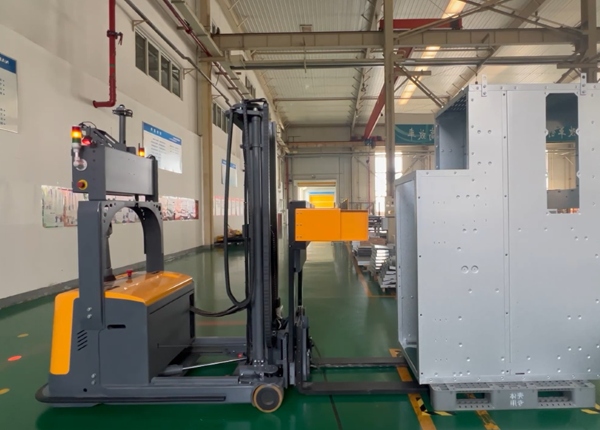
A warehouse rarely receives, stores and dispatches pallets at exactly the same rate. Trucks may deliver several pallets in a short period, while putaway requests are processed over a longer interval. Outbound orders may also be completed before the loading area is ready to receive them.
Staging buffers absorb these timing differences. However, an oversized buffer consumes valuable floor space, while an undersized one can cause pallets to accumulate in aisles or at transfer points. When AGV forklifts serve the area, poor buffer design can also create repeated vehicle waiting, blocked approaches and unnecessary repositioning.
The objective is to provide enough controlled capacity for the expected workflow without allowing temporary inventory to spread into unapproved locations.
Do not treat every staging area as interchangeable. The buffer's purpose determines which pallets can enter, how long they may remain and which process is responsible for removing them.
Inbound buffer: holds received pallets before inspection, identification or putaway.
Outbound buffer: holds completed orders while awaiting consolidation, documentation or loading.
Process buffer: separates two operations with different processing rates.
Retrieval buffer: temporarily holds pallets retrieved from storage before they move to picking or dispatch.
Exception buffer: isolates approved loads that need inspection or data correction before normal movement can resume.
Define the entry conditions and exit conditions for every buffer. For example, an outbound buffer may accept only pallets linked to released shipping orders, while an inbound buffer may allow loads awaiting verification but prohibit them from being treated as available inventory.
Buffer sizing should reflect the number of pallets likely to accumulate during the interval between arrival and removal. Daily throughput alone is insufficient because it does not show how concentrated the arrivals are or how long the downstream process takes.
A useful starting point is to examine the highest representative accumulation observed during comparable operating periods. If reliable historical data is unavailable, measure the process during a pilot or conduct a controlled workload test.
Consider the following factors:
Pallet arrivals by time interval, not just total daily volume.
The time required for inspection, picking, consolidation or loading.
The number of pallets that can be processed simultaneously downstream.
Variability caused by truck arrival patterns, shift changes and order release times.
The operating conditions under which the buffer must remain effective.
Capacity should be based on an explicit operating scenario. A buffer designed for normal inbound flow may not be sufficient for a concentrated delivery window. Conversely, designing every area around an extreme one-off event may use floor space that provides little day-to-day benefit.
A buffer should be close enough to its associated process to reduce unnecessary travel, but it must not obstruct the movement of vehicles, pedestrians or other equipment.
Review the approach and departure paths for loaded AGV forklifts. Include turning or alignment requirements, pallet overhang, rack and column positions, pedestrian crossings and access to emergency equipment.
Do not select a location based only on unused floor space. A vacant corner may be difficult for a loaded forklift to enter or leave, and a buffer placed beside a narrow aisle may create queues that interfere with storage operations.
Map the expected movement between the buffer and its connected processes. If pallets routinely travel between the same two points, examine whether a more direct transfer arrangement would reduce unnecessary handling.
Every position used by the automated workflow should have a clear occupancy state. The system needs to distinguish an empty position from one that is occupied, reserved for an incoming task or temporarily unavailable.
Specify how the system chooses a position when several are available. Depending on the process, the rule may prioritize a particular shipping order, a downstream destination, a product category or a position that reduces additional travel.
Also define what happens when the buffer is full. The system should hold the task, direct it to an approved alternative or request an authorized decision. It should not assign a pallet to an unregistered location merely because a vehicle has already arrived.
For outbound staging, position allocation may need to preserve shipment grouping. For inbound operations, the system may need to prevent restricted inventory from entering a buffer reserved for available stock.
A vehicle should not be sent to a destination that cannot accept its load. Before dispatch, the fleet or warehouse system should have a defined way to verify that the intended buffer position is available or appropriately reserved.
Where multiple vehicles serve the same buffer, define how they reserve positions and how reservations are released after a task is canceled or redirected. A stale reservation can make an empty position appear unavailable, while an uncontrolled assignment can cause two tasks to target the same space.
Measure vehicle waiting time at the buffer entrance, the time each pallet occupies a position and the number of tasks delayed because no position was available. These indicators help determine whether the constraint lies in buffer size, downstream processing or dispatch coordination.
Physical occupancy and digital inventory must remain consistent. A pallet may physically leave a buffer while its inventory transaction remains pending, or a canceled task may leave a reservation in the system.
Define the confirmation event that releases a buffer position. This may depend on verified pallet movement, a downstream equipment signal or a confirmed warehouse transaction. The exact process should reflect the actual equipment and software design.
Include a reconciliation procedure for cases where the physical position and system record disagree. Authorized staff should be able to verify the pallet's identity, correct the location record and release any invalid reservation without creating duplicate inventory movements.
Test the buffer with the expected pallet mix and a representative arrival pattern. Include periods when several pallets arrive together and when downstream processing slows down.
Record maximum occupancy and the duration of full-buffer conditions.
Measure vehicle waiting time at the entrance and inside the area.
Check whether vehicles can enter and leave without obstructing other routes.
Verify position reservations, cancellations and occupancy updates.
Confirm that the full-buffer response prevents unauthorized pallet placement.
Review how buffer use affects the connected process and total task completion time.
Each buffer has a defined operational purpose.
Capacity reflects measured or tested pallet accumulation.
Vehicle access, turning space and pedestrian routes are checked.
Each position has a defined occupancy and reservation state.
Full-buffer conditions trigger an approved response.
Inventory records match physical pallet locations.
Performance is tested under representative peak conditions.
Key checkpoint: A staging buffer should absorb a defined difference between process rates. If pallets remain there indefinitely or vehicles repeatedly wait for available positions, the buffer is masking a process constraint rather than solving it.
When requesting an AGV forklift proposal, mark all staging buffers on the warehouse layout. Provide the expected pallet volume, arrival pattern, downstream process rate, permitted load types and required inventory status.
Ask the supplier to review access geometry, position allocation, reservation logic and the response when a buffer is full. These details should be validated before the warehouse relies on the automated process during normal or peak operation.
📖 AGV Forklift Guide — Essential manual for selection and safety.
⚙️ How AGV Systems Work — A deep dive into navigation and logic.
⚖️ AGV vs. AMR Comparison — Choosing the right technology for your facility.
💰 AGV Cost and ROI — Evaluating investment and payback periods.












 Chinese
 English





