


WAREHOUSE TRAFFIC COORDINATION
Warehouse doors and aisle crossings can become bottlenecks when automated forklifts share limited passageways with other vehicles, pedestrians or connected equipment. Clear access rules and coordinated control signals help keep movements predictable and prevent one blocked crossing from disrupting the wider fleet.
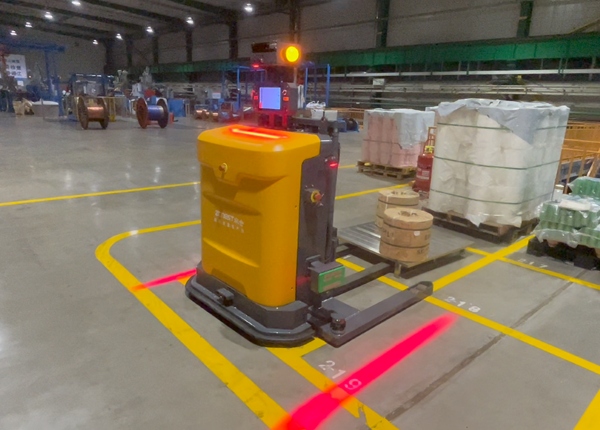
Many warehouse layouts include doors, narrow passages and intersections that serve several operational areas. These locations may connect receiving to storage, link two warehouse zones or provide access to a staging area.
When AGV forklifts begin using these routes, the challenge is not simply whether a vehicle can pass through the opening. The complete movement must account for vehicle and load dimensions, approach geometry, door operation, crossing traffic, access permissions and the behavior of other equipment.
Planning these interfaces before deployment helps reduce avoidable waiting and provides a clear response when a passage is unavailable.
Start by marking the doors, intersections and narrow passages that automated forklifts must use. Include both normal routes and approved alternative routes where available.
For each passage, document its usable width and height, nearby obstructions, floor conditions, approach space and expected traffic. Measure the complete vehicle and load envelope rather than using the vehicle body dimensions alone.
Check whether the vehicle must turn immediately before or after passing through the opening. A passage may have adequate width in isolation but insufficient space for the complete maneuver when a pallet overhangs or the vehicle approaches at an angle.
Also identify doors that are shared with pedestrians, manual forklifts, delivery equipment or other automated systems. Their operating rules may affect whether and when an AGV can enter.
If an AGV forklift needs an automatic door to open, the vehicle and door-control process must agree on when access is requested, granted and released.
Document the required request signal, door-ready indication, permitted entry conditions and confirmation that the passage can be used. The actual interface may depend on the door controller, fleet management system and site automation architecture.
Specify how the process behaves if the door does not open, closes unexpectedly or fails to return the expected status. The vehicle should follow an approved response rather than repeatedly attempting to pass through an unavailable opening.
Where the door is part of a fire compartment or another regulated building system, any automation interface must preserve the building's required safety and emergency functions. Door operation must be reviewed with the responsible facilities and safety teams.
A crossing can become congested when several routes converge at one location. If vehicles enter without a clear sequencing rule, they may block each other's paths or occupy the crossing while waiting for the next movement to become available.
Identify the locations where movement conflicts are possible and define the control method for each one. Depending on the installation, this may involve route reservations, traffic zones, controlled entry signals or other approved fleet-management logic.
Specify when a vehicle may reserve a crossing and when that reservation is released. The rule should prevent a vehicle from entering a constrained area unless it can proceed under the approved movement conditions.
Do not assume that a priority setting alone resolves a crossing conflict. Priority can influence task sequencing, but it does not replace route coordination, physical clearance checks or the site's safety controls.
Loaded AGV forklifts may require different clearances from empty vehicles. A pallet may extend beyond the forks, be wider than the vehicle body or have a height that affects visibility and passage requirements.
Verify the largest approved load configuration that must use each constrained passage. Include the permitted pallet orientation and any load-specific restrictions in the route planning process.
Where several vehicle models operate in the same warehouse, confirm that each model can use the assigned crossing under its own dimensions and operating constraints. Do not assume that a route validated for one vehicle is automatically valid for every unit in the fleet.
If a passage cannot accommodate the approved load envelope, define an alternative route or a different handling process. A system should not be expected to compensate for insufficient physical clearance through software configuration alone.
Some warehouses cannot dedicate every passage to automated vehicles. Manual forklifts, pallet jacks, pedestrians and maintenance staff may use the same areas at different times or under defined shared-traffic arrangements.
Map the expected interaction points and confirm how access is controlled. Use the site's approved traffic management and safety procedures to define pedestrian access, vehicle movement permissions and any required separation measures.
Where physical barriers, warning devices, sensors or controlled crossings are needed, determine their responsibilities and interfaces before installation. The complete arrangement should be reviewed by qualified safety personnel and validated for the actual operating conditions.
Do not rely solely on operator awareness or informal rules at a high-traffic crossing. The process should provide a consistent way to prevent conflicting movements and respond when an area is not available.
A door or crossing may become unavailable because of a manual vehicle, a misplaced pallet, maintenance work or a fault in the connected equipment. Define what the AGV system should do when the planned route cannot be used.
The response may include holding the task, waiting at a designated position, selecting an approved alternative route or requesting authorized intervention. The appropriate action depends on the layout and the site's safety requirements.
Define how waiting vehicles are positioned so they do not block emergency access, intersections or other operating areas. Also specify how the system resumes movement after the obstruction clears.
Record the location, duration and cause of repeated blockages. A recurring delay may indicate that the crossing has insufficient capacity, the door interface is unreliable or the route plan does not reflect actual warehouse traffic.
Test each constrained passage with the relevant vehicle and load configurations. Include normal movement, simultaneous traffic requests, door delays and an unavailable crossing where these conditions are part of the intended operation.
Verify physical clearance for the largest approved load.
Confirm the door request and ready signals operate as specified.
Test how the fleet handles competing crossing requests.
Verify the approved response when a passage is blocked.
Check that waiting vehicles do not obstruct other routes.
Confirm that the system resumes operation correctly after access returns.
Review shared-traffic and safety controls with the responsible site team.
All constrained passages are marked on the warehouse layout.
Clearance is checked for the complete vehicle and load envelope.
Automatic door interfaces and failure responses are documented.
Crossing reservations and traffic sequencing rules are defined.
Manual traffic and pedestrian interactions are reviewed.
Blocked-passage behavior and approved alternative routes are established.
Representative movement tests are completed before production use.
Key checkpoint: A crossing is ready for AGV operation only when the vehicle can physically pass, the access-control process works, competing movements are coordinated and the system has a defined response when the passage becomes unavailable.
Provide the supplier with the warehouse layout, door specifications, crossing locations, connected equipment details and information about shared traffic. Identify which party is responsible for door controls, traffic coordination, site modifications and safety review.
Ask for the required interface signals, dependencies and test conditions to be documented before commissioning. This helps prevent late changes when the AGV system is ready but a building interface or passage-control process has not been prepared.
📖 AGV Forklift Guide — Essential manual for selection and safety.
⚙️ How AGV Systems Work — A deep dive into navigation and logic.
⚖️ AGV vs. AMR Comparison — Choosing the right technology for your facility.
💰 AGV Cost and ROI — Evaluating investment and payback periods.












 Chinese
 English





