


As warehouses continue to maximize storage capacity without expanding their building footprint, mezzanine floor systems have become increasingly popular. Multi-level platforms allow businesses to create additional storage, picking, and production space while avoiding costly facility expansions.
However, when companies begin evaluating AGV forklifts and pallet AMRs from China, one critical question often arises:
Can an autonomous forklift safely operate on elevated mezzanine floors without exceeding floor load limits or creating safety risks?
The answer depends on several factors, including floor load capacity, wheel point-load distribution, navigation technology, safety systems, and vehicle design. Understanding these factors before purchasing can help avoid expensive redesigns and deployment delays.
📥 "Planning to automate your warehouse? Send us a simple layout sketch or channel dimensions, and our engineers will design a FREE AGV Route Simulation for you."
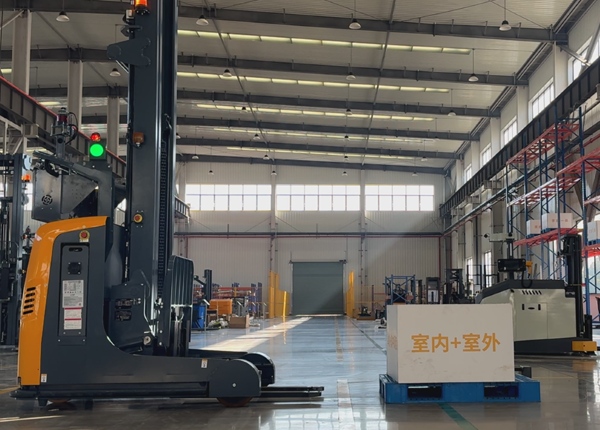
Unlike ground-level warehouse floors, mezzanine structures are designed with specific load limits and structural constraints.
When deploying AGV forklifts on elevated platforms, buyers must evaluate:
Floor load capacity
Wheel point-load concentration
Turning friction forces
Platform vibration
Safety barriers and drop zones
Navigation accuracy near edges
Ramp and elevator integration
These factors are often more important than the AGV's overall weight specification.
One of the most common misconceptions is focusing only on total vehicle weight.
Structural engineers are typically more concerned with wheel point-loads because the entire vehicle weight is transferred through a small contact area.
| AGV Type | Vehicle Weight | Load Capacity | Total Operating Weight |
|---|---|---|---|
| Pallet AMR | 800-1200 kg | 1000-1500 kg | 1800-2700 kg |
| AGV Pallet Truck | 1200-1800 kg | 1500-2500 kg | 2700-4300 kg |
| AGV Reach Truck | 2500-4500 kg | 1500-2500 kg | 4000-7000 kg |
Depending on wheel configuration, a single drive wheel may carry a substantial portion of the total load.
Before deployment, buyers should always request:
Wheel point-load calculations
Static load data
Dynamic load data
Floor pressure specifications
Wheel contact dimensions
The answer depends on the structural design of the mezzanine.
While industrial plywood decking may support pedestrian traffic and manual pallet jacks, AGVs introduce additional forces:
Concentrated wheel loads
Continuous traffic cycles
Turning friction
Acceleration forces
Emergency braking loads
A mezzanine floor that supports static storage may not necessarily support repeated AGV traffic without reinforcement.
Most AGV suppliers will require the mezzanine structural drawings before approving deployment.
In many projects, engineers perform floor-load verification before installation begins.
Elevated warehouse platforms create unique safety concerns that do not exist on ground-level floors.
Modern Chinese AGVs typically utilize multiple safety layers when operating near mezzanine edges:
Navigation software creates digital exclusion areas where AGVs are prohibited from entering.
Laser scanners continuously monitor surroundings and detect unexpected openings or obstructions.
AGVs can communicate directly with automated safety gates through PLC interfaces.
The vehicle receives confirmation that the gate is fully closed before proceeding.
If a safety gate unexpectedly opens, the AGV automatically stops and generates an alarm for warehouse personnel.
Yes, but this usually requires additional infrastructure.
Common solutions include:
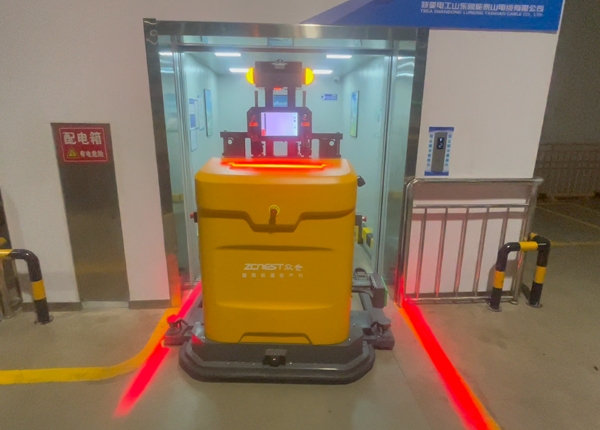
Freight elevators integrated with AGV control systems
Automated vertical lift modules
AGV-compatible goods lifts
Dedicated inter-floor transfer stations
The AGV software coordinates movement between levels and can automatically dispatch vehicles based on workflow requirements.
This enables seamless transportation between storage floors without manual intervention.
In projects where floor load is a critical concern, manufacturers may offer lightweight design alternatives.
Common weight-reduction strategies include:
High-strength steel frame optimization
Aluminum alloy structural components
Compact battery configurations
Integrated drive modules
Low-profile vehicle architecture
While carbon-fiber chassis technology exists in specialized robotics applications, it is still relatively uncommon in industrial AGV forklifts due to cost and durability considerations.
Most warehouse projects achieve floor-load objectives through optimized steel and aluminum designs rather than full carbon-fiber construction.
What are the maximum wheel point-load values?
Can you provide floor pressure calculations?
Has the AGV been deployed on mezzanine floors before?
Can the navigation system detect open floor edges?
Does the AGV integrate with automated safety gates?
Can the vehicle use freight elevators autonomously?
What lightweight chassis options are available?
Will a floor-load analysis be provided before shipment?
📥 "Planning to automate your warehouse? Send us a simple layout sketch or channel dimensions, and our engineers will design a FREE AGV Route Simulation for you."
Multi-level mezzanine warehouses present unique engineering challenges, but they can be successfully automated with properly designed AGV forklifts and pallet AMRs.
The key is not simply choosing an AGV with the right load capacity, but ensuring the vehicle's wheel loads, navigation systems, safety controls, and floor requirements are fully compatible with the mezzanine structure.
Before importing AGV forklifts from China, request wheel point-load calculations, floor-load verification reports, and mezzanine deployment references. These factors often determine the long-term success of the automation project more than the vehicle specifications alone.
FREE ENGINEERING SUPPORT Stop Gambling on Generic Platforms. Get an AGV/AMR Tailored to Your Warehouse.Buying automated guided vehicles involves complex safety standards (CE/ANSI), navigation setups (Laser SLAM), and ERP system integration. Don't risk your factory safety with middle-men. ✓ 100% Direct Factory: Customized payload up to 5 Tons. ✓ Free CAD Simulation: Send us your layout, and our engineers will simulate the optimal AGV routes. ✓ Global Support: Overseas installation guidance & local maintenance partners. |





 Chinese
 English