


For industries such as cement production, brick manufacturing, mining, ceramics, gypsum processing, and building materials, warehouse automation presents a unique challenge: dust.
While AGV forklifts have become increasingly popular for reducing labor costs and improving operational efficiency, many facility managers remain concerned about how autonomous vehicles perform in harsh industrial environments filled with airborne dust particles.
📥 "Planning to automate your warehouse? Send us a simple layout sketch or channel dimensions, and our engineers will design a FREE AGV Route Simulation for you."
Will dust block LiDAR sensors? How often will cleaning be required? Can the electronics survive long-term exposure to cement or brick dust?
These are critical questions for any company considering importing AGV forklifts from China. Fortunately, modern industrial AGVs are increasingly designed to operate in demanding environments where dust control is a daily challenge.
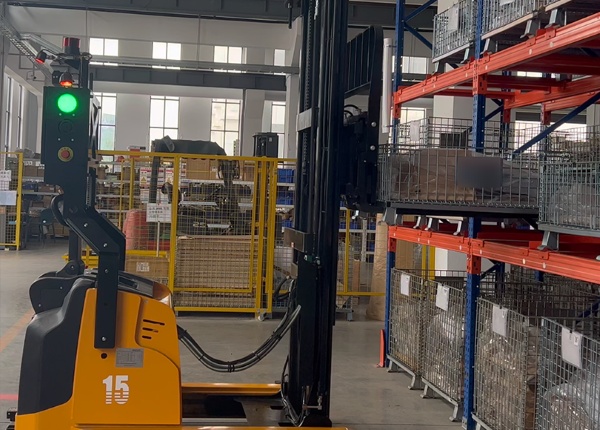
Unlike conventional forklifts driven by operators, AGVs rely heavily on sensors, onboard computers, communication modules, and electrical systems.
In high-dust environments, airborne particles can potentially affect:
LiDAR navigation sensors
Safety laser scanners
Vision cameras
Electronic control systems
Cooling fans and ventilation systems
Battery compartments
Wireless communication equipment
Without proper protection, dust accumulation can reduce sensor accuracy, increase maintenance requirements, and shorten component lifespan.
This is one of the most common concerns among factory managers evaluating AGV automation.
The good news is that modern industrial LiDAR systems are designed to operate in environments where dust, smoke, and airborne particles are present.
However, performance depends on dust concentration levels.
| Dust Environment | Typical LiDAR Performance |
|---|---|
| Light Industrial Dust | Minimal Impact |
| Moderate Dust Levels | Occasional Lens Cleaning Required |
| Heavy Cement or Brick Dust | Protective Measures Recommended |
| Extreme Dust Clouds | Additional Sensor Redundancy Required |
Most Chinese AGV suppliers utilize industrial-grade LiDAR systems equipped with:
Anti-dust protective covers
Optical contamination monitoring
Multi-sensor navigation fusion
Automatic fault detection algorithms
This allows the AGV to maintain navigation accuracy even when limited dust accumulation occurs on sensor surfaces.
Dust protection extends far beyond the navigation sensors.
Modern AGV forklifts use specially designed electronic compartments to isolate sensitive components from airborne contamination.
Many manufacturers install multi-stage filtration systems inside electronic bays.
These systems commonly include:
Pre-filter screens
Fine particulate filters
High-efficiency air filtration modules
Replaceable maintenance cartridges
Some AGV platforms create controlled airflow within electrical compartments, reducing the likelihood of dust entering sensitive areas.
Industrial AGVs often use sealed cooling solutions that prevent dust accumulation while maintaining safe operating temperatures.
Cleaning frequency varies significantly depending on environmental conditions.
Factors that influence maintenance intervals include:
Dust particle concentration
Vehicle operating hours
Airflow patterns inside the facility
Sensor placement design
Cleaning procedures already in place
In many manufacturing facilities, AGV inspection is incorporated into routine maintenance schedules.
Rather than asking how often cleaning is required, buyers should ask suppliers how sensor contamination is monitored and what preventive maintenance procedures are recommended for their specific industry.
Advanced systems may provide automatic alerts when sensor visibility drops below acceptable operating thresholds.
Yes. Many AGV manufacturers offer enhanced protection packages for dusty industrial environments.
One increasingly popular solution is the use of pressurized electrical enclosures.
These systems maintain positive internal air pressure, preventing dust from entering through small openings and cable entry points.
Benefits include:
Improved electronics reliability
Reduced contamination risk
Extended component lifespan
Lower maintenance requirements
Enhanced system uptime
For cement plants, mining operations, and brick factories, pressurized cabinet options are often recommended during project planning.
When evaluating AGV suppliers, buyers should consider additional protective features such as:
IP65 or higher protection ratings
Sealed industrial connectors
Protected charging interfaces
Industrial-grade safety laser scanners
Redundant navigation systems
Anti-static protection measures
Industrial shock and vibration resistance
These enhancements can significantly improve long-term reliability in demanding operating environments.
What ingress protection (IP) rating does the AGV provide?
Are LiDAR sensors protected against heavy dust accumulation?
Does the vehicle include multi-stage air filtration?
Are pressurized electrical cabinets available?
How is sensor contamination monitored?
What preventive maintenance schedule is recommended?
Can the AGV operate in cement, brick, or mining environments?
Are customer references available from similar industries?
High-dust manufacturing facilities present unique challenges for warehouse automation, but modern Chinese AGV forklifts are increasingly engineered to perform reliably in these environments.
With protected LiDAR systems, industrial filtration solutions, sealed electronics compartments, and optional pressurized cabinets, AGVs can successfully support operations in cement plants, brick factories, mining facilities, and other dust-intensive industries.
Before importing AGV forklifts from China, focus not only on load capacity and navigation technology but also on dust protection measures, filtration systems, enclosure design, and long-term maintenance requirements. These factors often determine the true reliability and ROI of an automation project in harsh industrial environments.
FREE ENGINEERING SUPPORTStop Gambling on Generic Platforms. Get an AGV/AMR Tailored to Your Warehouse.Buying automated guided vehicles involves complex safety standards (CE/ANSI), navigation setups (Laser SLAM), and ERP system integration. Don't risk your factory safety with middle-men. ✓ 100% Direct Factory: Customized payload up to 5 Tons. ✓ Free CAD Simulation: Send us your layout, and our engineers will simulate the optimal AGV routes. ✓ Global Support: Overseas installation guidance & local maintenance partners. |





 Chinese
 English