


When companies evaluate AGV forklifts from China, one of the most critical long-term cost factors is the lithium battery system. Unlike traditional forklifts, autonomous vehicles depend on stable, high-cycle energy systems to support 24/7 warehouse operations.
This raises several key procurement questions:
How long do AGV lithium batteries last? How many cycles can they handle? Can they be replaced locally? And can charging systems support continuous operation?
This article breaks down the real-world performance of industrial lithium battery systems used in Chinese AGV forklifts and how they impact long-term operational strategy.
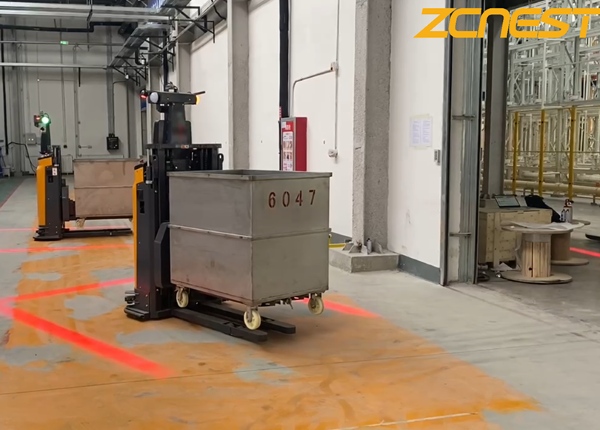
Modern Chinese AGV forklifts typically use industrial-grade lithium battery systems based on LiFePO4 (Lithium Iron Phosphate) chemistry.
Under standard warehouse conditions, the expected lifespan is:
5 to 8 years of operational service life
Stable performance across 3,000 to 6,000 cycles
Gradual capacity degradation after 4,000 cycles depending on usage intensity
Actual lifespan depends heavily on:
Charging frequency
Depth of discharge
Operating temperature
Charging infrastructure quality
AGV duty cycle (24/7 vs intermittent use)
Well-managed fleets using opportunity charging can often extend battery life beyond expected averages.
LiFePO4 batteries are widely used in AGV systems because of their stability and long cycle life.
| Battery Type | Typical Cycle Life | Application Suitability |
|---|---|---|
| Standard LiFePO4 | 3000–4000 cycles | Light to medium warehouse use |
| Industrial Grade LiFePO4 | 4000–6000 cycles | 24/7 AGV operations |
| High-performance Pack | 6000+ cycles | High automation logistics hubs |
Cycle life is directly influenced by temperature control, charging rate, and depth of discharge management.
Chinese AGV forklifts are often equipped with high-rate automatic charging systems designed for opportunity charging during short breaks.
Typical charging performance:
0% to 80%: 1.0 to 2.5 hours
80% to 100%: slower controlled charging to protect battery life
Most AGV systems are designed to avoid full deep discharge cycles. Instead, they rely on frequent partial charging to maximize uptime and extend battery lifespan.
This strategy is known as “opportunity charging” and is widely used in 24/7 logistics operations.
Yes. Depending on system design, Chinese AGV forklifts may support multiple energy management strategies.
Robot returns to charging station autonomously
No human intervention required
Best for continuous warehouse flow
Quick-release battery modules
Forklift-style battery replacement
Used in high-intensity 24/7 operations
Some heavy-duty AGV systems are designed with interchangeable battery packs, allowing operators to replace depleted batteries within minutes.
However, most modern warehouses prefer opportunity charging due to lower labor requirements and higher automation efficiency.
In principle, battery replacement is possible, but it requires technical validation.
AGV battery systems are tightly integrated with:
BMS (Battery Management System)
Voltage control logic
Charging communication protocols
Safety certification systems
If replacing with a local brand battery, key compatibility factors include:
Voltage matching
Communication protocol compatibility (CAN bus, RS485, etc.)
Physical dimensions and mounting design
Thermal management requirements
Charging curve alignment
In many cases, suppliers can support third-party battery integration, but it must be validated during system design—not after deployment.
What is the expected battery cycle life under real operating conditions?
Does the system support opportunity charging?
How long does it take to reach 80% charge?
Is battery swapping supported?
Can third-party batteries be integrated in the future?
What BMS communication protocols are used?
What is the warranty period for battery packs?
What is the degradation curve after 3–5 years?
Lithium battery systems are one of the most critical components in AGV forklift operations. When properly managed, LiFePO4 batteries used in Chinese AGVs can deliver 5–8 years of reliable performance with thousands of charge cycles.
For 24/7 warehouse automation, success depends not only on battery quality but also on charging strategy, system integration, and long-term maintenance planning.
Before importing AGV forklifts from China, evaluate the full energy ecosystem—battery chemistry, charging system speed, swapping capability, and future upgrade flexibility. These factors determine true operational uptime and ROI.
FREE ENGINEERING SUPPORT Stop Gambling on Generic Platforms. Get an AGV/AMR Tailored to Your Warehouse.Buying automated guided vehicles involves complex safety standards (CE/ANSI), navigation setups (Laser SLAM), and ERP system integration. Don't risk your factory safety with middle-men. ✓ 100% Direct Factory: Customized payload up to 5 Tons. ✓ Free CAD Simulation: Send us your layout, and our engineers will simulate the optimal AGV routes. ✓ Global Support: Overseas installation guidance & local maintenance partners. |





 Chinese
 English