


Many companies focus on AGV specifications, battery life, and lifting capacity when importing AGV forklifts from China. However, one of the most common causes of deployment delays is poor wireless network planning.
An AGV fleet is only as reliable as the communication network supporting it. Even the most advanced autonomous forklift can experience navigation interruptions, task delays, or fleet congestion if wireless coverage is unstable.
Before deploying AGV forklifts, buyers should understand wireless frequency support, latency requirements, roaming capabilities, and warehouse Wi-Fi coverage design.
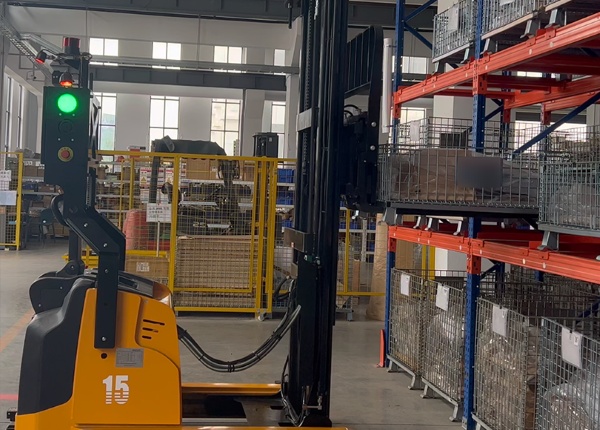
Modern AGV forklifts continuously exchange data with the Fleet Management System (FMS) or Robot Control System (RCS).
Typical communication includes:
Task assignment and dispatching
Real-time vehicle positioning
Traffic management
Battery monitoring
Obstacle and safety reporting
Remote diagnostics and software updates
If communication is interrupted, productivity drops immediately and, depending on system design, vehicles may stop for safety reasons.
A warehouse automation project should always include a wireless site survey before AGV installation begins.
Most modern Chinese AGV manufacturers equip their vehicles with industrial wireless communication modules supporting:
2.4GHz Wi-Fi
5GHz Wi-Fi
Dual-band operation
Each band offers different advantages:
| Frequency | Advantages | Limitations |
|---|---|---|
| 2.4GHz | Longer coverage distance | More interference |
| 5GHz | Higher bandwidth and lower congestion | Shorter signal range |
For most warehouse automation projects, 5GHz is preferred whenever infrastructure allows.
Latency directly affects fleet responsiveness.
Typical AGV system requirements:
Excellent: Below 30ms
Recommended: Below 50ms
Acceptable: Below 100ms
High Risk: Above 150ms
High latency can result in:
Delayed task execution
Traffic congestion at intersections
Slow obstacle response reporting
Reduced fleet efficiency
Most Chinese RCS platforms are optimized for low-latency industrial Wi-Fi environments operating under 50ms.
There is no universal number because warehouse layouts vary significantly.
However, common deployment guidelines include:
Coverage overlap between access points: 15%–25%
Signal strength target: -65dBm or better
Dedicated wireless design for AGV traffic lanes
Avoid blind spots behind tall racking systems
High-density pallet racking often blocks wireless signals, especially in:
Very Narrow Aisle (VNA) warehouses
Cold storage facilities
High-bay warehouses above 10 meters
Many AGV projects require additional access points compared to standard office Wi-Fi deployments.
As AGVs move throughout the facility, they continuously transition between wireless access points.
Without fast roaming technology, vehicles may experience:
Temporary communication loss
Navigation pauses
Task interruption
Position update delays
Many industrial AGV communication modules support:
802.11r Fast Roaming
802.11k Neighbor Reports
802.11v Network Assisted Roaming
Fast roaming capability is particularly important for high-speed AGVs operating across large warehouses or multiple buildings.
For maximum reliability, many successful AGV installations use:
Industrial-grade Wi-Fi 6 access points
Managed PoE network switches
Dedicated AGV VLAN
Centralized wireless controller
Redundant core network paths
24/7 network monitoring platform
Separating AGV traffic from office users and guest networks significantly improves communication stability.
Insufficient access point density
Coverage shadows behind steel racking
Roaming delays between floors
Interference from handheld scanners
Poor channel planning
Shared warehouse and office Wi-Fi congestion
Outdated consumer-grade networking equipment
These issues are far easier and cheaper to solve before deployment than after AGVs are operational.
Which wireless standards are supported?
Does the AGV support dual-band Wi-Fi?
Is 802.11r fast roaming supported?
What network latency is recommended?
Can the supplier perform a wireless site survey?
What signal strength is required throughout the warehouse?
Can the fleet manager operate across multiple buildings?
Are there network redundancy recommendations?
A reliable wireless infrastructure is one of the most important foundations of a successful AGV deployment. While Chinese AGV forklifts are increasingly equipped with advanced communication modules, overall system performance still depends on proper warehouse network design.
By planning coverage, latency, roaming, and access point density before installation, companies can avoid costly downtime and maximize automation efficiency from day one.
Before importing AGV forklifts from China, conduct a professional wireless network assessment. In modern warehouse automation, network quality directly affects robot productivity, safety, and ROI.
FREE ENGINEERING SUPPORT Stop Gambling on Generic Platforms. Get an AGV/AMR Tailored to Your Warehouse.Buying automated guided vehicles involves complex safety standards (CE/ANSI), navigation setups (Laser SLAM), and ERP system integration. Don't risk your factory safety with middle-men. ✓ 100% Direct Factory: Customized payload up to 5 Tons. ✓ Free CAD Simulation: Send us your layout, and our engineers will simulate the optimal AGV routes. ✓ Global Support: Overseas installation guidance & local maintenance partners. |





 Chinese
 English