


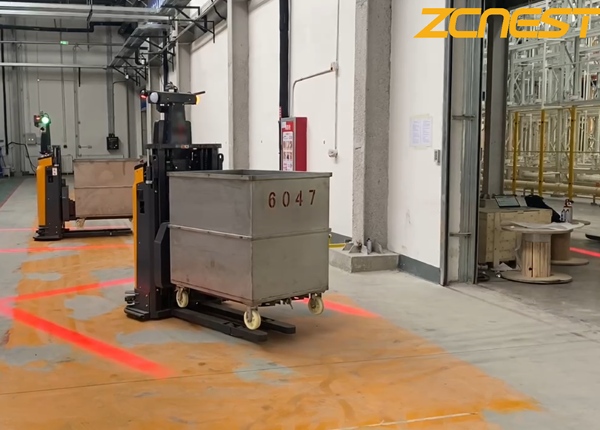
Unlike traditional forklift delivery, AGV systems require technical validation of software, navigation accuracy, fleet coordination, safety behavior, and real-world warehouse performance.
What KPIs must be met before sign-off? How long should error-free operation last? Who validates load capacity? And what happens if performance targets are not achieved?
The Site Acceptance Test (SAT) is conducted after installation, commissioning, and initial debugging. It verifies that the AGV system performs according to contract specifications under real warehouse conditions.
SAT typically confirms:
Navigation accuracy and stability
Fleet coordination and task execution
Safety system response behavior
Battery charging and operational endurance
Load handling performance
System reliability under continuous operation
This is the final validation before formal project acceptance and payment release.
Most Chinese AGV contracts define measurable KPIs that must be achieved before final approval.
Common SAT performance metrics include:
Navigation accuracy: ±10–30 mm depending on system type
Docking success rate: ≥ 99%
Task completion rate: ≥ 98–99%
Fleet uptime: ≥ 95–99%
Obstacle detection response time: within milliseconds
System stability: no critical failure during test window
All KPI thresholds should be explicitly defined in the contract before deployment begins.
A standard SAT requires uninterrupted operation to demonstrate system reliability under real warehouse load conditions.
Typical requirements include:
Basic systems: 24–48 hours continuous operation
Industrial warehouse deployments: 72 hours continuous operation
High-reliability logistics centers: up to 120 hours stress testing
During this period, the system must demonstrate:
No critical shutdowns
No repeated navigation failures
No systemic communication breakdowns
Stable fleet coordination under load variation
Short interruptions may be allowed depending on contract terms, but repeated failures usually reset the SAT clock.
To validate forklift lifting capacity, standardized certified test weights are used during SAT.
These weights are typically provided by:
Third-party testing agencies
Local accredited inspection companies
Customer-supplied certified industrial loads
Load tests verify:
Maximum lifting capacity
Load stability during transport
Braking performance under full load
Fork alignment accuracy under stress
Using uncertified or estimated weights is not acceptable in formal acceptance testing.
If the system does not meet agreed performance metrics, several outcomes are typically defined in commercial contracts.
Common resolutions include:
Additional debugging and optimization period
Software parameter tuning by supplier engineers
Hardware replacement or adjustment
Extended SAT retesting period
In more strict contracts:
Penalty clauses for missed KPIs
Partial payment withholding
Refund or system replacement options
Final acceptance should only be signed when performance is stable under real production conditions—not laboratory conditions.
A proper SAT is a multi-party verification process involving:
Customer project management team
Warehouse operations supervisors
Supplier engineering team (on-site or remote)
Third-party inspection agency (if required)
Electrical and IT infrastructure engineers
Each party verifies different aspects of system performance, ensuring objective validation.
Unstable Wi-Fi or network latency
Inaccurate warehouse floor mapping
Insufficient charging infrastructure
Sensor miscalibration under real load
Poor traffic management rules
Unrealistic KPI expectations not matched to environment
Most issues are not hardware failures, but system integration and environment mismatches.
Confirm all KPIs in contract before deployment
Prepare certified test weights in advance
Ensure warehouse network is fully stable
Validate floor conditions and navigation maps
Prepare 24/7 test operation schedule
Assign internal acceptance team
Document all performance test results
Define acceptance and rejection criteria clearly
The Site Acceptance Test is the final gateway between installation and full operational deployment. For AGV forklift projects imported from China, SAT is not just a technical formality—it is a contractual and operational validation of system readiness.
Clear KPIs, proper test conditions, and structured evaluation processes are essential to ensure long-term system success.
Before signing final acceptance for AGV forklifts from China, ensure performance is validated under real warehouse conditions—not ideal simulations. SAT is where automation promises become operational reality.
FREE ENGINEERING SUPPORT Stop Gambling on Generic Platforms. Get an AGV/AMR Tailored to Your Warehouse.Buying automated guided vehicles involves complex safety standards (CE/ANSI), navigation setups (Laser SLAM), and ERP system integration. Don't risk your factory safety with middle-men. ✓ 100% Direct Factory: Customized payload up to 5 Tons. ✓ Free CAD Simulation: Send us your layout, and our engineers will simulate the optimal AGV routes. ✓ Global Support: Overseas installation guidance & local maintenance partners. |





 Chinese
 English