


One of the most common misconceptions among companies importing AGV forklifts from China is that existing warehouse racking can be used without any evaluation. While many AGV systems can operate within standard warehouse environments, rack design and pallet positioning accuracy often determine whether automation succeeds or struggles.
Unlike manual forklift operators who can visually compensate for pallet misalignment, AGV forklifts depend on sensors, navigation algorithms, and repeatable positioning. Small rack inconsistencies that humans ignore can become major challenges for autonomous equipment.
Do your racks need modification? How much pallet spacing is required? Are guide rails necessary? And can Chinese AGVs work with push-back or gravity-flow storage systems?
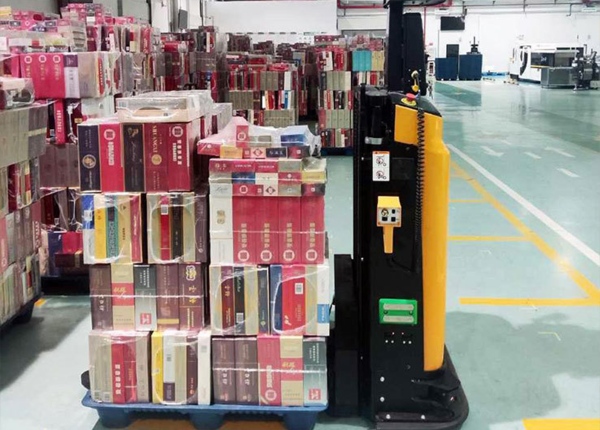
Manual forklift operators continuously make small steering and fork adjustments while placing pallets. AGV forklifts, however, rely on pre-defined coordinates and sensor feedback.
As a result, rack systems must provide:
Consistent pallet positions
Repeatable storage locations
Predictable rack geometry
Clear sensor visibility
Minimal structural deformation
The more consistent the storage environment, the higher the AGV success rate.
Many AGV deployment issues originate from pallet and rack inconsistencies rather than robot performance.
When pallets are stored side-by-side, AGVs require sufficient clearance to identify target loads accurately and avoid accidental contact.
The required spacing depends on:
Fork dimensions
Pallet type
Rack design
Sensor technology
Load size variation
In general, automated warehouses benefit from maintaining consistent pallet placement tolerances throughout the facility.
Key goals include:
Reducing pallet overlap
Ensuring fork entry alignment
Preventing adjacent load interference
Improving pallet identification accuracy
Specific clearance requirements should always be validated during the project design phase and acceptance testing.
Most modern Chinese reach-truck AGVs use laser navigation, SLAM mapping, reflectors, or natural navigation systems rather than mechanical guidance.
Because of this, physical steel guide rails are often unnecessary.
However, guide rails may still be beneficial in:
Very Narrow Aisle (VNA) applications
High-lift operations
Older warehouse facilities
Facilities with uneven floors
Guide rails can provide:
Additional positioning confidence
Reduced rack impact risk
Improved aisle consistency
Many modern AGV projects achieve excellent performance without guide rails when floor quality and navigation systems are properly designed.
Warehouse racks frequently contain:
Barcode labels
Reflective inventory tags
Location markers
Safety decals
Certain highly reflective materials can influence optical sensing systems under specific conditions.
Potential effects include:
Unexpected laser reflections
Reduced camera contrast
Navigation mapping inconsistencies
False object identification
Most modern AGV software is designed to filter environmental noise, but excessive reflective surfaces should be evaluated during commissioning.
A site survey and sensor validation test are recommended before full deployment.
Push-back racking introduces additional complexity because pallets are stored on inclined rolling mechanisms rather than fixed positions.
Successful AGV integration depends on:
Rack design accuracy
Pallet consistency
Fork positioning capability
Load stability requirements
Some AGV systems can be engineered to interact with push-back storage, but this typically requires project-specific validation and testing.
Push-back racking should never be assumed compatible without engineering review and operational testing.
Gravity-flow systems present similar challenges because pallet positions change dynamically after loading or unloading.
Potential concerns include:
Variable pallet stopping positions
Inconsistent load presentation
Changing sensor reference points
Additional safety considerations
Many AGV projects using gravity-flow storage require customized software logic and extensive commissioning tests.
In some cases, dedicated automation-friendly rack designs may provide higher long-term reliability.
Warehouse operators frequently implement the following upgrades before automation:
Rack alignment correction
Pallet position standardization
Damaged beam replacement
Improved rack labeling systems
Enhanced aisle visibility
Consistent pallet quality standards
Traffic and safety zoning updates
These improvements often increase both AGV performance and overall warehouse efficiency.
Can my current rack system support AGV operations?
What pallet positioning tolerances are recommended?
Are guide rails required for my aisle width?
Will reflective labels affect navigation performance?
Can the AGV handle push-back racking safely?
Is gravity-flow storage compatible with the system?
What rack modifications are typically required?
Will rack validation be included during commissioning?
Successful AGV deployment depends not only on the vehicle itself but also on the storage environment it operates within. Rack alignment, pallet consistency, aisle conditions, and storage system design all play critical roles in automation performance.
Before importing AGV forklifts from China, warehouse operators should conduct a detailed rack assessment to identify potential obstacles and determine whether modifications are necessary.
The most successful AGV projects begin with an automation-ready warehouse. Optimizing your racking system before installation can significantly improve productivity, safety, and long-term return on investment.
FREE ENGINEERING SUPPORT Stop Gambling on Generic Platforms. Get an AGV/AMR Tailored to Your Warehouse.Buying automated guided vehicles involves complex safety standards (CE/ANSI), navigation setups (Laser SLAM), and ERP system integration. Don't risk your factory safety with middle-men. ✓ 100% Direct Factory: Customized payload up to 5 Tons. ✓ Free CAD Simulation: Send us your layout, and our engineers will simulate the optimal AGV routes. ✓ Global Support: Overseas installation guidance & local maintenance partners. |





 Chinese
 English