


When overseas buyers compare AGV forklift suppliers, discussions often focus on payload capacity, navigation technology, batteries, and software. However, one of the most critical components inside every autonomous vehicle receives surprisingly little attention—the onboard Industrial PC (IPC).
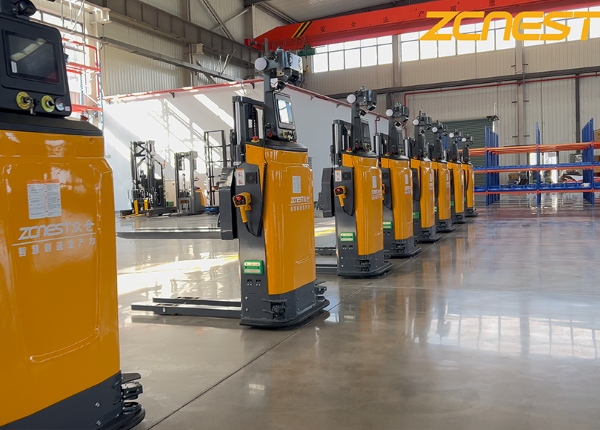
The IPC is the computing platform responsible for running navigation algorithms, processing sensor data, communicating with the fleet management system, controlling motion, and executing safety-related tasks. In many respects, it functions as the "brain" of the AGV.
An underpowered or poorly designed IPC can lead to slower response times, reduced system stability, unexpected downtime, and expensive maintenance. Conversely, a well-engineered industrial computer helps ensure reliable operation even in demanding warehouse environments.
Before purchasing AGV forklifts from China, buyers should evaluate more than processor specifications. Ruggedness, operating system architecture, thermal management, storage reliability, and long-term serviceability all have a direct impact on fleet performance and lifecycle cost.
Every autonomous forklift continuously processes thousands of data points while moving through the warehouse.
The onboard IPC typically coordinates:
Navigation and localization algorithms
Laser scanner and LiDAR data processing
Camera image processing
Wheel encoder calculations
Fleet communication
Motion control commands
Obstacle detection logic
Safety monitoring functions
Human-machine interface (HMI)
Diagnostic and maintenance logs
Because multiple systems operate simultaneously, the IPC must deliver stable computing performance without interruption, even during continuous multi-shift operations.
A high-performance navigation system is only as dependable as the industrial computer running it.
Unlike desktop computers, AGV industrial PCs operate inside constantly moving vehicles that experience vibration, shock loads, and repeated acceleration throughout the day.
A properly designed IPC should be engineered to withstand industrial operating conditions rather than office environments.
Important design characteristics may include:
Industrial-grade enclosure construction
Shock-resistant internal mounting
Secure connector locking mechanisms
Vibration-resistant circuit board design
Industrial power input protection
High-reliability industrial connectors
Buyers should ask suppliers how the IPC has been validated for long-term operation in mobile warehouse equipment rather than assuming all industrial computers offer the same durability.
The operating system plays a major role in overall system stability, cybersecurity, software compatibility, and long-term maintenance.
Depending on the supplier's software architecture, the IPC may operate on different platforms designed for industrial automation.
When evaluating suppliers, buyers should discuss topics such as:
System stability during continuous operation
Real-time task scheduling capabilities
Cybersecurity update policies
Long-term software support
Compatibility with fleet management software
Backup and recovery procedures
Rather than selecting a platform based solely on familiarity, buyers should evaluate whether the operating system aligns with the supplier's automation architecture and long-term support strategy.
Software reliability is determined not only by the operating system itself, but also by how well the entire automation platform is engineered and maintained.
Industrial PCs installed inside AGVs typically operate within enclosed electrical compartments where airflow may be limited.
During continuous operation, processors generate heat that must be effectively managed to maintain stable performance.
Common thermal protection strategies may include:
Passive aluminum heat sinks
Industrial fan-assisted cooling
Heat pipe technology
Thermal monitoring sensors
Automatic processor throttling
Optimized enclosure airflow design
Effective thermal management becomes especially important in environments such as:
High-temperature warehouses
Steel manufacturing plants
Paper mills
Distribution centers operating around the clock
Facilities with heavy-duty lifting cycles
Buyers should request information about the supplier's thermal design philosophy and environmental operating specifications.
Most modern AGVs rely on solid-state drives (SSDs) to store operating systems, navigation software, configuration files, and historical logs.
Although SSDs provide excellent performance, buyers should understand how the supplier handles maintenance and recovery if storage problems occur.
Questions worth discussing include:
Can the SSD be replaced without replacing the entire IPC?
Are configuration backups automatically created?
How is software restored after storage replacement?
Are industrial-grade SSDs used?
What procedures are recommended for data recovery?
A well-designed AGV should support efficient maintenance while protecting important operational data.
Storage replacement should be a planned maintenance procedure—not an emergency requiring complete system reconfiguration.
Beyond computing performance, procurement teams should consider the following factors:
Available communication interfaces
Industrial Ethernet support
CAN bus compatibility
USB service ports
Expansion capabilities
Remote diagnostic access
Event logging functions
Cybersecurity protection mechanisms
Hardware watchdog systems
Power failure recovery functions
These capabilities contribute to easier maintenance, improved diagnostics, and greater long-term flexibility.
What industrial PC platform is installed?
How has the IPC been tested for vibration resistance?
Which operating system supports the automation software?
How is processor temperature managed during continuous operation?
Can storage devices be replaced in the field?
How are software backups and recovery handled?
Is remote diagnostics supported?
How are firmware and operating system updates managed?
What is the expected service life of the IPC?
Are replacement components available internationally?
While processor speed and memory capacity are important, they represent only part of the overall picture.
A reliable AGV computing platform combines rugged hardware, stable software architecture, efficient cooling, dependable storage, and strong maintenance support into a single integrated solution.
When comparing suppliers, procurement teams should evaluate how these elements work together to support reliable warehouse automation over many years of continuous operation.
The onboard Industrial PC is one of the most important components inside an AGV forklift. It influences navigation accuracy, operational stability, maintenance efficiency, cybersecurity, and long-term system reliability.
By evaluating rugged construction, operating system strategy, thermal protection, storage architecture, and serviceability, overseas buyers can make more informed purchasing decisions and reduce operational risk throughout the lifecycle of their automation investment.
When comparing AGV suppliers, don't stop at the vehicle specifications. Ask what industrial computer powers the system, how it is protected, and how easily it can be maintained—because the reliability of your entire fleet depends on it.
FREE ENGINEERING SUPPORT Stop Gambling on Generic Platforms. Get an AGV/AMR Tailored to Your Warehouse.Buying automated guided vehicles involves complex safety standards (CE/ANSI), navigation setups (Laser SLAM), and ERP system integration. Don't risk your factory safety with middle-men. ✓ 100% Direct Factory: Customized payload up to 5 Tons. ✓ Free CAD Simulation: Send us your layout, and our engineers will simulate the optimal AGV routes. ✓ Global Support: Overseas installation guidance & local maintenance partners. |





 Chinese
 English