


Many first-time AGV buyers assume that navigation technology is simply a specification on a product brochure. In reality, the positioning system determines how easy the vehicle will be to deploy, maintain, expand, and troubleshoot over the next ten years.
If you are considering AGV forklifts that use optical barcode positioning, the important question isn't "How does the camera read a QR code?" The real question is whether QR-code navigation fits your warehouse, your maintenance team, and your long-term automation strategy.
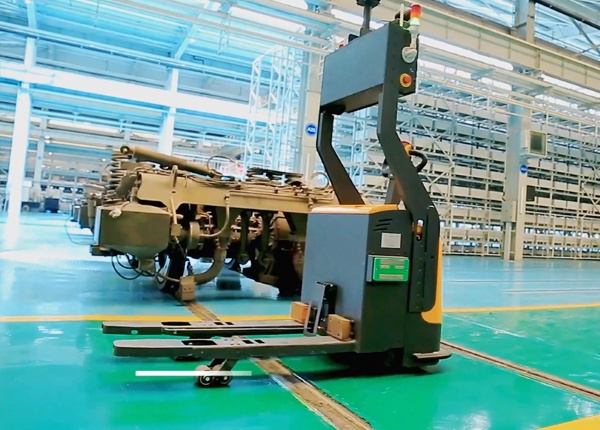
When evaluating Chinese AGV suppliers, many procurement teams immediately ask whether the vehicle uses downward-facing cameras or laser navigation.
However, experienced automation engineers usually begin somewhere else:
Will the navigation remain reliable after years of daily operation?
How much maintenance does the positioning system require?
Can damaged floor markers be replaced quickly?
How expensive is future warehouse expansion?
Can local technicians troubleshoot the system without waiting for overseas support?
These operational questions often have a much greater impact on long-term ownership costs than the navigation technology itself.
QR-code navigation relies on optical cameras mounted beneath the AGV to periodically identify coded floor markers installed throughout the warehouse.
Instead of continuously measuring the environment like laser-based systems, the vehicle regularly updates its position whenever it passes over a recognized location marker.
This approach offers several operational advantages for facilities with clearly defined travel routes and repeatable logistics workflows.
Simple Route Layout
Easy to understand and document for maintenance teams.
High Repeatability
Suitable for production lines with fixed transportation paths.
Lower Deployment Complexity
Generally easier to commission than some advanced navigation systems.
This is one of the most common concerns among warehouse operators.
Floor markers may gradually become dirty, scratched, or partially covered due to heavy warehouse traffic, dust, or pallet movement.
Rather than asking whether damage is possible, buyers should understand how the supplier's navigation software responds when a marker cannot be read.
Important evaluation questions include:
Can the AGV continue operating until the next valid position marker?
How are positioning errors detected?
Does the fleet management software generate maintenance alerts?
How quickly can damaged markers be replaced?
Can maintenance personnel perform replacement without factory assistance?
A mature navigation system should tolerate occasional marker damage without immediately stopping warehouse operations.
Many companies compare only the purchase price of barcode cameras during supplier evaluation.
However, the long-term maintenance strategy is usually more important than the replacement cost of a single sensor.
| Evaluation Item | Why It Matters |
|---|---|
| Camera accessibility | Reduces maintenance time |
| Replacement availability | Minimizes equipment downtime |
| Calibration process | Simplifies local servicing |
| Spare parts inventory | Supports continuous production |
Many automation projects begin with only a few AGVs but gradually expand into larger warehouse systems.
Before choosing QR-code navigation, buyers should ask whether additional travel routes, workstations, production lines, or storage areas can be integrated without major operational disruption.
The scalability of the positioning system may ultimately have a greater financial impact than the original equipment purchase price.
How tolerant is the system to damaged QR codes?
Can local technicians replace floor markers?
How often do cameras require cleaning?
How are positioning errors reported?
Can navigation routes be expanded easily?
How quickly are replacement sensors delivered?
QR-code navigation is not simply a positioning technology—it is a long-term operational strategy. The best solution depends on your warehouse environment, maintenance capabilities, expansion plans, and production requirements.
Instead of focusing solely on camera specifications, overseas buyers should evaluate how the entire positioning system performs throughout its lifecycle, including maintenance, spare parts availability, software diagnostics, and future scalability.
The best navigation system isn't the one with the most advanced hardware—it's the one your warehouse can operate reliably every day with minimal maintenance and maximum uptime.
FREE ENGINEERING SUPPORT Stop Gambling on Generic Platforms. Get an AGV/AMR Tailored to Your Warehouse.Buying automated guided vehicles involves complex safety standards (CE/ANSI), navigation setups (Laser SLAM), and ERP system integration. Don't risk your factory safety with middle-men. ✓ 100% Direct Factory: Customized payload up to 5 Tons. ✓ Free CAD Simulation: Send us your layout, and our engineers will simulate the optimal AGV routes. ✓ Global Support: Overseas installation guidance & local maintenance partners. |





 Chinese
 English