


Beverage warehouses require more than simple pallet transportation. Automation must handle high-volume operations while protecting fragile loads, managing wet environments, and maintaining consistent delivery speed.
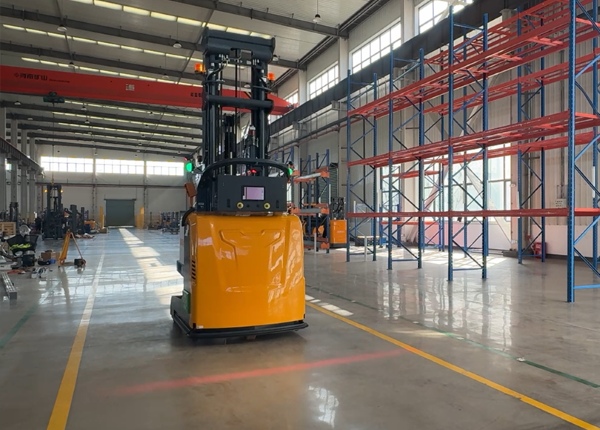
When beverage manufacturers evaluate AGV forklifts from China, the main concern is not only whether the robot can move pallets.
The real question is:
Beverage logistics involves heavy pallet loads, continuous warehouse movement, moisture exposure, and strict delivery schedules. A successful AGV project must solve all these challenges together.
Production facilities require continuous transportation between production lines, storage areas, and shipping zones.
Canned drinks and bottled products require controlled movement to prevent shifting or damage.
Spilled liquids can affect traction, sensors, and daily operating reliability.
Beverage plants need automation systems capable of maintaining stable output over long shifts.
One of the biggest concerns in beverage automation is product damage caused by sudden acceleration, sharp turns, or unstable pallet handling.
A professional AGV solution should optimize movement parameters based on load characteristics instead of simply operating at maximum speed.
Smooth acceleration and deceleration control
Stable turning behavior under heavy loads
Accurate pallet positioning
Controlled lifting and lowering movements
Safe handling of different pallet conditions
Some beverage facilities consider transporting multiple pallets in one operation to improve efficiency.
However, increasing payload capacity requires careful evaluation of stability, center of gravity, braking performance, and floor conditions.
| Evaluation Area | Why It Matters |
|---|---|
| Load Balance | Prevents pallet instability during movement |
| Braking Control | Maintains safe stopping distance |
| Fork Structure | Supports repeated heavy-duty cycles |
Unlike dry warehouses, beverage facilities may experience water, syrup, condensation, and occasional product leakage.
The AGV solution should consider:
Wheel traction performance
Protection of electrical components
Sensor reliability in changing environments
Easy cleaning and maintenance procedures
Floor condition management
Hourly pallet movement capacity depends on more than the maximum driving speed.
A realistic evaluation should include:
Travel Distance
Average distance between pickup and delivery points.
Loading Time
Time required for lifting and positioning pallets.
Traffic Management
Efficiency when multiple AGVs operate together.
Can the AGV maintain stable operation during continuous beverage production?
How does the system prevent product damage during acceleration and turning?
Can the vehicle operate safely in wet warehouse areas?
How is hourly pallet throughput calculated?
Can the AGV fleet scale when production volume increases?
What testing is completed before delivery?
For beverage companies, AGV automation is not only about replacing manual forklift operations. It is about creating a reliable logistics system that improves productivity while protecting products and maintaining stable factory performance.
The best AGV supplier should understand beverage industry challenges and provide a complete solution covering load handling, warehouse conditions, software scheduling, and long-term operational reliability.
FREE ENGINEERING SUPPORT Stop Gambling on Generic Platforms. Get an AGV/AMR Tailored to Your Warehouse.Buying automated guided vehicles involves complex safety standards (CE/ANSI), navigation setups (Laser SLAM), and ERP system integration. Don't risk your factory safety with middle-men. ✓ 100% Direct Factory: Customized payload up to 5 Tons. ✓ Free CAD Simulation: Send us your layout, and our engineers will simulate the optimal AGV routes. ✓ Global Support: Overseas installation guidance & local maintenance partners. |





 Chinese
 English