


AGV suppliers often provide cycle-time estimates when discussing warehouse throughput. These figures can be useful during preliminary planning, but an overseas buyer should understand exactly what the number represents before using it to calculate fleet capacity.
A quoted cycle time is not necessarily the same as the time required to complete a real pallet mission in a working warehouse.
Different suppliers may use different definitions of cycle time.
One supplier may measure only loaded travel. Another may include pickup and drop-off. Another may include empty repositioning and waiting.
Before comparing two suppliers, define exactly where the measurement starts and ends.
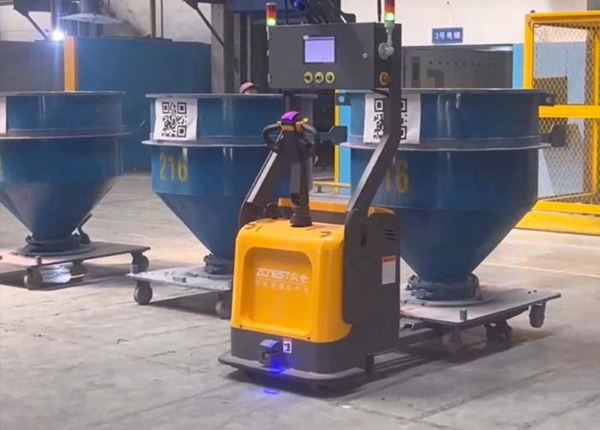
A complete automated forklift mission may include:
Empty travel to the pickup location
Pickup positioning
Fork insertion
Load lifting
Loaded travel
Destination positioning
Pallet placement
Fork withdrawal
Empty travel to the next mission
Waiting caused by traffic or station availability
Each step can affect the actual mission time.
Maximum travel speed is only one specification.
An AGV may travel at its maximum speed on an open section of floor but operate more slowly near racks, intersections, pedestrians, doors, or other vehicles.
For warehouse planning, completed pallet missions are generally more meaningful than maximum unloaded travel speed.
Ask the supplier to calculate or demonstrate cycle time using representative warehouse routes.
Choose actual pickup and destination locations. Include both short and long routes, as well as routes involving high-level storage or narrow aisles when those conditions apply to the project.
This prevents a short showroom route from becoming the basis for a much larger production fleet.
Loaded travel can have different operating conditions from empty travel.
Payload, load center, lifting requirements, braking behavior, and positioning requirements can all influence mission time.
Recording the different portions separately makes the supplier's calculation easier to review.
For an automated forklift, pickup and placement can be more complicated than simply driving to a location.
The vehicle may need to align with the pallet, insert the forks, lift the load, approach the rack, position accurately, and place the pallet.
High-bay and narrow-aisle applications should therefore be tested under representative load and lift conditions.
A single AGV operating alone cannot show fleet-level traffic behavior.
When multiple vehicles operate simultaneously, they may encounter shared aisles, intersections, staging queues, and mission conflicts.
Run repeated tests with multiple vehicles whenever possible.
One successful cycle does not establish a reliable production cycle time.
Repeat the same mission several times and record the variation. Waiting, positioning, traffic, and other operating conditions can cause the actual time to vary.
The test should also use the same pallet and payload conditions when comparing different suppliers.
Even an accurate cycle-time measurement does not automatically determine fleet throughput.
Fleet capacity is also affected by congestion, charging, task distribution, vehicle availability, shared workstations, and WMS task demand.
Therefore, buyers should avoid simply multiplying one theoretical cycle-time result by the number of AGVs.
| Test Condition | Define Before Testing |
|---|---|
| Route | Exact pickup and drop-off locations |
| Payload | Representative pallet and load |
| Lift height | Actual operating requirement |
| Traffic | Defined vehicle and pedestrian conditions |
| Measurement | Repeatable timing method |
The objective is not to find the fastest demonstration. It is to determine whether the supplier's cycle-time assumption remains realistic under the conditions in which the AGV will actually operate.
A clearly defined and repeatable cycle-time test gives procurement and engineering teams a much stronger basis for evaluating an automated forklift project.





 Chinese
 English