


However, communication infrastructure is equally important. An AGV fleet depends on stable wireless communication between robots, fleet management systems, warehouse software, and operators.
As private 5G networks become more common in industrial environments, many companies are evaluating whether this technology can improve AGV reliability, scalability, and security.
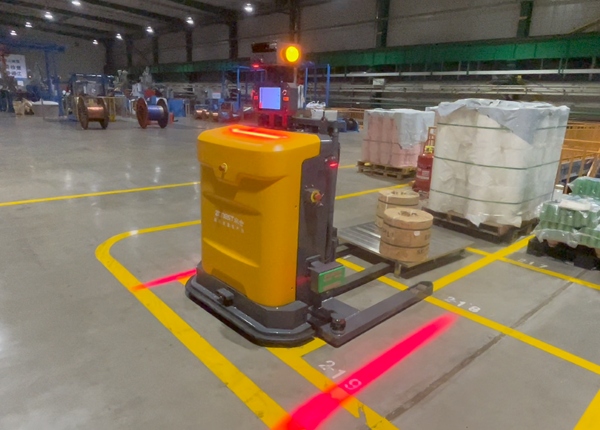
An AGV is not an isolated machine. It continuously exchanges information with multiple systems, including:
Robot Control System (RCS)
Fleet management platform
Warehouse Management System (WMS)
Enterprise Resource Planning (ERP)
Safety monitoring systems
If wireless communication becomes unstable, the impact may include delayed commands, slower traffic coordination, and reduced operational efficiency.
For large warehouses, communication reliability becomes a key factor when scaling from several AGVs to dozens or hundreds of vehicles.
Industrial Wi-Fi networks can support many AGV applications, but certain warehouse environments create additional challenges.
Common issues include:
Signal interference from industrial equipment
Coverage problems in deep rack aisles
Roaming delays when AGVs move between access points
Network congestion with many connected devices
Difficulties maintaining consistent performance across large facilities
These challenges become more noticeable in high-bay warehouses, narrow aisles, and facilities with large metal structures.
Private 5G networks are designed specifically for industrial environments where companies require greater control over wireless communication.
Potential advantages include:
More predictable network performance
Lower communication latency
Higher device connection capacity
Better network management
Dedicated industrial wireless coverage
For AGV fleets, improved communication consistency can support smoother traffic coordination and more reliable operation.
Private 5G can improve wireless coverage planning, but it does not automatically eliminate every communication problem.
Warehouse performance depends on:
Building structure
Rack configuration
5G frequency selection
Antenna placement
Network design
Before deployment, companies should perform a wireless site survey to determine the optimal network architecture.
Compatibility depends on the communication hardware and software architecture used by each AGV manufacturer.
Before purchasing, overseas buyers should confirm:
Communication module specifications
Supported network frequencies
SIM card compatibility
Ethernet or wireless gateway options
RCS communication protocol
API integration capability
Some AGVs can integrate with private 5G through industrial communication gateways, while others may require hardware modifications.
Lower latency can improve communication speed between AGVs and centralized control systems.
This can be valuable for applications requiring:
High-density AGV traffic management
Real-time fleet coordination
Dynamic route optimization
Fast response safety systems
However, actual performance depends on the complete system design, including robot controller response time, software architecture, and warehouse layout.
Security is becoming increasingly important as warehouses become more connected.
Private 5G networks can provide additional control through:
Dedicated network infrastructure
Controlled user access
Network segmentation
Enterprise security policies
Centralized monitoring
However, security depends on proper configuration, device management, software updates, and overall cybersecurity practices.
Private 5G may become valuable when companies have:
Large warehouse facilities
Dozens or hundreds of AGVs
High-density automation systems
Strict reliability requirements
Complex WMS and RCS integration
Future plans for industrial IoT expansion
For smaller AGV deployments, optimized industrial Wi-Fi may still provide sufficient performance at a lower cost.
Can your AGV communicate through private 5G networks?
What communication modules are installed?
Does the system support industrial gateways?
Can the RCS operate on a customer's local network?
What network requirements are needed for fleet expansion?
How is remote support handled under private network conditions?
Are cybersecurity requirements supported?
Private 5G is not a replacement technology that every AGV project immediately requires. Its value depends on warehouse size, fleet scale, reliability requirements, and future automation plans.
For companies importing AGV forklifts from China, evaluating communication infrastructure early can prevent future limitations and create a more scalable automation environment.
FREE ENGINEERING SUPPORT Stop Gambling on Generic Platforms. Get an AGV/AMR Tailored to Your Warehouse.Buying automated guided vehicles involves complex safety standards (CE/ANSI), navigation setups (Laser SLAM), and ERP system integration. Don't risk your factory safety with middle-men. ✓ 100% Direct Factory: Customized payload up to 5 Tons. ✓ Free CAD Simulation: Send us your layout, and our engineers will simulate the optimal AGV routes. ✓ Global Support: Overseas installation guidance & local maintenance partners. |





 Chinese
 English