

Enterprise customers also need to understand a critical question:
How can we protect our operational data, intellectual property, and cybersecurity when connecting Chinese AGV systems to our facility?
For global manufacturers, logistics companies, and warehouses, data protection should be evaluated before signing an AGV purchase agreement.
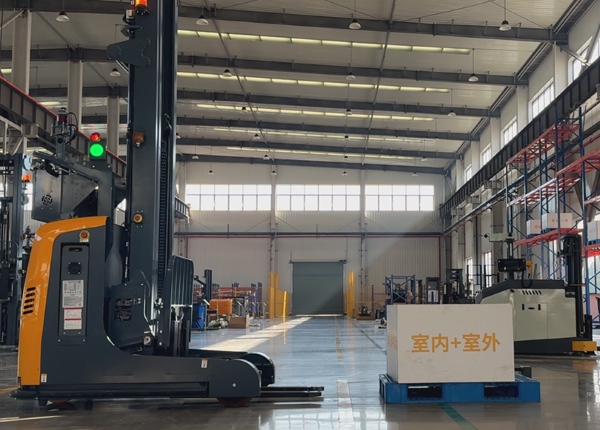
Modern AGV forklifts are connected industrial systems. They communicate with warehouse software, fleet management platforms, and internal networks.
During daily operation, AGV systems may generate information such as:
Robot location data
Warehouse navigation maps
Task execution records
Equipment status information
Maintenance history
Sensor information
Production or logistics flow data
Some of this information is operational data, while some may represent valuable business information that companies want to protect.
Before purchasing AGV forklifts, companies should request a clear explanation of what data is collected and why it is required.
Important questions include:
Does the AGV use cameras or only LiDAR sensors?
Are images stored permanently?
Does the system capture employee faces?
Are warehouse maps uploaded to external servers?
Does the supplier access operation records?
Different AGV systems have different architectures. Some process data locally inside the factory, while others may use cloud-based platforms.
Data storage location is one of the most important questions for international buyers.
Companies should confirm whether data is stored in:
Customer local server
Factory industrial computer
Private cloud environment
Supplier cloud platform
Overseas data center
Before deployment, buyers should define:
Who owns the data
Who can access the data
How long data is retained
How data is deleted
How backups are managed
Remote support is often required for AGV troubleshooting, software updates, and system optimization.
However, enterprise customers usually do not allow unlimited remote access.
A secure remote support process should include:
Customer approval before connection
Time-limited access windows
User authentication
Access activity records
Permission management
Customer IT supervision
Companies can include these requirements in the technical agreement before installation.
AGV projects often involve sensitive operational information.
Examples include:
Warehouse layout design
Material flow process
Production scheduling information
Inventory movement patterns
Custom automation workflows
Companies should clearly define ownership of:
Digital warehouse maps
Software configuration files
Integration documents
Customized algorithms
Operation reports
Enterprise customers often ask whether AGV suppliers comply with international cybersecurity standards.
The required certification depends on the company's internal security policy and deployment model.
During supplier evaluation, companies may review:
Information security management procedures
Network protection methods
User access control
Data encryption practices
Software update procedures
Security incident response process
Certifications can provide additional confidence, but the actual system architecture and access control process are equally important.
| Security Topic | Questions To Ask |
|---|---|
| Data Collection | What information does the AGV collect during operation? |
| Data Storage | Where are logs and maps physically stored? |
| Remote Access | Can access require customer approval? |
| Ownership | Who owns operational data and software configuration? |
| Security | What cybersecurity documents can be provided? |
Can the AGV system operate with a local server?
Where are daily operation logs stored?
Does the system upload warehouse maps externally?
Can remote support require customer approval?
Who owns the generated operation data?
What cybersecurity measures are implemented?
What software access permissions are available?
How are software updates controlled?
AGV automation is not only a hardware investment. It is also a digital infrastructure decision.
By reviewing data ownership, storage location, remote access rules, and cybersecurity requirements before deployment, companies can reduce risks and build stronger long-term relationships with AGV suppliers.
For companies importing AGV forklifts from China, a clear data protection strategy is an essential part of successful warehouse automation.
FREE ENGINEERING SUPPORT Stop Gambling on Generic Platforms. Get an AGV/AMR Tailored to Your Warehouse.Buying automated guided vehicles involves complex safety standards (CE/ANSI), navigation setups (Laser SLAM), and ERP system integration. Don't risk your factory safety with middle-men. ✓ 100% Direct Factory: Customized payload up to 5 Tons. ✓ Free CAD Simulation: Send us your layout, and our engineers will simulate the optimal AGV routes. ✓ Global Support: Overseas installation guidance & local maintenance partners. |





 Chinese
 English