


When companies introduce AGV forklifts into existing warehouses, one of the biggest concerns is not transportation efficiency.
The real question is:
Can autonomous forklifts safely operate in the same environment as human workers?
In modern warehouses and factories, AGVs are often expected to share working areas with operators, maintenance staff, and other equipment.
Therefore, safety design, detection capability, and compliance standards should be evaluated before deployment.
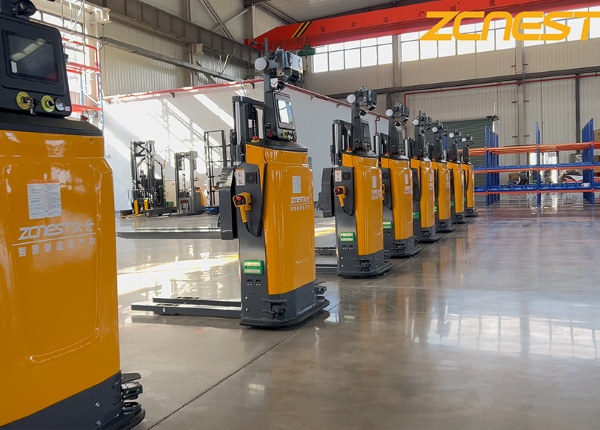
Unlike traditional automated systems operating inside isolated areas, modern AGV forklifts often work in dynamic environments.
Typical mixed-operation environments include:
Warehouse aisles
Loading areas
Production supply zones
Packaging areas
Material staging locations
Because people and robots share the same space, the AGV system must continuously monitor surroundings and respond safely.
Modern AGV forklifts typically use multiple sensing technologies instead of relying on one detection method.
Common safety technologies include:
Safety laser scanners
LiDAR sensors
3D cameras
Ultrasonic sensors
Collision detection systems
Safety controllers
The purpose of these systems is to detect obstacles, monitor working zones, and trigger appropriate safety responses.
A properly configured AGV should not simply continue driving when an unexpected obstacle appears.
Typical safety responses include:
Reduce travel speed
Enter warning mode
Stop movement
Wait until the path is clear
Request operator assistance
The actual stopping behavior depends on vehicle speed, load condition, sensor configuration, and safety parameter settings.
Blind spot management is especially important for forklift-type AGVs because their loads may affect visibility.
Safety design may include:
Multiple sensor coverage areas
360-degree scanning
Rear obstacle detection
Side protection zones
Speed limitation in narrow areas
During deployment, the safety coverage should be tested according to the actual warehouse layout.
For international projects, buyers should verify safety documentation instead of relying only on product descriptions.
Relevant standards may include:
ISO 3691-4 safety requirements for driverless industrial trucks
ANSI industrial mobile robot safety guidelines
CE compliance requirements
Machine safety risk assessment documentation
The exact certification requirements depend on the destination country and application environment.
Every warehouse has different traffic conditions, aisle widths, and human interaction levels.
Professional AGV systems usually allow configuration of:
Maximum travel speed
Deceleration zones
Stopping distance
Restricted areas
Slow-speed zones
Human interaction areas
Customization allows the AGV to match the actual operating environment instead of using identical settings everywhere.
Stopping distance is not determined only by the sensor system.
Important factors include:
Vehicle speed
Payload weight
Floor condition
Tire condition
Sensor response time
Control system reaction time
Safety validation should be performed under real operating conditions.
Technology alone cannot create a safe workplace. Human behavior is also important.
Employee training should cover:
AGV operating principles
Robot warning signals
Restricted areas
Emergency procedures
Safe interaction rules
| Safety Area | Questions To Verify |
|---|---|
| Detection | What sensors detect people and obstacles? |
| Emergency Response | How does the AGV stop during unexpected events? |
| Certification | What safety standards and documents are available? |
| Customization | Can safety zones be adjusted for the facility? |
Which safety standards does the AGV comply with?
What sensors are used for human detection?
Can stopping zones be customized?
How is safety validation performed?
Can the AGV operate in mixed human environments?
What safety documents are provided before installation?
How are software safety updates managed?
Safe human-robot collaboration is one of the most important factors when introducing AGV forklifts into existing operations.
A successful deployment requires more than purchasing an autonomous vehicle. Companies should evaluate sensor technology, safety standards, configuration flexibility, employee training, and real-world operating conditions.
For businesses importing AGV forklifts from China, a complete safety evaluation helps create a reliable automation system where people and robots can work together effectively.
FREE ENGINEERING SUPPORT Stop Gambling on Generic Platforms. Get an AGV/AMR Tailored to Your Warehouse.Buying automated guided vehicles involves complex safety standards (CE/ANSI), navigation setups (Laser SLAM), and ERP system integration. Don't risk your factory safety with middle-men. ✓ 100% Direct Factory: Customized payload up to 5 Tons. ✓ Free CAD Simulation: Send us your layout, and our engineers will simulate the optimal AGV routes. ✓ Global Support: Overseas installation guidance & local maintenance partners. |





 Chinese
 English