


Battery performance is one of the most important factors affecting the productivity of an AGV fleet. For warehouse managers, the key question is not simply how large the battery is, but whether the vehicles can support continuous operations without disrupting material flow.
When evaluating Chinese AGV forklifts, buyers should consider battery endurance, charging strategy, charging infrastructure and long-term maintenance rather than focusing only on battery specifications.
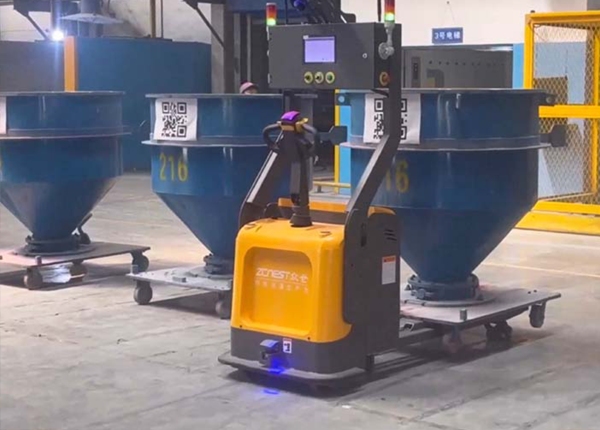
A well-designed battery management strategy helps ensure that AGVs remain available throughout daily warehouse operations while minimizing unnecessary downtime.
Before selecting a system, companies should evaluate:
Operating hours per shift
Number of daily charging cycles
Fleet utilization rate
Charging strategy
Future expansion requirements
Actual operating time depends on multiple factors rather than battery capacity alone.
Performance may vary based on:
Payload weight
Travel distance
Lifting frequency
Warehouse temperature
Driving speed
Shift schedule
Companies operating two or three shifts should evaluate battery performance under their own workload rather than relying solely on laboratory data.
Modern AGV fleets are typically designed to manage charging automatically as part of daily operations.
A typical charging workflow may include:
The fleet management software continuously monitors battery levels.
When the battery reaches a predefined threshold, the system schedules charging.
The AGV completes its current task before traveling to an available charging station.
After charging, the vehicle automatically returns to normal warehouse operations.
Automated charging helps reduce manual intervention and keeps fleet utilization at a high level.
Many warehouses use opportunity charging to maximize equipment availability.
Instead of waiting for a full discharge, AGVs may recharge during planned idle periods such as:
Shift changes
Lunch breaks
Scheduled production pauses
Temporary task gaps
This charging strategy can help reduce the need for extended charging sessions while supporting continuous operations.
Charging stations should be planned as part of the overall warehouse automation project.
Before installation, companies should review:
Electrical power availability
Charging station locations
Cable routing
Floor space allocation
Network connectivity
Safety clearances
Proper infrastructure planning helps support reliable fleet operation and future expansion.
Battery lifecycle management is an important part of the total cost of ownership.
Maintenance planning may include:
Battery health monitoring
Charging history analysis
Preventive inspections
Replacement planning
Safe battery handling procedures
Understanding long-term battery management helps companies estimate operating costs more accurately.
What operating time can be expected under our workload?
Does the AGV automatically schedule charging tasks?
Can opportunity charging be configured?
What charging infrastructure is recommended?
How is battery health monitored?
What is the expected battery service life?
What maintenance is required during normal operation?
How can additional charging stations be added as the fleet grows?
| Evaluation Area | Questions to Consider |
|---|---|
| Operating Time | Can the battery support the required shift schedule? |
| Charging Strategy | Is automatic and opportunity charging available? |
| Infrastructure | Is the facility prepared for charging station installation? |
| Lifecycle | How will battery maintenance and replacement be managed? |
Battery performance and charging strategy directly influence the productivity and reliability of an AGV fleet. Rather than evaluating battery specifications alone, companies should consider operational requirements, charging workflows, infrastructure planning and long-term maintenance.
A well-designed charging system helps maximize vehicle availability, supports continuous warehouse operations and contributes to a lower total cost of ownership over the lifetime of the automation project.
FREE ENGINEERING SUPPORT Stop Gambling on Generic Platforms. Get an AGV/AMR Tailored to Your Warehouse.Buying automated guided vehicles involves complex safety standards (CE/ANSI), navigation setups (Laser SLAM), and ERP system integration. Don't risk your factory safety with middle-men. ✓ 100% Direct Factory: Customized payload up to 5 Tons. ✓ Free CAD Simulation: Send us your layout, and our engineers will simulate the optimal AGV routes. ✓ Global Support: Overseas installation guidance & local maintenance partners. |





 Chinese
 English