


One of the most common concerns before deploying AGV forklifts is whether an existing warehouse floor is suitable for autonomous operation. Many facilities were built years ago and include uneven concrete, expansion joints, loading ramps or repaired floor sections.
Before importing industrial AGVs from China, companies should evaluate whether their warehouse floor can support safe navigation, stable load handling and long-term equipment reliability without requiring costly renovations.
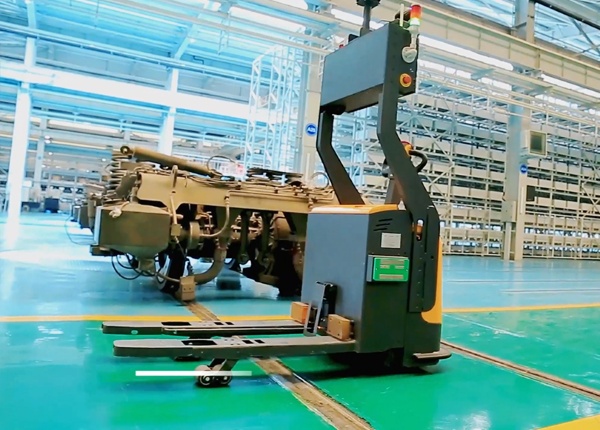
The warehouse floor is the operating environment for every AGV movement. Floor quality can influence travel stability, positioning accuracy, lifting performance and overall system reliability.
A site assessment should review not only floor flatness, but also traffic routes, loading areas and future expansion plans.
Many companies assume that installing AGVs requires rebuilding the warehouse floor. In reality, many existing industrial concrete floors are suitable for autonomous forklifts, provided they are in good structural condition.
Before deployment, inspect the warehouse for:
Uneven floor sections
Surface damage
Loose concrete
Water accumulation
Heavy wear caused by forklift traffic
A professional site survey helps determine whether repairs are necessary before installation.
Many warehouses include ramps connecting loading docks, production areas or mezzanine levels.
Companies should evaluate:
Ramp gradients
Transition areas
Surface traction
Load weight during climbing
Safe stopping distances on slopes
The acceptable incline depends on the AGV model, payload and operating conditions. Buyers should request verified performance data for their specific application.
Expansion joints and repaired concrete sections are common in large warehouses.
During project planning, companies should evaluate whether these floor features may influence:
Vehicle stability
Fork positioning accuracy
Load handling performance
Wheel wear
Travel comfort
For Laser SLAM systems, navigation is primarily based on environmental reference features rather than floor markings. However, severe floor damage can still affect vehicle movement and operational efficiency.
Many buyers ask whether new floor coatings are required before introducing autonomous forklifts.
The answer depends on the warehouse environment and traffic conditions rather than the navigation technology itself.
Companies should consider:
Surface durability
Dust generation
Wheel traction
Chemical resistance
Cleaning procedures
The goal is to provide a durable, safe and easy-to-maintain operating surface for long-term AGV use.
| Inspection Area | What to Evaluate |
|---|---|
| Concrete Surface | Check for uneven areas, damage and wear. |
| Expansion Joints | Assess joint width and vehicle crossing conditions. |
| Slopes | Measure gradients and evaluate loaded vehicle performance. |
| Surface Finish | Review traction, dust control and maintenance requirements. |
What floor flatness recommendations apply to this AGV model?
What maximum ramp incline can the AGV safely climb under full load?
How does the vehicle perform on expansion joints and repaired concrete?
Does Laser SLAM require any floor markings or embedded guidance?
Are special floor coatings recommended for heavy-duty operation?
Can a site survey be completed before project implementation?
What floor conditions have been successfully used in previous customer projects?
Evaluating warehouse floor conditions is an important step before importing industrial AGV forklifts from China. Rather than assuming that an existing facility requires major reconstruction, companies should perform a structured site assessment covering floor quality, ramps, expansion joints and surface durability.
A thorough floor evaluation helps reduce implementation risks, improves long-term AGV performance and provides a solid foundation for successful warehouse automation.
FREE ENGINEERING SUPPORT Stop Gambling on Generic Platforms. Get an AGV/AMR Tailored to Your Warehouse.Buying automated guided vehicles involves complex safety standards (CE/ANSI), navigation setups (Laser SLAM), and ERP system integration. Don't risk your factory safety with middle-men. ✓ 100% Direct Factory: Customized payload up to 5 Tons. ✓ Free CAD Simulation: Send us your layout, and our engineers will simulate the optimal AGV routes. ✓ Global Support: Overseas installation guidance & local maintenance partners. |





 Chinese
 English