


A reliable wireless network is one of the most important infrastructure requirements when deploying autonomous forklifts in warehouses. AGV systems depend on stable communication between vehicles, fleet management software and warehouse control systems.
Before importing AGV forklifts from China, companies should evaluate whether their existing Wi-Fi infrastructure can support continuous robot operation, safe movement and future fleet expansion.
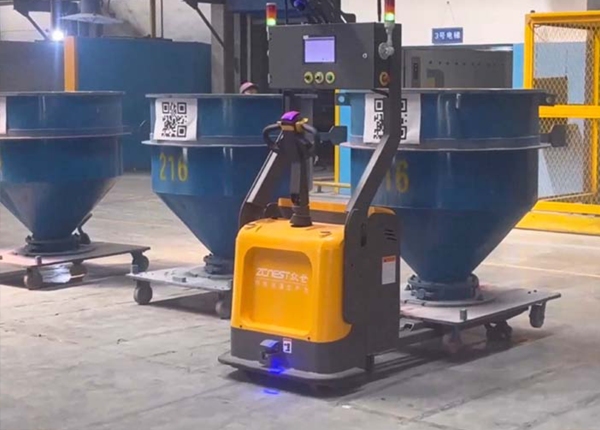
Unlike traditional forklifts, autonomous vehicles continuously exchange information with control systems during operation.
The wireless network supports:
Task assignment
Fleet coordination
Traffic management
Vehicle status monitoring
Warehouse system communication
Software updates and diagnostics
A poor network environment can reduce efficiency and create unnecessary operational risks.
A professional AGV system should not rely only on continuous wireless communication to maintain basic safety.
When communication quality decreases, the AGV system may apply safety strategies such as:
Controlled deceleration
Safe stopping behavior
Local safety monitoring
Automatic task recovery
Communication reconnection procedures
The exact behavior depends on the AGV architecture, safety design and fleet management software.
Large warehouses usually require multiple wireless access points because robots move across large operating areas.
A reliable AGV network should support:
Fast roaming between access points
Continuous communication during movement
Stable signal coverage
Low communication interruption
Industrial wireless optimization
Proper access point placement is critical in warehouses with metal racks, high ceilings and narrow aisles.
The answer depends on warehouse size, robot quantity and operational requirements.
Companies should evaluate:
Number of AGVs operating simultaneously
Warehouse coverage area
Network latency
Signal interference
Bandwidth availability
Future fleet expansion plans
A small warehouse with several AGVs may operate successfully with optimized industrial Wi-Fi, while large facilities may require more advanced network planning.
Industrial AGV environments have different requirements compared with office networks.
Important considerations include:
Reliable coverage throughout robot travel paths
Low latency communication
Fast roaming capability
Network redundancy
Industrial-grade access points
Interference management
Some large industrial facilities are evaluating private 5G networks as an alternative or complement to industrial Wi-Fi.
Private 5G may provide:
Large-area coverage
Predictable latency
High device capacity
Improved mobility management
Dedicated industrial connectivity
For large warehouses with hundreds of autonomous vehicles, private 5G can become part of a long-term automation infrastructure strategy.
Network preparation should be completed before robot deployment.
Recommended preparation steps include:
Perform warehouse Wi-Fi coverage testing
Identify signal dead zones
Optimize access point locations
Test roaming performance
Measure network latency
Plan future AGV expansion capacity
What wireless communication standards does the AGV support?
How does the AGV behave during communication loss?
Does the system support seamless Wi-Fi roaming?
What latency requirements are recommended?
Can the AGV operate with private 5G networks?
How many AGVs can one network infrastructure support?
What network testing is required before deployment?
| Network Area | Evaluation Focus |
|---|---|
| Coverage | Can wireless signals cover all AGV travel areas? |
| Roaming | Can vehicles switch access points without interruption? |
| Latency | Is communication fast enough for fleet control? |
| Scalability | Can the network support future AGV growth? |
A stable wireless network is the foundation of reliable AGV operation. Before importing autonomous forklifts from China, companies should evaluate Wi-Fi coverage, roaming capability, network security and future expansion requirements.
By preparing the right communication infrastructure, warehouses can achieve safer operation, higher efficiency and a smoother path toward large-scale automation.
FREE ENGINEERING SUPPORT Stop Gambling on Generic Platforms. Get an AGV/AMR Tailored to Your Warehouse.Buying automated guided vehicles involves complex safety standards (CE/ANSI), navigation setups (Laser SLAM), and ERP system integration. Don't risk your factory safety with middle-men. ✓ 100% Direct Factory: Customized payload up to 5 Tons. ✓ Free CAD Simulation: Send us your layout, and our engineers will simulate the optimal AGV routes. ✓ Global Support: Overseas installation guidance & local maintenance partners. |





 Chinese
 English