

Many manufacturers have already invested in conveyor systems, PLC-controlled production lines, robotic palletizers and warehouse software. When evaluating AGVs from China, one of the biggest questions is whether the new automation equipment can integrate seamlessly with existing infrastructure rather than requiring a complete system replacement.
A successful AGV project should connect with conveyors, robots and warehouse control systems to create an automated material flow while protecting previous automation investments.
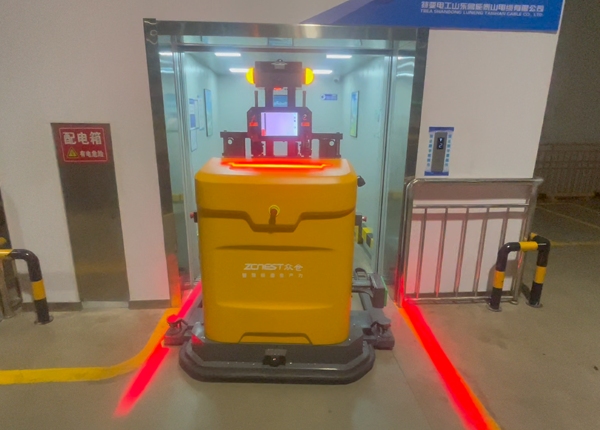
Most warehouse automation projects are expansions of existing facilities rather than greenfield installations. Companies want AGVs to become part of their current material handling process instead of operating as isolated machines.
Typical integration scenarios include:
Receiving pallets from conveyor systems
Delivering pallets to automated storage areas
Connecting robotic palletizers with warehouses
Transporting goods between production lines and shipping docks
Supporting cross-docking operations
Before a pallet transfer takes place, the AGV and conveyor typically exchange status signals to ensure safe and synchronized operation.
A standard transfer sequence may include:
AGV arrives at the transfer station
Position verification is completed
Ready signal is exchanged
Conveyor releases or receives the pallet
Transfer completion is confirmed
AGV resumes its assigned task
This electronic handshake helps prevent product loss, collisions and unnecessary downtime.
Yes, many AGV applications are designed to work with robotic palletizing stations, allowing finished pallets to move automatically from production to storage without manual forklift intervention.
Common integration scenarios include:
Robot palletizer to AGV
Stretch wrapper to AGV
Conveyor to AGV
AGV to AS/RS
Production line to warehouse
Industrial communication compatibility is a key consideration when selecting an AGV supplier.
Depending on the system architecture, AGVs may support integration through:
OPC UA
PROFINET
EtherNet/IP
Modbus TCP
MQTT
RESTful API
Digital I/O handshaking
The actual communication method should match the customer's PLC, WMS and MES architecture.
Cross-docking requires fast and coordinated movement of goods between inbound and outbound logistics without long-term storage.
AGVs can support cross-docking workflows by:
Collecting pallets from receiving conveyors
Transporting loads directly to outbound staging areas
Coordinating with warehouse management software
Reducing manual forklift travel
Improving truck turnaround efficiency
The fleet management system acts as the coordination layer between AGVs and warehouse equipment.
Typical responsibilities include:
Task scheduling
Traffic management
Equipment status monitoring
Transfer station management
Error recovery
Workflow optimization
Which PLC protocols are supported?
Can the AGV communicate with my existing conveyor controls?
Do you provide standard APIs for WMS and MES integration?
Can the system interface with robotic palletizers?
How are conveyor transfer signals synchronized?
Can multiple conveyors and AGVs operate simultaneously?
Do you have successful integration case studies in similar industries?
| Evaluation Area | Key Questions |
|---|---|
| Conveyor Integration | Can pallets transfer automatically and safely? |
| PLC Communication | Does the AGV support my control system protocols? |
| Robot Integration | Can robotic palletizers exchange tasks with AGVs? |
| Fleet Coordination | Can the software optimize conveyor and AGV workflows together? |
The value of an AGV project depends not only on the vehicle itself, but also on how well it integrates with existing conveyor lines, PLCs, robotic workstations and warehouse software. Choosing a supplier with proven system integration capabilities can reduce implementation risk, protect previous automation investments and accelerate deployment.
FREE ENGINEERING SUPPORT Stop Gambling on Generic Platforms. Get an AGV/AMR Tailored to Your Warehouse.Buying automated guided vehicles involves complex safety standards (CE/ANSI), navigation setups (Laser SLAM), and ERP system integration. Don't risk your factory safety with middle-men. ✓ 100% Direct Factory: Customized payload up to 5 Tons. ✓ Free CAD Simulation: Send us your layout, and our engineers will simulate the optimal AGV routes. ✓ Global Support: Overseas installation guidance & local maintenance partners. |





 Chinese
 English